







Roll-to-Roll Screen Printing Machine Delivery: Site Access and Handover Checklist
Before dispatching a roll-to-roll screen printing machine, check how every package will travel from the unloading point to its final position. Fitting the assembled line onto the production floor is only part of that check. Before dispatch, obtain a package list, transport dimensions and weights, an agreed access route, named handling responsibilities, and a written receiving and installation handover plan.
This guide is for converters and industrial print buyers purchasing a new roll-fed line. It covers the gap between selecting the machine and starting installation. It does not replace a qualified lifting plan, structural assessment, or the manufacturer’s installation instructions.
Why the installed footprint is not enough
A layout drawing shows the space needed to operate and service a machine. It may not show the size of its shipping crates, the largest indivisible module, or the room needed to turn a load through a doorway. A dryer, unwinder, electrical cabinet, or accessory can create a different delivery constraint from the printing unit.
In a published installation account, Natgraph describes work involving narrow passages, doorways and low ceilings. The account concerns Natgraph installations; it does not describe Winshol’s facilities or delivery service.
For machine configuration, start with the Winshol WL-350 model comparison. Then request a transport and installation drawing for the exact quoted configuration. Do not use a catalogue photograph or another customer’s layout as the delivery plan.
Request the shipment information before booking transport
Ask the manufacturer to identify each package and its contents. The list should distinguish dimensions and weights for the packed shipment from those for the unpacked machine module. If anything must be separated for transport, ask who is authorized to do that work and who will reassemble it.
Request these details in writing:
- Package identification, contents and shipment count.
- Packed length, width and height, plus gross weight for each package.
- Unpacked module dimensions and weight where relevant to the route.
- The largest unit that must remain assembled during handling.
- Manufacturer-specified handling, storage and orientation requirements.
- Loose accessories, documentation and components shipped separately.
- Any work needed before the installation team can begin.
A weight for the complete line is not a substitute for individual package weights. Likewise, removing packaging does not automatically make a difficult route safe: the exposed module may have different handling requirements. Have the manufacturer and the buyer’s qualified handling contractor resolve those questions before dispatch.
Walk the complete delivery route
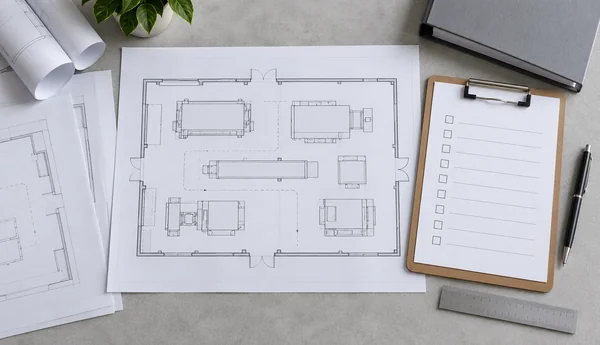
Document the route from the agreed unloading location to the final machine position. Use an annotated floor plan and current photographs, including the approach to each restriction as well as the opening itself.
Record doors, corridors, turns, ramps, thresholds, overhead services and other fixed obstructions. Identify any shared areas that must remain accessible during the move. Where lifts or intermediate storage areas are involved, have the responsible site specialists assess their suitability for the actual loads and handling method.
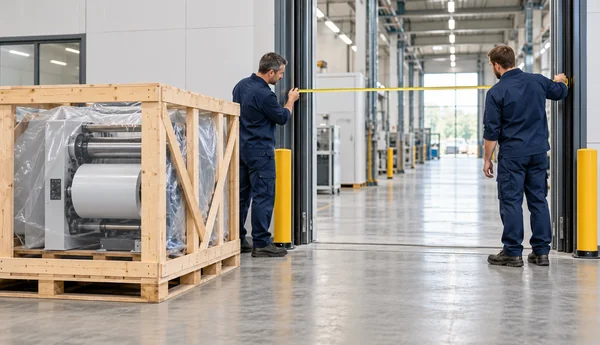
Doorway width alone is not enough. Turning space, handling equipment and the load’s travel orientation also matter. Required allowances depend on the shipment and the approved method; there is no universal clearance that this article can prescribe.
Ask the qualified contractor or site specialist to confirm the route and identify unresolved restrictions. A photograph alone is not approval of floor capacity or a lifting method. If a building alteration is necessary, arrange the relevant approvals before the shipment leaves the manufacturer.
Which document answers which question?
| Evidence | Câu hỏi được giải đáp | Thông số này không xác nhận điều gì |
|---|---|---|
| Operating and service layout | Where will the assembled line run, and where is service access needed? | Whether its crates or modules can reach that position. |
| Package and module list | What is arriving, and what are the transport dimensions and weights? | Whether the buyer’s route and handling arrangements are suitable. |
| Reviewed delivery route and handling plan | How will the actual shipment reach its designated position? | That the machine meets production acceptance requirements. |
| Receiving and installation records | What arrived, what was observed, and what remains open before installation? | Automatic acceptance of print quality, output or the complete contract. |
Keep the drawings and lists under revision control. A later change to the dryer, cabinet location or packing arrangement can invalidate an earlier access review. Confirm that the transport booking and site team are working from the same approved revision.
Assign responsibilities before the truck arrives
Create a short responsibility schedule with a named contact for each activity. Clarify who provides unloading equipment, who performs movement inside the building, who checks site readiness, and who authorizes the installation team to start. Do not assume the manufacturer, carrier and local contractor have agreed these details with one another.
Confirm who will manage temporary storage, packaging removal, waste disposal and delivery outside normal working hours. If the delivery includes multiple vehicles or separately arriving accessories, agree how the site will identify and reconcile them.
Purchase and delivery terms should be reviewed against the actual contract. This checklist does not determine legal responsibility, insurance coverage or the point at which risk transfers. Ask the relevant parties to resolve those matters explicitly rather than treating an informal delivery email as a contract amendment.
For the broader commercial and machine specification, use the danh mục kiểm tra yêu cầu báo giá máy in lụa. The access schedule is a separate attachment, not a replacement for that specification.
Record arrival condition and open items
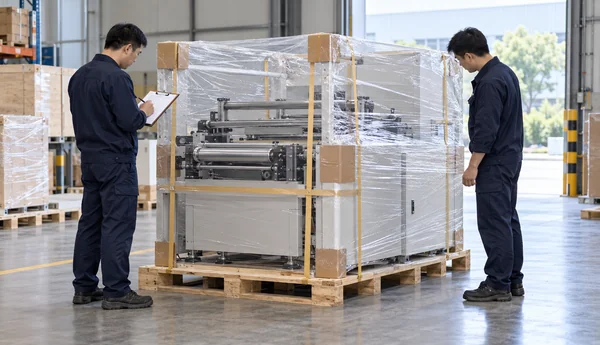
At receipt, reconcile package identifiers and quantities with the packing list. Record visible packaging damage or discrepancies promptly, following the agreed receiving procedure and the applicable carrier and contract requirements. Keep photographs linked to package numbers and delivery records.
Do not open or move a suspect package contrary to safety instructions merely to obtain a photograph. Escalate concerns to the responsible people and agree the next step.
Use a punch list for missing items, observed damage, incomplete documentation and installation dependencies. Each item should have an owner, an agreed action and a closure record. Separate observations from conclusions: a damaged crate is an observation; whether the equipment inside is affected requires appropriate inspection.
A receiving signature, an installation release and production acceptance serve different purposes. Make their meanings clear in the project documents.
Installation release is not production acceptance
Release for installation means that the agreed prerequisites for the installation work have been addressed. It does not, by itself, show that the machine has passed a production trial with the buyer’s substrate, ink and acceptance criteria.
THIEME describes factory acceptance followed by installation and commissioning at the customer’s site. SGS describes factory acceptance testing in relation to contractual requirements, functionality and documentation. These are descriptions of other companies’ services, not evidence that Winshol supplies the same testing package.
Agree which checks occur before dispatch, which occur after installation, and how outstanding items are handled. Retain the existing sample and production acceptance criteria rather than replacing them with a delivery checklist.
What to send with your delivery-planning request
Send the quoted configuration, destination details, an annotated route, site photographs and your proposed receiving arrangements. Ask the supplier to confirm the package information and identify any manufacturer requirements that your site team must address.
For a Winshol project, contact the team with those documents and the quotation reference. Confirm the precise scope of delivery, installation and assistance in writing; availability and responsibilities should not be assumed from this article.
Câu hỏi thường gặp
1. Is the machine’s catalogue footprint enough to plan delivery?
No. The operating footprint does not establish packed dimensions, individual module weights or access through the building. Request shipment-specific information and have the complete route reviewed before dispatch.
2. Which dimensions should I request from the manufacturer?
Request packed dimensions for every package and unpacked dimensions for modules that may travel separately. Identify the largest unit that must remain assembled, and confirm which drawing revision applies to the shipment.
3. Who should approve the unloading and internal movement plan?
The buyer should coordinate the manufacturer, qualified handling contractor and relevant site specialists. Each party should confirm the matters within its responsibility; a general sales drawing is not approval of a lifting method or floor capacity.
4. Can the crate be removed if it will not fit through a doorway?
Do not assume it can. Ask the manufacturer whether unpacking at that location is permitted and what handling requirements then apply. The qualified handling contractor must assess the revised route and method before work proceeds.
5. Does a successful factory test mean the machine is ready for production immediately after delivery?
No. Transport, installation and commissioning are separate stages. Define any post-installation checks and production acceptance criteria in the project documents, including the agreed materials and how open items will be closed.
6. What should the receiving record include?
Record package identifiers, quantities, visible condition, discrepancies and relevant photographs, together with the delivery documentation. Follow the agreed receiving procedure and applicable notification requirements rather than relying on this checklist alone.
7. What belongs on an installation punch list?
List unresolved items such as missing components, observed damage, incomplete documents or site dependencies. Assign an owner and agreed action to each item. Record its closure and identify any issue that prevents safe installation or further work.
8. Does this checklist confirm that Winshol provides unloading or installation services?
No. It is a buyer’s planning checklist, not a service commitment. Confirm the exact delivery, handling, installation and commissioning scope for your quotation with Winshol in writing.