







Screen Printing Machine Safety Documents: Declarations, Manuals and Responsibilities
Before ordering a roll-to-roll screen printing machine, agree a document schedule with the manufacturer. Match it to the quoted line and installation country, name the organization responsible for each item, and set a review date. List the actual deliverables rather than accepting a vague promise of “certificates included.”
This guide helps purchasing and engineering teams organize those requests. A qualified specialist still needs to assess machine safety and determine the requirements for your project. The regulatory examples below apply specifically to Great Britain or the European Union and were checked on 3 November 2026.
Start with the line the documents need to describe
Attach the quoted configuration and a numbered layout to the request. Include the unwinder, printing stations, dryer, rewinder and any separately supplied cleaning, foil or inspection equipment. Identify existing equipment that will connect to the new machine. Record the installation country and expected project dates.
Have the supplier mark which parts of that arrangement each document covers. A declaration for a print unit may exclude the dryer or a customer-supplied rewinder, even when the model names look similar.
For example, suppose one supplier quotes the printer and another provides the drying section. Purchasing should ask who documents the combined arrangement and who reviews their interfaces. Neither an approved print sample nor two complete equipment invoices answers those questions.
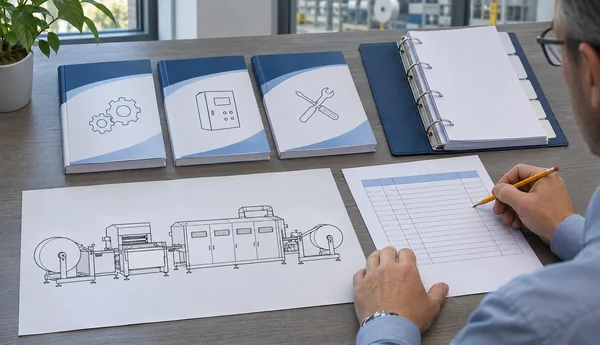
Separate the documents by purpose
The following categories help buyers compare what suppliers have actually offered. They serve different purposes and should be reviewed separately.
| Document category | Câu hỏi dành cho nhà cung cấp | What to compare |
|---|---|---|
| Quality-management certificate | Which legal entity, site and activities does it cover? | Holder, scope, issuing body and validity information. |
| Applicable product declaration | Which equipment and destination requirements does it address? | Equipment identification, responsible entity and declared scope. |
| Use and maintenance instructions | Which delivered configuration do these instructions describe? | Document revision, language, included modules and intended use. |
| Integration information | Who supplies the information needed to connect separately supplied equipment? | Module boundaries, named responsibilities and unresolved interfaces. |
| Agreed project verification records | What evidence will the responsible technical reviewers require? | Defined scope, reviewer, results, open items and closure records. |
ISO’s conformity-assessment guidance explains that management-system certification concerns the management system, not certification of the products themselves. Keep that distinction when checking ISO 9001 documents. The broader manufacturer comparison guide covers company and supplier checks.
Check the destination before interpreting a declaration
For Great Britain, HSE’s machinery guidance distinguishes the Declaration of Conformity accompanying complete machinery from the Declaration of Incorporation and assembly instructions for partly completed machinery. HSE also tells buyers to check for obvious safety defects. Collecting paperwork does not replace that review.
For an EU project, ask the supplier and your compliance adviser to identify the applicable framework and relevant dates. Regulation (EU) 2023/1230 generally applies from 20 January 2027, with specified provisions applying earlier. As of this article’s review date, that general application date is still ahead. Do not select requirements solely by the purchase-order date.
Record the answer in the project file. Avoid copying a declaration request from a previous shipment to a different market without review.
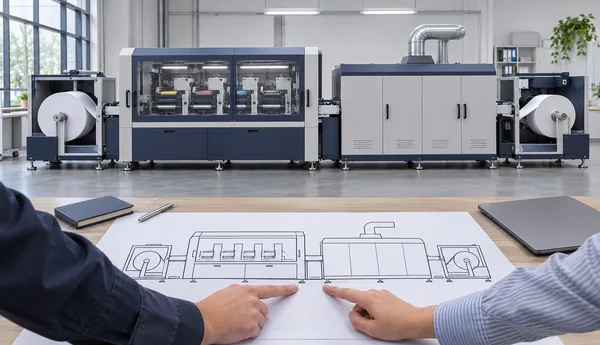
Name the organization responsible for integration
A roll-fed printing project may combine equipment from several sources. In its GB guidance on assemblies of machinery, HSE explains that safety depends on the interfaces as well as the constituent machines. The organization constituting an assembly can take on the manufacturer’s responsibilities for that assembly.
Ask the technical team to define the relevant boundary and identify the responsible organization. Record that name on the project layout or its accompanying responsibility list. Have the parties agree who provides the information, reviews the combined arrangement and resolves interface questions.
Where a supplier cites a safety standard, request its identifier, edition and stated application. ISO 12643-2:2023, for example, addresses safety requirements for prepress and press equipment and auxiliary equipment integrated into the press control system. Its published scope is a reference for specialist review, not evidence that a particular machine conforms.

Keep a short document register
A shared register keeps the quotation, delivery and commissioning reviews connected. Each entry needs:
- Document title and identifier.
- Machine, module or line boundary covered.
- Issuing organization and person responsible for delivery.
- Revision, language and document status.
- Agreed delivery stage and technical reviewer.
- Missing information, required action and closure evidence.
Mark a quotation-stage example as an example. When final documents arrive, reconcile them with the supplied configuration and available machine identifiers. If the dryer or another module changes, reopen the affected entries and ask the reviewer what must be updated.
Agree exactly which documents your team will receive; the manufacturer’s entire design archive is not necessarily part of the handover. Under the European Commission’s Machinery Directive guide, §393, the technical file is maintained for competent authorities. Agree buyer-delivered documentation separately, with advice on the applicable legal requirements.
Put the request into the quotation discussion
Send the configuration, destination, proposed integration arrangement and document register with your machine RFQ. Ask for missing items to be identified explicitly, together with the organization expected to provide them. Keep document review separate from print-quality acceptance and the physical delivery check.
Trang OEM/ODM information describes project-specific documentation, market-specific electrical and safety adaptation, and a project compliance file. Ask what those provisions mean for your proposed line and destination, including the named market responsibilities and actual deliverables. Any certification claim still needs evidence for the specific configuration.
Câu hỏi thường gặp
1. What should I request before ordering the machine?
Request a document schedule for the exact configuration and installation country, with an owner and delivery stage for each item. Ask which examples are available during quotation and which final documents will identify the delivered equipment. Have your technical reviewer assess the proposed scope before the order is finalized.
2. Is a photograph of the CE mark enough?
No. A photograph cannot establish whether the accompanying documents match the machine or whether the installed arrangement is safe. In the Great Britain example discussed above, HSE also directs buyers to check the declaration, instructions and obvious safety defects. Refer discrepancies to the responsible qualified people.
3. Does ISO 9001 certification cover the safety of every machine model?
No. ISO 9001 concerns a quality management system. Check its holder and scope separately from the product documentation for the quoted machine. A management-system certificate should not be used to close a question about a particular model, added module or destination requirement.
4. Why might a module have a Declaration of Incorporation?
In the GB framework described by HSE, partly completed machinery is supplied with a Declaration of Incorporation and assembly instructions. Ask the supplier to explain the module’s status and who will complete the final assembly. Do not file that document as though it declares conformity of the complete printing line.
5. Are separate documents for the printer and dryer enough for the complete line?
They do not settle the integration question. Ask the responsible specialist to define the assembly boundary, review the interfaces and identify the organization responsible for the final arrangement. The purchase documents should make that responsibility visible, including when equipment comes from more than one supplier.
6. Should the manufacturer give me its entire technical file?
Do not assume a universal entitlement to the complete file. The EU Machinery Directive distinguishes the technical file available to competent authorities from the information accompanying machinery. Agree the operating, maintenance and other project documents you need, with qualified advice on the applicable requirements.
7. What should happen if the configuration changes after quotation?
Record the changed module or function and send the change to the responsible technical reviewer. Ask which document references, instructions and agreed verification records need revision. Keep the earlier version for traceability, but clearly identify the current approved project documents so staff do not use an outdated package.
8. Can I use the same document list in every country?
Use the register as an organizing template, then have it reviewed for the destination and relevant dates. The GB and EU examples here are jurisdiction-specific. Confirm the applicable framework with the supplier and qualified local advisers rather than treating a familiar certificate or another buyer’s checklist as universal approval.