







Bring Screen Printing In-House? 6 Costs to Compare Before Buying
Bring industrial screen printing in-house when the jobs pass a production trial, the available staff and equipment can meet the delivery schedule, and the total cost compares favorably with outsourcing across realistic order volumes. The investment needs to work for the full order schedule, including setup and rejected material.
For labels and flexible films, compare the same finished output on both sides: the same material construction, printed layers, curing, inspection and required converting. If the outside supplier delivers finished labels while the proposed machine delivers only printed web, price the missing operations before calculating a saving.
Define what you would actually bring in-house

List the jobs you intend to transfer, including artwork changes, repeat orders, batch sizes and seasonal peaks. Separate confirmed orders from possible future sales. Mark which operations stay outside your plant, such as screen preparation or die cutting. A mixed route can be more practical than buying every supporting machine at once.
Tài liệu của chúng tôi: screen printing equipment guide maps the supporting operations. It helps identify which stages belong in the investment. Then compare these six cost groups.
1. Equipment, installation and the cost of using capital
Obtain a written quotation for the complete proposed route. Include required drying, web handling, inspection and any separate finishing equipment. Add transport, applicable import costs, installation work, site preparation and initial training where they are your responsibility. Check exclusions rather than assuming a turnkey price.
Separate the cash needed before production from the cost allocated to each operating period. For an operating comparison, agree an annual capital charge or another consistent equipment-cost basis with your finance team. Do not count the full purchase price and depreciation again in the same annual calculation. A separate cash-flow forecast should show when deposits, final payments and other costs fall due.
Tài liệu delivery and site-access checklist helps identify installation dependencies before shipment. It does not establish the cost of those works or their inclusion in a Winshol quotation.
2. People, setup and changeovers
Allow time for material loading, screen mounting, ink preparation, alignment, cleaning and inspection, not just the print stroke. Assign responsibility for maintenance and quality decisions. If existing staff take on the work, identify which duties they will stop or who will cover them.
Record the expected number of jobs as well as the annual piece count. Many short runs can require more setup time than a few long runs producing the same total quantity. Use a representative changeover trial to estimate labor and lost production time. Our changeover guide explains which start and finish points to keep consistent.
3. Screens, cleaning and consumables
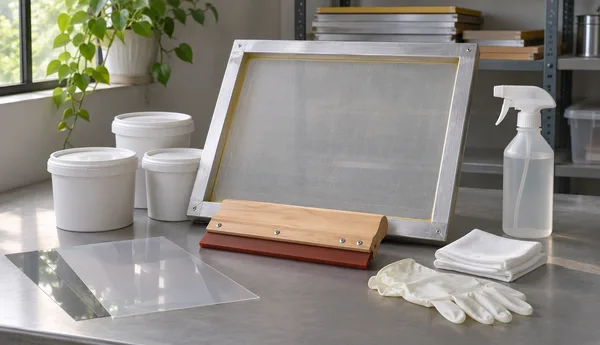
Price screens and stencil preparation for the actual artwork mix. Include storage, cleaning, inspection and replacement, and identify whether prepared screens will be bought or made internally. A repeat order may reuse a screen only if its condition and the artwork still permit it.
Include ink, additives, squeegees, cleaning materials and the handling of waste. Match cleaning chemistry to the ink and stencil system using supplier instructions and safety data. For example, KIWO’s ink-wash guidance specifies product-dependent dilution and screen-storage precautions. Those instructions illustrate why a generic cleaning allowance needs review; they are not a recommendation for every Winshol application.
4. Material loss and accepted output
Compare cost per accepted finished item, not cost per impression. Include setup stock, trial material, print rejects and losses exposed during later conversion. If a supplied roll is already printed, rejected material may carry more value than its blank substrate cost.
Keep input and output quantities separate. For a simplified example, a 95% acceptance rate requires about 105,263 processed pieces to deliver 100,000 accepted pieces, before any separately counted setup loss. This is arithmetic, not a suggested Winshol yield. Do not add the same rejected material again if your measured cost per accepted piece already includes it.
Sử dụng accepted-output calculation to check whether the planned hours cover the work. Check that the required volume fits the hours left after setup, maintenance and other commitments.
5. Utilities, maintenance and interruptions
Request the utility requirements for the quoted line, including auxiliaries. Estimate electricity from measured operation on representative jobs where possible; a connected-load rating is not an annual electricity bill. Treat cooling, extraction and compressed air consistently in both the equipment scope and operating budget.
Allow for planned maintenance, consumable replacement and the service arrangements you actually purchase. Test a separate interruption scenario: what happens if a repair takes longer than expected? Price any backup outsourcing from a real quotation rather than inventing a universal downtime percentage or adding speculative lost sales to every job.
6. The full cost of the outsourced alternative
Use current supplier quotations or invoices for comparable work. Identify setup charges, order minimums, freight, incoming inspection, stockholding and the treatment of rejects. Separate costs that disappear when work moves in-house from overhead that remains regardless of the decision.
Review delivery flexibility too. An outside specialist may absorb peaks or supply a process your plant cannot yet run reliably. Conversely, internal production may shorten a particular handover. Neither outcome follows automatically from owning a machine. Compare the actual order and production schedules.
Build a comparison that can change with demand

Tài liệu U.S. Small Business Administration’s break-even guidance distinguishes fixed, variable and mixed costs. For this make-or-buy decision, compare the two production routes rather than substituting a selling price into the calculation.
For a simplified single-job comparison over the same period:
- In-house cost = fixed in-house cost + accepted quantity × variable in-house cost per accepted item.
- Outsourced cost = fixed outsourced cost + accepted quantity × outsourced cost per accepted item.
- Crossover quantity = (fixed in-house cost − fixed outsourced cost) ÷ (outsourced unit cost − in-house variable unit cost).
The crossover expression is useful only where the unit-cost saving is positive and the assumptions hold over the volume range. Tiered quotations, extra shifts, different job mixes and capacity limits require separate scenarios. This crossover is not a payback period or a return-on-investment forecast.
A hypothetical annual comparison
Assume fixed in-house costs of USD 24,000 per year, a variable cost of USD 0.08 per accepted label and an outsourced cost of USD 0.14 per accepted label with no separate annual fixed charge. Both routes are assumed to supply the same accepted product. These invented figures demonstrate the method; they are not Winshol prices, costs or performance data.
| Accepted labels/year | In-house total | Outsourced total |
|---|---|---|
| 200,000 | USD 40,000 | USD 28,000 |
| 400,000 | USD 56,000 | USD 56,000 |
| 600,000 | USD 72,000 | USD 84,000 |
The arithmetic crosses at 400,000 accepted labels. If the in-house variable cost rises to USD 0.10, the crossover rises to 600,000. Before using either figure, check whether the required job mix fits the available production hours. A theoretical saving above attainable capacity is not a purchasing case.
Replace the example with your own costs. Run at least a lower-demand case, the expected case and a case with more short runs or lower acceptance. Keep the same time period and currency throughout. Have finance review financing, tax, depreciation and cash timing separately.
When continuing to outsource is the better decision
Keep work outside, or transfer it in stages, when demand is too uncertain to support the fixed commitment, the material has not passed trials, trained staff are unavailable, or critical downstream operations remain unresolved. A low machine price does not remove these conditions.
A partial transfer can make sense: retain external screen preparation, specialized finishing or peak-volume work while evaluating a defined group of repeat jobs internally. Confirm capacity and quality on that group before assuming the savings apply to every product.
What to send before requesting a machine proposal
Prepare a job list showing material, artwork, accepted quantity, batch size, repeat frequency and current outsourced scope. Attach representative samples, the required finished-product checks, available hours and site constraints. Mark unknown costs rather than assigning convenient values.
Máy của Winshol danh sách kiểm tra yêu cầu báo giá can structure the technical request. Ask for the proposed equipment, exclusions, trial conditions and supporting operations needed for your label or film jobs. Use the resulting quotation in your comparison. Once the proposed route passes the trial, use its measured output and quoted scope to revise the investment case.
Câu hỏi thường gặp
1. Is in-house screen printing always cheaper than outsourcing?
No. Compare the full cost of supplying the same accepted product over the same period. Low or irregular demand, frequent setups, extra finishing and limited staff can make outsourcing the better choice.
2. How many labels justify buying a screen printing machine?
There is no universal quantity. Calculate a crossover from your own fixed costs, comparable outsourced prices and variable cost per accepted label, then check that the required job mix fits available capacity.
3. Should I compare cost per impression or per finished label?
Use cost per accepted item at the same completion stage. If one route includes die cutting and inspection while the other ends at printed web, add the missing operations before comparing them.
4. Can I outsource screen preparation while printing in-house?
Yes, if a suitable supplier can provide screens to the required specification and schedule. Include preparation, delivery, replacement and any internal cleaning or storage in the cost model.
5. Why does changeover frequency affect the buying decision?
Each job may require preparation, alignment, cleaning and inspection before accepted output begins. More short runs can consume more labor and available hours than fewer long runs with the same annual quantity.
6. Is the crossover quantity the same as machine payback?
No. A crossover compares the costs of two routes under stated assumptions. Payback concerns the timing of net cash benefits against the initial investment and requires a separate cash-flow calculation.
7. What if the new machine cannot supply peak demand?
Evaluate a mixed route using verified internal capacity and a real backup supplier quotation. Include the cost and coordination of outsourced peak work rather than assuming the machine must handle every order.
8. What should I verify before committing to in-house production?
Confirm the finished-product requirements, representative material trials, complete equipment scope, staffing, site services and achievable accepted output. Compare realistic demand and cost scenarios before committing funds.