





Should You Overprint Cold Foil or Apply It Last?
Overprint cold foil when the design needs color on a metallic base. Apply foil after color printing when the design calls for a distinct metallic feature over or beside existing print. Neither route is automatically better. Before buying a cold stamping machine, establish which surfaces must bond to one another and which printing stages the proposed line actually includes.
Here, “foil last” means after the color-printing stages, not necessarily the final manufacturing operation. A protective coating, die cutting or another approved finishing step may still follow.
Choose the layer order from the finished label
A buyer comparing two metallic samples needs more than a foil color name. One sample may show exposed foil; another may show color printed over a metallic base. They can look different even when their foil source is the same. Ask the designer to identify each metallic area and say whether its final color comes from the transfer material, an overprint or a combination.
Make three artwork views: the color layers, the foil mask and the finished appearance. Mark areas that must remain nonmetallic. Keep small text, product identifiers and other information that must be readable separate from decorative approval. Record the intended layer order alongside those artwork views.
A metallic blue panel and a plain white information area
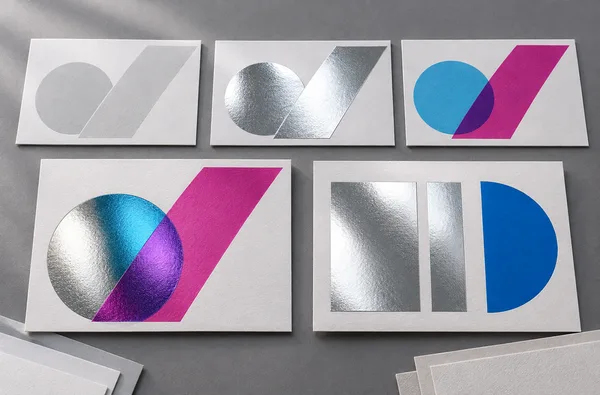
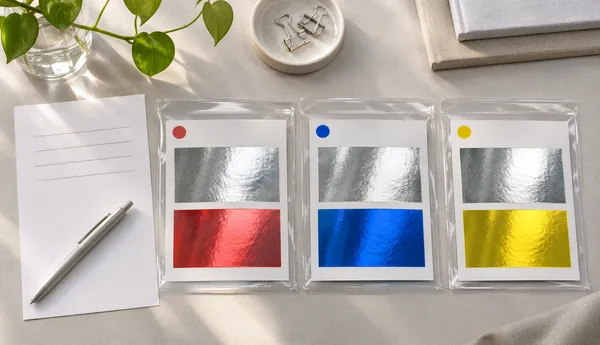
Consider an illustrative label with a metallic blue panel, a silver logo and a plain white information area. Each area needs its own instruction in the artwork. For a candidate overprint route, mark the blue panel as metallic base plus a compatible transparent color, and the silver logo as an area where that color must not print. Keep the information area outside the foil mask where the design and substrate allow it.
If the proposed layout instead places an opaque white layer over a metallic area, require that construction to be shown separately. Do not assume it will hide the reflective background to the required degree. Nor should the designer simply extend the foil mask underneath every element because that makes the artwork file easier to prepare.
For a foil-after-print route, ask how the same blue metallic panel will be obtained. An exposed silver transfer over an ordinary blue printed panel is not the same layer stack as transparent blue over silver. A different transfer grade or another operation may be needed. Resolve that difference before comparing the machine prices.
What overprinting changes
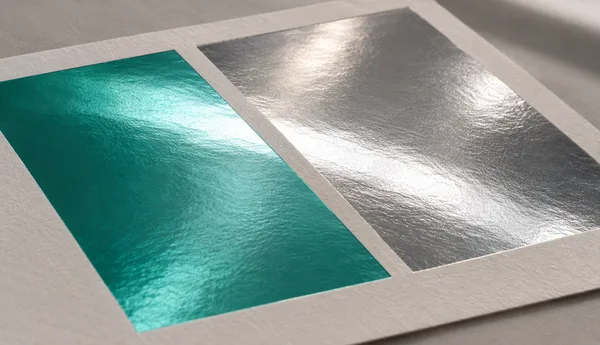
KURZ’s web-fed flexo cold-transfer FAQ describes applying cold transfer before later color printing to create metallic shades. This is evidence for that process route, not proof that every screen-printing line has the required stations or can use the same consumables.
For a screen-printing project, have the ink and foil suppliers identify products suitable for the intended surface. An ink that performs on the original film has not thereby been approved on the transferred finish. Ask how opaque and transparent printed areas should be represented in the trial artwork. Judge the actual result instead of assuming that the same color recipe will look identical on film and on a metallic base.
TOPAC’s cold-foil production guidance describes subsequent color stations overprinting foil and recommends press proofs. Its stated limits apply to its own manufacturing process. They should not become Winshol line limits or universal settings.
What applying foil after color printing changes
If foil follows existing print, the adhesive may encounter ink, coating or exposed substrate in different parts of the same image. Identify the actual receiving surface. A foil-and-adhesive combination demonstrated on unprinted stock is not enough evidence for an area printed earlier in the job.
Keep an unfoiled sample of the upstream print with the finished trial. If the existing printer or coating changes later, this reference helps the teams recognize that the material stack has changed too. Obtain consumable-supplier advice before transferring an approval to another ink or coating.
This route can suit a design with a distinct metallic logo and separate printed colors, provided the construction is validated. It does not guarantee brighter foil, stronger adhesion or a simpler line. Those are questions for the actual materials and sample, not consequences of the word “last.”
Compare two routes without changing the target
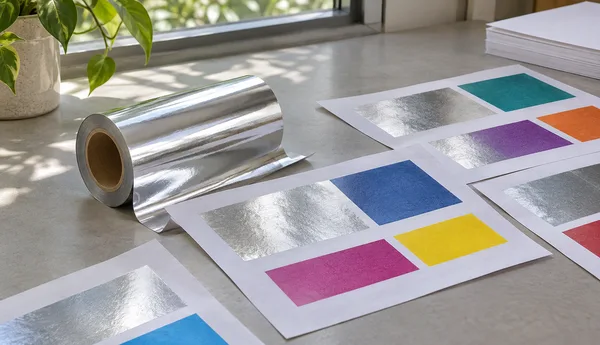
Where both constructions are feasible, ask for samples made to the same artwork revision and finished-label requirements. Keep the substrate batch and intended converting steps consistent, and list any material differences between the routes. Otherwise a preferred sample may reflect a different foil grade or coating rather than a better sequence.
- Compare the metallic area, nearby nonmetallic colors and the boundary between them against the physical target.
- Inspect critical text and codes in their real location, under agreed viewing conditions rather than only in a favorable photograph.
- Agree checks appropriate to the label’s use with the material suppliers. Record the method, conditioning and acceptance criteria rather than inventing one universal test limit.
- Examine the sample after the intended protective finish and converting steps. Keep that result distinct from the uncoated print.
Record a separate decision for each requirement. An attractive metallic background should not override unreadable text or an unapproved layer interface. If a raised varnish effect is also required, show it as another layer and evaluate the complete label; metallic color does not by itself establish relief or tactile height.
Confirm what the machine quotation actually contains
Pada Winshol, screen-printing and cold-foil equipment family includes combined configurations and separate foil units. WL-350DW is listed as combining screen printing and cold foil, while WL-350-LTJ is a horizontal cold-foil finishing unit. These descriptions establish equipment roles, not an unlimited choice of station order.
For each proposed route, ask the supplier to mark where color is printed, where adhesive is applied, where transfer takes place and where any overprint or protective finish occurs. Identify which stages are in the supplied machine, which use existing equipment and which need another pass. Do not count a foil-finishing unit as an additional color-printing station.
Adapun guide to combining screen printing and cold foil covers the broader equipment-scope discussion. For this decision, keep the comparison narrower: does the proposed sequence produce the approved layer stack without leaving an unquoted printing or finishing stage?
Approve a construction, then choose the configuration
Kirimkan kepada Winshol the substrate, separated artwork, physical target and known consumable references. Include your existing printer’s role and say whether the metallic regions need color overprinting or exposed foil. Ask for a proposed sequence with unresolved compatibility questions clearly identified.
Choose the equipment after that review. Keep the approved sample, its layer order and the exact material references together. A later substitution needs review at the affected interface, even if the artwork and machine name remain unchanged.
Pertanyaan yang sering diajukan
1. Should cold foil always be applied before printing?
No. Foil followed by compatible overprinting is one route to metallic colors. Printing followed by foil can serve a different design. Agree the layer order and validate the complete material stack before selecting the equipment sequence.
2. Does applying foil last mean no coating can follow?
No. In this comparison, foil last means after the color-printing stages. A protective coating or other converting operation may still follow if the selected materials and finished-label requirements allow it.
3. Can one silver foil create several metallic colors?
Compatible color overprints can create different metallic shades over a silver-colored base. The result depends on the selected ink, foil and layer construction. Approve physical production samples rather than treating a digital color preview as a match.
4. Can I use the same ink above and below the foil?
Do not assume so. The ink may be printing onto a different surface, and the adhesive may need to bond to an existing printed layer. Ask the consumable suppliers to confirm the intended interfaces and test the complete sequence.
5. Is a bright foil sample proof of readable small text?
No. Inspect the actual text and other critical artwork under agreed viewing conditions. Reflective backgrounds can change apparent contrast with viewing angle. Keep a nonmetallic alternative where readability is more important than the effect.
6. Does WL-350DW confirm that all overprinting stages are included?
No. Winshol lists WL-350DW as a combined screen-printing and cold-foil machine. The required number and position of color stations, any separate passes and the compatibility of the materials must be confirmed for the proposed configuration.
7. Should a raised varnish effect be approved with the foil sample?
Yes, if both belong to the finished label. Identify the varnish as a separate layer and approve its location, appearance and tactile result on the complete construction. Metallic appearance alone does not establish a raised effect.
8. What should I send Winshol before requesting a configuration?
Send the actual label stock, separated foil and color artwork, a physical target, known consumable references and the proposed order of operations. Identify which equipment already exists and ask for confirmation of each remaining production stage.