




UV LED vs Mercury Curing for Screen Printing: Ink Compatibility and Trial Checks
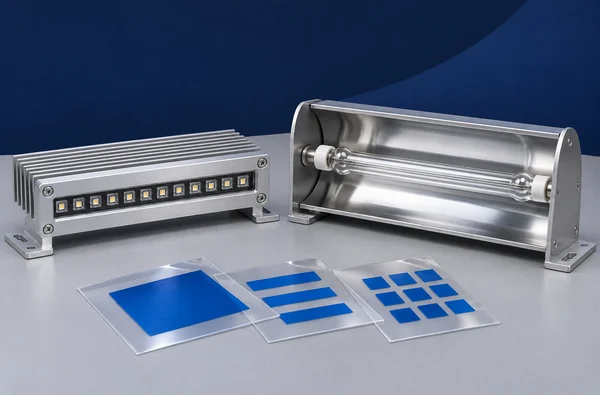
Choose the UV light source with the ink supplier, using the exact ink, color and printed layer planned for production. LED and mercury systems have different spectral outputs, so a lamp substitution needs a compatibility review and finished-sample checks. A quotation that says only “UV dryer included” leaves the curing specification unresolved.
This decision comes after selecting a UV-curable ink system. If you are still choosing between UV and thermal drying, start with the hướng dẫn so sánh đóng rắn bằng UV và sấy khí nóng. Here, the question is which UV configuration can run your approved job and what evidence belongs in the purchase specification.
Start with the ink, including each color and coating
Send the ink supplier’s current technical data sheet to the machine manufacturer. Identify the product code, color, substrate and intended deposit. Include any clear coating or adhesive that also needs curing. An approval for one layer does not automatically cover the next.
LED sources emit within a narrow wavelength range. Conventional mercury sources have a broader spectral output. The ink’s photoinitiators must respond to the proposed source. GEW’s UV LED FAQ explains that conventional UV formulations cannot simply be assumed suitable for LED, while some products are formulated for both processes.
Ask the ink supplier to confirm the proposed source in writing. If the data sheet names an LED wavelength, include that requirement in the quotation. If it specifies a mercury process, request a separate assessment before considering LED. Keep “dual cure” tied to the named ink product and its stated conditions.
Ví dụ, Nazdar’s Indigo Overprint screen-ink technical sheet gives separate mercury and LED curing conditions and calls for trials under actual production conditions. Its values belong to that ink system; they are not settings for other inks or Winshol machines.
Compare the proposed systems on the same basis
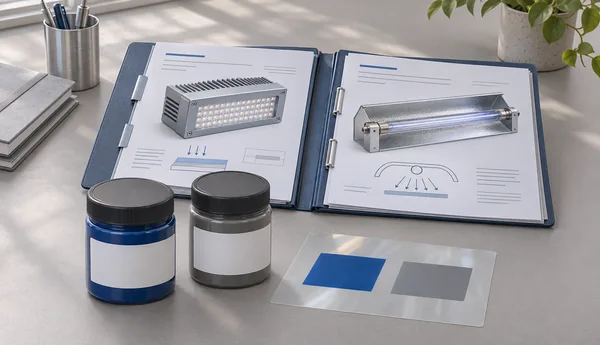
Use the following questions when reviewing two quotations. Have the supplier fill in the missing details for the actual configuration.
| Purchasing question | Mercury UV proposal | UV LED proposal |
|---|---|---|
| Which ink is approved? | Record the ink product and the specified lamp type or spectrum. | Record the ink product and approved LED wavelength. |
| How is exposure verified? | Agree the measurement band, instrument and position at the web. | Use a measurement method suitable for the LED spectrum and geometry. |
| What happens to the material? | Check web temperature and dimensional behavior at the proposed operating conditions. | Check the same properties; lower radiant heat does not establish material compatibility. |
| What does installation include? | Identify power supply, cooling, exhaust where required, controls and shielding. | Identify power supply, air or water cooling, controls and shielding. |
| What proves the job is acceptable? | Use agreed tests on the complete printed construction. | Use the same finished-product requirements, with the LED process recorded separately. |
A lamp’s electrical rating, irradiance at the web and delivered energy describe different things. Comparing the largest number in each brochure can therefore give a misleading result.
Ask how irradiance and energy density will be measured
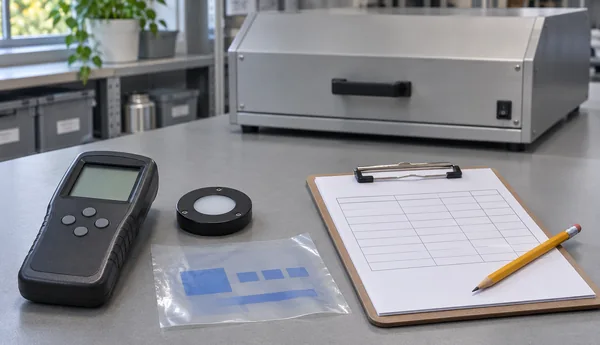
Irradiance describes radiant power per unit area. Energy density describes the energy received per unit area over the exposure. Both need a stated spectral band and measurement method. GEW’s explanation of UV energy measurement separates these quantities and discusses why the source spectrum must suit the chemistry.
For purchasing, request a record of the source, measurement instrument, measurement location and operating condition. Include lamp-to-web geometry and the web’s movement through the curing zone. On an intermittent line, have the equipment team explain how the actual feed and dwell sequence affects exposure.
Keep instrument readings with the trial sample. Measurements from different spectral bands or instruments may not be directly comparable. The ink supplier and curing-system specialist should agree the method before either bidder claims that its higher reading proves a better cure.
Check cooling and integration before discussing a conversion
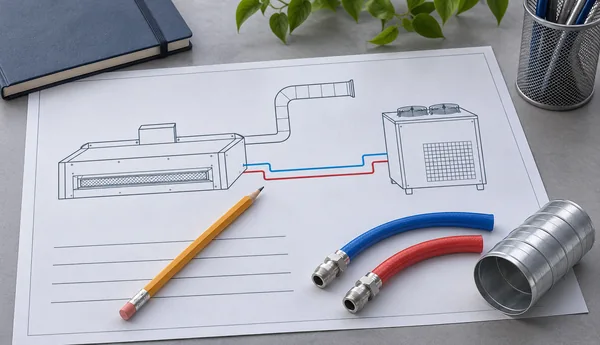
LED can reduce radiant heat reaching the substrate compared with a conventional mercury system. The full label construction still needs a trial. Face film, adhesive and liner may respond differently, and the printed material absorbs energy during curing.
Ask where the web temperature will be checked and how material distortion will be assessed. Include the next print or converting step if it depends on dimensional stability. The IST METZ LED technology guide describes the source’s narrow spectrum; that characteristic alone cannot establish suitability for a particular film.
For a proposed change to an existing press, ask for an integration review covering available space, electrical supply, cooling and machine controls. Identify who is responsible for the completed arrangement and its safety review. GEW notes that LED and arc lamps normally require different power supplies, although its own hybrid systems can support both. That product-specific capability should never be assumed for another installation.
Have qualified suppliers define the work. Buying a replacement light source without checking the rest of the system can leave the buyer with incompatible equipment.
Use a trial that reflects the order you need to produce
Choose production stock and artwork that include the demanding areas of the job. A thin, lightly colored sample may tell you little about the intended opaque white or heavy coating. Record the screen and deposit conditions so the two proposals are assessed fairly.
Before printing, agree the tests and when they will be performed. Depending on the product, these may include adhesion, surface resistance, blocking after winding or performance after lamination. The ink and material suppliers should specify suitable methods and conditioning times.
Retain samples after curing and after the next required operation. Record rejected sections as well as accepted ones. If the proposed LED route needs a different ink, identify that change explicitly and assess the finished construction again.
Compare operating costs only after both routes meet the job requirements. Ask for measured electricity use over a stated production period, with cooling and other included equipment identified. Use the same accepted-output basis. A quoted saving from another press or another ink is not a forecast for your line.
What to confirm with Winshol
Tài liệu trang sản phẩm WL-350D UV lists a single-color roll-to-roll configuration with a two-lamp UV dryer. That description does not identify the source as mercury or LED, or establish that an LED conversion is available.
Send Winshol your ink data, stock specification and artwork, together with any preferred curing source. Ask which configuration can be proposed and what sample evaluation is needed. The danh sách kiểm tra khi yêu cầu báo giá máy covers the wider project; attach the curing questions above so that the written offer identifies the light source and its integration scope.
Câu hỏi thường gặp
1. Can ordinary UV screen ink run under LED lamps?
Only if the ink supplier approves that product for the proposed LED source and conditions. Obtain confirmation for the exact ink and test the printed construction.
2. Does dual-cure ink use the same settings with both sources?
Do not assume so. Follow the separate source-specific guidance and record each trial’s exposure conditions. Dual-cure describes compatibility within specified conditions, not identical operating settings.
3. Is UV LED always better for thin film?
Lower radiant heat can be useful, but the film, coatings, adhesive and liner must all tolerate the process. Check temperature and dimensional behavior on production material.
4. Can I compare curing systems by lamp wattage?
Lamp wattage alone cannot establish cure performance. Review the spectrum and measured exposure at the web, then verify the required properties on printed samples.
5. Can a mercury dryer be converted by replacing its lamps?
Ask the equipment and curing-system suppliers to review the complete installation. Power supply, cooling, geometry and controls may require changes. Availability depends on the existing system.
6. What should a curing trial report include?
Include material and ink identifiers, artwork, print conditions, source configuration, exposure measurements and the agreed test results. Record when samples were tested and any downstream processing.
7. Does a dry-feeling surface prove full cure?
Touch alone does not establish the properties required for the job. Use the ink supplier’s recommended checks and the customer’s finished-product acceptance tests.
8. Does Winshol’s two-lamp UV listing mean LED curing is included?
No. The published description does not specify LED. Ask Winshol to identify the proposed curing source and confirm the available configuration in the written quotation.