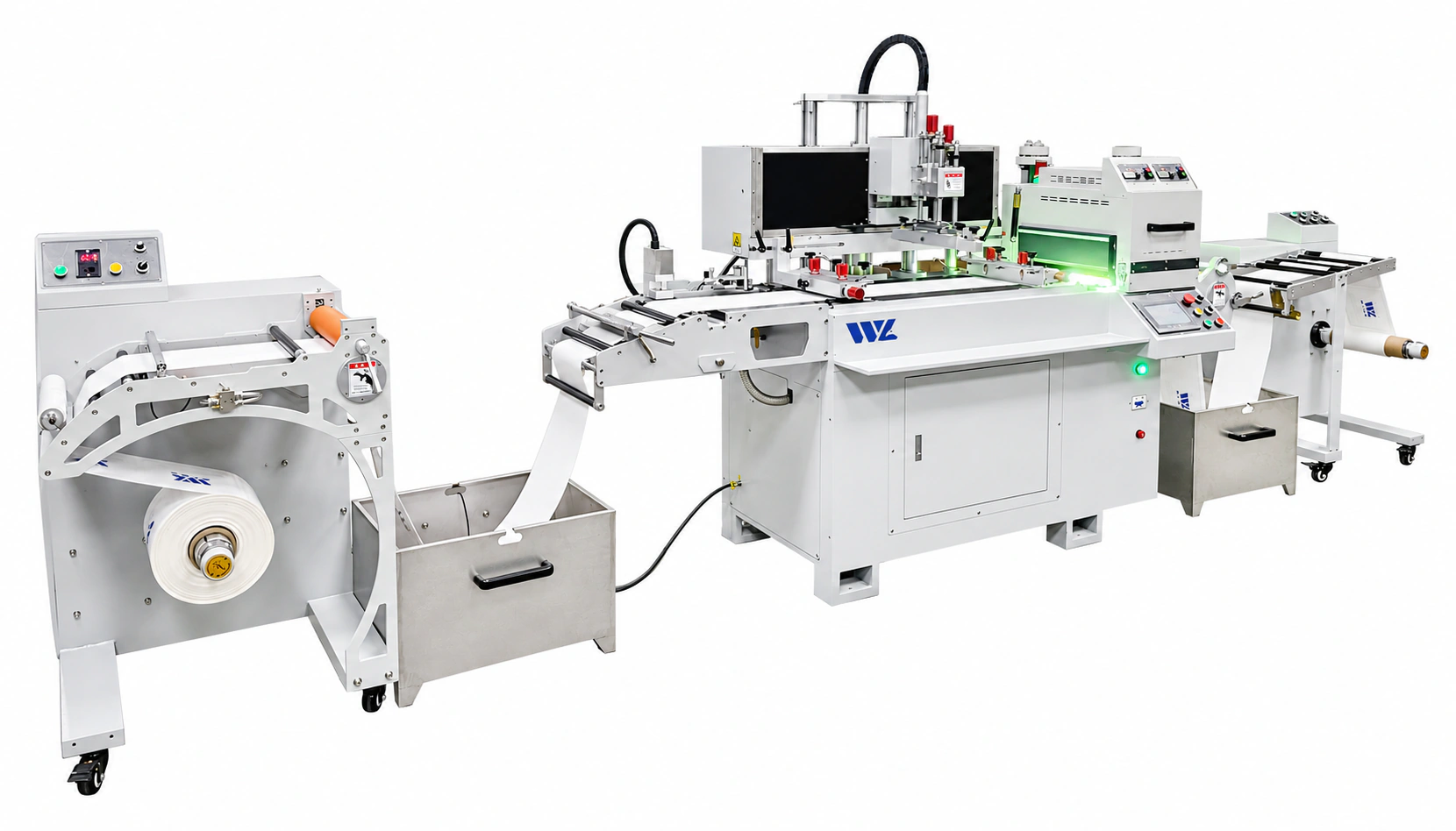
This WL-350D is the single-color UV roll-to-roll configuration for labels. The catalogue lists a 350 mm maximum web width, a 330 × 450 mm maximum print area and a two-lamp UV dryer. Confirm substrate and ink compatibility, artwork, required output and the complete line scope using representative production material.
Single-color screen printing with inline UV curing
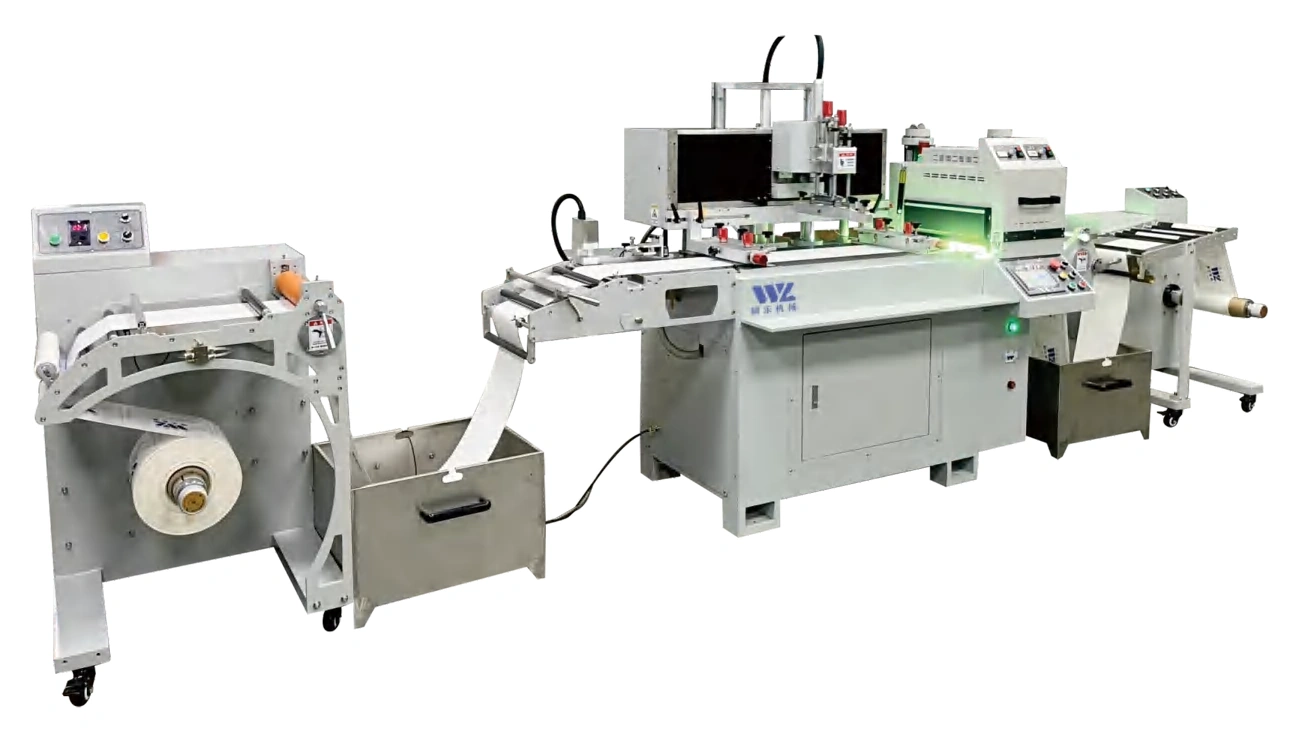
The WL-350D is a single-station, roll-to-roll screen printing machine for label production. This configuration combines unwinding, material feeding, screen printing, a two-lamp UV dryer and rewinding. It supports a maximum web width of 350 mm and a maximum print area of 330 × 450 mm. Check the web width versus print area guide to confirm artwork fit, edge margins and repeat length rather than relying on roll width alone.
The equipment shown is the single-color UV version. Review your label stock, ink system, artwork and curing requirements with our team to confirm the configuration for your production.
WL-350D single-color UV configuration · Click image to enlarge
Machine features
CNC-machined printing head: the aluminum printing-head structure is designed to provide rigidity during printing.
Adjustable squeegee and flood bar: their angles can be adjusted separately to suit the printing process.
Pneumatic pressure compensation: supports consistent printing pressure through the stroke.
One-piece cast machine frame: provides a stable support structure for the printing unit.
Servo-controlled material feeding: coordinates the material advance with the print cycle.
Two-lamp UV drying unit: connects printing and curing within the roll-fed workflow.
Configuration shown in the catalogue
The listed configuration includes an unwinding unit, main printing machine, two feeding units, a two-lamp UV dryer, a rewinding unit, two squeegees, two ink-return blades and a tool box.
Plan the machine around your label job
For a machine recommendation, send the substrate type and thickness, web width, artwork dimensions, print repeat, ink information and target output. Sample material helps our team review feeding behavior and compatibility with the UV curing process. The good labels per hour calculation guide explains how measured running time, repeat layout and accepted yield affect output; catalogue speed alone does not establish finished-label production.
The dimensions below refer to the main machine. Confirm the complete line layout, electrical requirements and supplied configuration in the quotation.
Compare single-color and multicolor configurations
Shortlist the WL-350D UV when your job requires one screen color and a compatible UV ink and substrate. If the artwork requires two screen colors, compare the WL-350S; if the drying route is still undecided, read the UV versus hot-air guide. Confirm material behavior and final line scope with a production sample.
For a job-based choice between the three 350 mm configurations, see the WL-350D, WL-350S and WL-350DW comparison. It separates screen-color count from cold foil and lists the samples needed for a fair quote.
What is included, and what needs confirmation?
The catalogue describes one single-color UV configuration, not every possible production line. Use the following scope when reviewing a quotation.
Catalogue-listed equipment
Unwinding unit, main printing machine, two feeding units, two-lamp UV dryer, rewinding unit, two squeegees, two ink-return blades and a tool box. Ask the quotation to identify each supplied unit and its configuration.
Separate configurations, not assumed upgrades
Two-color printing, oven drying and cold-foil processing are not included simply because a machine shares the WL-350 model family. Compare the linked models above and specify the complete model and drying route in your enquiry. Do not assume CCD registration or additional downstream equipment is included.
Project-specific items to confirm
Material and artwork: stock, thickness, usable image area, edge margins and registration marks. Numerical thickness limits and finished registration tolerance are not specified here; agree the acceptance requirement for your job.
Roll handling and curing: core size, roll diameter and weight, tension range, selected UV ink, curing settings and substrate thermal limits.
Installation: complete line drawing, footprint, connected load, phase/frequency, air and exhaust requirements. The main-machine dimensions and individual motor ratings are not the complete line footprint or total power requirement.
Commercial scope: documents, operator training, warranty, lead time, spare parts and service arrangements.
Configuration and installation: request an itemized supply list and a line drawing for the quoted equipment, with the utility schedule.
Material trial: agree the substrate, ink, artwork, repeat layout and test conditions before a trial. Request a record identifying the actual configuration, run duration and accepted result, rather than treating a general demonstration as proof for your job.
Acceptance: agree how print appearance, alignment, curing and usable output will be assessed. A catalogue specification alone does not establish finished-label performance.
These are documents to request during project review; no job-specific trial report or performance guarantee is supplied on this page. Use the RFQ checklist to prepare a comparable enquiry.
Roll-fed label stock compatible with UV screen printing. Substrate and ink compatibility should be reviewed with sample material before configuration.
Typical applications
Personal-care and household-product labels
Single-color label printing with inline UV curing
Technical specifications
Model
WL-350D
Configuration
Single-color, UV curing
Screen frame size
550 × 700 mm
Maximum print area
330 × 450 mm
Maximum web width
350 mm
Maximum feed length
450 mm
UV drying unit
Two-lamp UV dryer
Main machine dimensions (L × W × H)
2500 × 1100 × 1700 mm
Net weight
1300 kg
Gross weight
1800 kg
Main machine power supply
220 V
Squeegee servo motor power
0.75 kW
Material-feed servo motor power
1.3 kW
Vacuum motor power
0.37 kW
Product questions
Frequently Asked Questions
1.What is the WL-350D UV screen printing machine used for?
The WL-350D configuration shown here is a single-station, single-color roll-to-roll screen printing machine for label production, including personal-care and household-product labels. Printing is followed by inline UV curing. Jobs requiring multiple colors should be reviewed for a suitable multi-station configuration.
2.What are the maximum material width and print area?
This WL-350D UV configuration supports a maximum web width of 350 mm, a maximum print area of 330 × 450 mm and a maximum feed length of 450 mm. The screen frame size is 550 × 700 mm. These dimensions refer to different parts of the process and should be checked against the label layout and print repeat.
3.Which label materials and inks can be used?
The machine is intended for roll-fed label stock compatible with UV screen printing. Suitability depends on the substrate, thickness, surface coating and ink system. Provide the material specification and a sample so feeding behavior, ink adhesion and UV curing compatibility can be reviewed for the intended application.
4.What equipment is included in the catalogue configuration?
The listed configuration includes an unwinding unit, the main printing machine, two feeding units, a two-lamp UV dryer and a rewinding unit. The catalogue also lists two squeegees, two ink-return blades and a tool box. Confirm the final supplied configuration in the quotation.
5.How much installation space and electrical supply are required?
The catalogue lists the main machine dimensions as 2500 × 1100 × 1700 mm and its power supply as 220 V. These dimensions do not describe the complete production line. The full layout must also account for unwinding, UV drying, rewinding and access around the equipment. Confirm the complete electrical requirements and installation layout before ordering.
6.What information is needed to recommend a configuration and quote?
Provide the substrate type and thickness, web width, artwork dimensions, print repeat, ink details and target output. Include the number of colors, installation country, available space and electrical requirements. Sample material and artwork help the engineering team review the printing and curing process before recommending a configuration.