






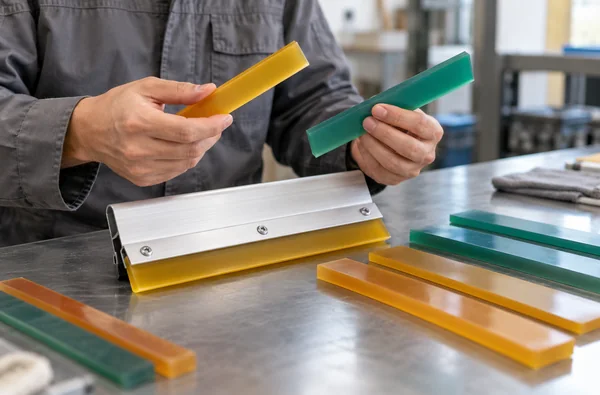
How to specify squeegee blades for industrial screen printing
Specify an industrial screen-printing squeegee blade by its compound, hardness, layer construction, edge profile, dimensions and holder fit. Then qualify that exact assembly with the production ink and a documented print trial. Ordering by durometer or color alone leaves too much undefined for a repeatable replacement.
This guide is for buyers and process engineers preparing a blade specification for flatbed industrial printing, including labels, nameplates and printed functional layers. It focuses on what to order, what to inspect and what evidence should support approval.
Start with the approved print requirement
Before asking which blade is best, write down what the printed part must pass. Depending on the job, that may be line width, edge definition, opacity, deposit thickness or an electrical result after the specified cure. Use the customer drawing and quality plan to set the limits. A supplier cannot select a meaningful trial candidate from the phrase high-quality printing.
Prepare a short job record with the substrate, image dimensions, ink product and additives, cleaning products, screen specification and production run conditions. Include the current blade designation and a retained acceptable print if a qualified process already exists. Treat a proposed substitute as a controlled change to that process.
If the project also needs a new production line, use the screen-printing equipment overview to define the wider equipment scope. Keep the blade approval record specific to the print station where it will be used.
Separate hardness from compound and construction
Durometer is one material property
Record the hardness scale, nominal value, permitted tolerance and measurement method. A statement such as 75 Shore A is more useful than medium, but it still does not specify the polyurethane formulation or the assembled blade’s behavior.
FIMOR’s serilor HR technical data sheet gives softer and harder grades different general deposit applications. It also describes a hard center layer in its triple-layer blades. Those are supplier selection guidelines, not universal settings for every industrial ink, screen or substrate. Use them to choose trial candidates, then judge the printed result.
Chemical resistance needs its own check
Supply the ink and cleaner product references, including any approved additives. Ask the blade supplier to recommend a grade for those materials and the expected exposure conditions. Do not assume that moving to a higher hardness solves swelling or softening.
SAATI distinguishes cut-edge, molded-edge and higher-resistance products in its Duralife range. Its HP data sheet specifically addresses aggressive UV and solvent-based inks. These distinctions explain why a quote should name the grade, not just the brand and durometer. They do not establish compatibility with an untested ink mixture.
For a proposed substitution, request the current technical data sheet and a written list of differences from the approved blade. Keep any performance claim tied to the manufacturer’s stated product and conditions.
Put the complete blade specification in the purchase record
The following comparison turns a vague reorder into a specification that purchasing, the supplier and the press operator can all use. Dimensions and acceptance limits should come from the machine documentation and the approved trial, rather than from a generic chart.
| Specification field | Incomplete request | Better purchase requirement | Receiving or trial check |
|---|---|---|---|
| Material grade | Solvent-resistant blade | Manufacturer, grade and current data-sheet revision; named ink and cleaner | Correct product identity; documented response to the production materials |
| Hardness | Medium or blue | Scale, nominal value, tolerance and agreed test method | Recorded measurements under consistent conditions |
| Construction | Same durometer as before | Single-layer or composite; layer sequence and orientation | Label or drawing agrees with the approved construction |
| Edge | Standard sharp edge | Profile drawing, bevel or land where applicable, and edge finish | Profile matches; working edge passes the agreed inspection |
| Dimensions | Fits our press | Finished length, overall height, thickness, units and tolerances | Measured dimensions and holder fit |
| Installed assembly | Use the existing holder | Holder identification, clamping arrangement and free height | Correct seating and consistent projection along the working length |
| Traceability | Send an equivalent replacement | Part and batch identification; substitutions require documented review | Delivery record links to the blade used in the trial |
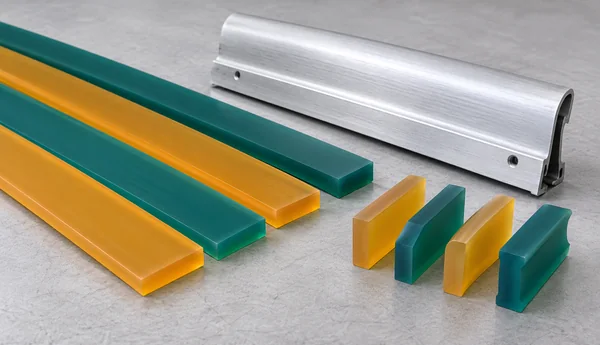
Make dimension names unambiguous
Attach a dimensioned sketch. In this article, length runs along the printing edge, overall height runs from the top of the blade to that edge, and thickness is the cross-section dimension clamped by the holder. A supplier may call overall height width, so a bare three-number size can be misread.
SAATI’s Duralife CE data sheet lists several profiles and dimensions and notes that not every specification is continuously stocked. Check the lead time for the exact cut size and profile before approving a production spare.
FIMOR advises that blade length extend beyond the image while leaving clearance to the frame, and that blade thickness suit the holder without being forced into it. Its serilor SR instructions provide these checks. Confirm the actual dimensions with the machine supplier.
Record free height, not just stock size
Free height is the unsupported portion of the blade below the holder. As a mechanical consideration, changing this length changes the way a flexible blade can bend under load. The same stock size in a different holder, or at a different insertion depth, should not automatically be treated as the same setup.
Record free height after installation and again after any sharpening that removes material. Check the holder’s condition and clamping arrangement. Buying the correct blade does not resolve a damaged or unsuitable holder.
Inspect the edge and material before the press trial
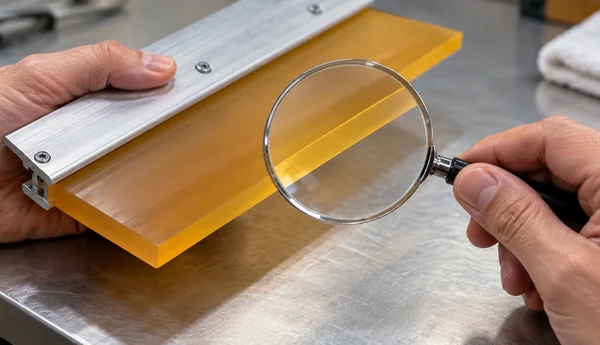
Define an incoming inspection that the factory can repeat. A practical record includes the blade and batch identification, dimensional readings, photographs of the working edge and the agreed hardness readings. Keep the inspection method and rejection criteria with the approved specification.
Look for damage or irregularities along the entire working edge, not just at the ends. Compare the supplied profile with the drawing. A square edge, a beveled edge and a rounded profile are different geometries; avoid substituting one simply because it fits the holder. SAATI’s Duralife ME data sheet illustrates why profile identification needs more than the word molded.
Hardness checks can help identify a blade that has changed in service. SAATI describes this purpose in its squeegee quality-control guidance. Its durometer data sheet also identifies calibration and measurement traceability. For a factory test, agree on instrument, conditioning, measurement locations and acceptance limits with the supplier. A reading taken under different conditions should not be treated as a direct comparison without checking the method.
Color is a convenience, not a purchase specification. SAATI explicitly warns in the CE data sheet that other manufacturers use different color codes.
Approve the replacement with a traceable trial
The workflow below is a suggested factory acceptance procedure. It is not a blade manufacturer’s performance guarantee. Set the sample plan and limits for the actual job before the trial starts.
- Establish the reference. Identify a known acceptable blade and holder assembly, its condition, the job specification and the current press recipe. Retain labeled reference prints.
- Hold the comparison conditions steady. Use the same substrate and ink system, screen and support arrangement where practical. Record relevant material batches and environmental conditions. Log blade angle, stroke speed, pressure or force setting, and any other machine parameters used.
- Install and inspect the candidate. Record its grade, batch, dimensions, profile, hardness readings and free height. Check seating and alignment before printing.
- Compare more than start-up sheets. Collect samples at planned points during a run representative of production. Measure the agreed print properties, and record rejects and every setup adjustment. If the candidate needs a new recipe, qualify that recipe rather than calling it a drop-in replacement.
- Check the normal reuse cycle. If blades are cleaned, rested and reinstalled in production, include that sequence in qualification. Reinspect the blade and repeat the relevant print checks.
- Release an exact configuration. Save the approved part designation, holder setup, recipe, inspection limits and retained samples. Identify who may authorize later substitutions.
Do not prescribe a universal blade angle, speed or pressure in the purchase order. Ask for the settings used in the sample trial and the machine’s available adjustment range. The production recipe belongs to the qualified combination of blade, ink, screen, substrate and press.
For cost comparison, record accepted output, blade consumption, sharpening and cleaning effort, and time spent changing or readjusting the assembly. A lower price per strip is not enough to establish a lower cost per accepted part.
Keep maintenance linked to the approved condition
Use the maintenance instructions for the purchased grade. FIMOR’s squeegee guidance calls for suitable cleaning products, solvent evaporation before reuse or sharpening, and sharpening only when the blade is dry. It also recommends flat storage away from direct light and extreme conditions. Do not turn one manufacturer’s rest or storage recommendation into a universal rule for every material.
Give each working assembly an identifier. Log sharpening, visible damage, unusual chemical exposure and removal from service. When a blade no longer meets the agreed condition or print limits, investigate and disposition it through the quality process. Avoid repeatedly changing machine settings just to keep an unidentified, deteriorating blade in use.
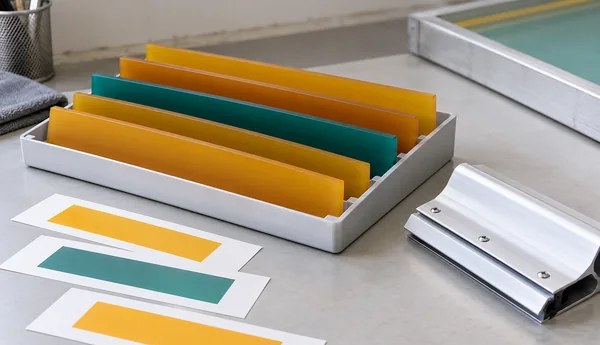
What to send with a machine or replacement-blade inquiry
Send the job record, holder drawing or identification, current blade specification and the print acceptance limits. Request a proposed blade configuration, current technical data sheet, trial quantity, exact-specification lead time and a statement of any substitutions.
For a new machine purchase, add these items to the screen-printing machine RFQ checklist. Ask which holder and blade configuration will be used for sample printing and what is included in the quotation. Contact Winshol with the application details and request confirmation of the holder interface and trial scope before finalizing the consumable specification.
Frequently asked questions
1. What information is needed to order an industrial screen-printing squeegee blade?
Specify the blade manufacturer and grade, hardness scale and value, layer construction, edge profile, finished dimensions and tolerances. Add the holder drawing or identification, installed free height, ink and cleaner references, and the print requirement. For a replacement, attach the approved blade record and ask the supplier to identify every proposed difference before shipping.
2. Is a higher-durometer blade always better for fine detail?
No. A harder blade may be a useful trial candidate, but a hardness value alone does not define the working edge or how the installed blade behaves. The compound, support layers, profile, free height and press settings also need to be considered. Compare candidates against measured line width or another agreed print limit, rather than selecting the highest available number.
3. Can blade color be used to match a replacement?
Use color only as a quick identifier within a confirmed manufacturer and product range. SAATI explicitly states that competitor color codes differ. A reorder should carry the grade and hardness designation, not a description such as blue rubber. If the original specification is missing, measure and identify the blade before treating another product as equivalent.
4. What does a triple-durometer designation mean?
It identifies the hardnesses of the layers in a composite blade. For example, FIMOR lists a 75/90/75 Shore A construction with a harder center supporting the outer layers. Confirm the layer sequence and mounting orientation with the supplier. A composite blade should be qualified as its own construction, rather than treated as interchangeable with a single-layer blade that shares an outer-layer value.
5. Why record free height if the total blade dimensions already match?
Free height is the portion extending beyond the holder toward the printing edge. Two installations can use the same blade stock while exposing different amounts of it. As a mechanical consideration, changing that unsupported length can change bending under load. Record the holder arrangement and free height with the trial settings so that a repeat installation reproduces the approved assembly.
6. When should a blade be sharpened or replaced?
Use the blade supplier’s maintenance instructions and the job’s acceptance limits. Inspect the edge and check dimensions and hardness before deciding. Sharpening may be appropriate for an eligible blade with edge wear, but it is not evidence that chemical damage has been corrected. After sharpening, verify the remaining height, installed free height and print result before returning the blade to production.
7. How should a factory compare two suppliers’ blades?
Use a documented reference assembly and the same controlled job conditions. Inspect both candidates before printing, compare start-up and later samples, and record any setting changes needed to keep each within specification. Include a cleaned-and-reinstalled check if that reflects normal production. Approve the grade and setup that meet the agreed limits; do not approve by appearance on a single good sheet.
8. Should a machine quotation include the squeegee specification?
Yes. Ask the machine supplier to identify the holder interface, supported blade dimensions, available setup adjustments and the blade configuration used for any sample test. Record whether trial blades, holders or spare assemblies are included in the quoted scope. Confirm the final consumable specification separately, especially if the production ink differs from the demonstration ink.