





Screen Printing Mesh Selection: What to Specify Beyond Mesh Count
Choose screen printing mesh against the actual ink, artwork and required print result. Specify the count with its unit, then identify the thread diameter, mesh opening, weave and fabric thickness. Agree on the stencil and finished-screen requirements before ordering. A purchase description such as “305 mesh” leaves too much unresolved.
For buyers of industrial label and film printing equipment, this matters when comparing samples, transferring an existing job to a new press or ordering replacement screens. Both the screen maker and machine supplier need the same approved specification. There is no single mesh count that is right for every job.
Start with the layer you need to print
Begin with the artwork and the ink product, not a mesh number copied from another job. Identify the smallest feature that must remain readable, the solid areas that need consistent coverage and any customer requirement for the printed layer. Keep the intended substrate and surface treatment in the brief.
Ask the ink supplier for its current technical data sheet. For example, Nazdar’s 2800 Series sheet specifies both mesh count and opening, with separate guidance for specialty effects. It also warns that coarser mesh or twill weave can increase deposit and cure demand. Those instructions belong to that ink family; they are not a universal setting for a Winshol press.
Send the exact ink series and color, artwork at production size, substrate identification and the result to be accepted. If the existing process works, include its screen specification and a retained print. If it does not, describe the specific problem without assuming that mesh is the cause.
What belongs on the mesh specification?
Use the following as a purchasing worksheet. Some fields describe fabric supplied on a roll; others belong to the prepared screen. Make clear which item the supplier is quoting.
| Field | What to request | What it resolves |
|---|---|---|
| Mesh identity | Manufacturer, product code and material | Whether a repeat order is the same construction or a proposed substitute |
| Count and units | Threads per inch or threads per centimeter, as listed by the supplier | Ambiguity in an order that states only a number |
| Thread diameter and opening | Both values in micrometers, with the supplier’s specification | Differences hidden behind an identical nominal count |
| Weave and fabric geometry | Weave, thickness and open-area percentage | Whether the compared fabrics are actually equivalent |
| Theoretical ink volume | Published value and unit, where available | A basis for comparing constructions, rather than a promised finished thickness |
| Prepared-screen details | Frame drawing, image position, stencil system and agreed tension checks | What will be delivered ready to use on the proposed press |
Do not translate a supplier’s product code into a generic description and discard the original. That code is often the simplest way to identify what was approved. Keep the data-sheet revision with the order, and ask the supplier to identify any proposed change before production.
Keep the units explicit
The Screen Printing Technical Foundation’s study of polyester mesh during tensioning defines mesh count as threads per unit length. It also discusses rounded commercial designations and changes in mesh geometry during stretching. For purchasing, record the manufacturer’s stated units and product designation rather than relying on a converted count alone.
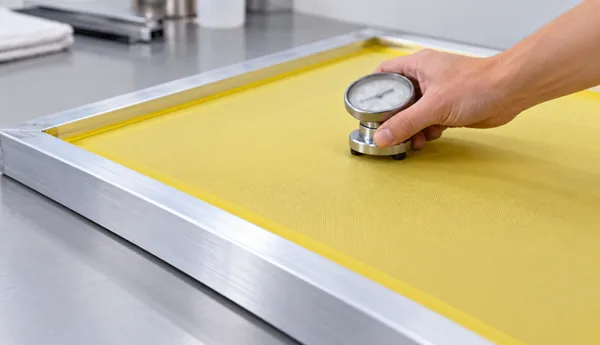
For a finished screen, ask when and how tension will be measured. A fabric specification and a tension reading on the mounted screen are different records. Agree on acceptance requirements with the screen maker and press supplier; do not treat a tension used in a research paper as a production target.
Same count, different construction: a supplier example
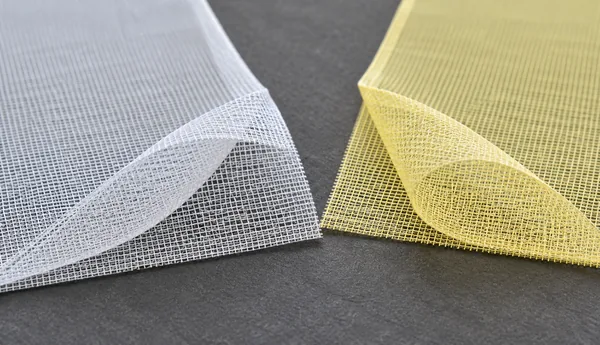
The SAATI Hi-R technical data sheet, revision 2, October 2024, lists these two plain-weave constructions. Both are designated 305 threads per inch, or 120 per centimeter.
| Published property | 31 µm thread construction | 40 µm thread construction |
|---|---|---|
| Mesh count | 305/inch; 120/cm | 305/inch; 120/cm |
| Weave | Plain weave | Plain weave |
| Mesh opening | 53 µm | 38 µm |
| Fabric thickness | 48 µm | 67 µm |
| Open area | 40% | 20% |
| Theoretical ink deposit | 19 cm³/m² | 13 cm³/m² |
The same count does not make these fabrics interchangeable. The thicker fabric in this comparison has the lower theoretical deposit. These are published SAATI values, not Winshol test results or a recommendation to choose either construction for your job.
Theoretical volume is a comparison value
Do not write a finished-film guarantee into a purchase order by copying the theoretical deposit column. Agree separately on how the actual printed layer will be assessed. Where thickness matters, identify the measurement method, sampling locations and acceptance limits before the trial.
Also state whether acceptance concerns the wet, dried or cured layer. Keep the approved stencil and press setup with the results so that a later comparison does not attribute every difference to mesh.
Check the ink and stencil together
Effect inks deserve their own review. Nazdar’s NSC240 texture-clear guidance warns that excessively fine mesh can filter the texture agent and change viscosity during a run. This is a product-specific reason to check opening and ink compatibility rather than assuming that a finer screen is an upgrade.
Ask the screen maker to name the proposed emulsion or film and explain how it matches the ink and cleaning process. Record stencil details with the mesh approval. If an existing screen is being replaced, distinguish a change of mesh from a change of stencil construction so that the trial can answer a useful question.
A multicolor job should have a record for each printed layer. Do not force an opaque layer, fine text and a special-effect coating into one mesh specification for the convenience of ordering. Review the requirements first; use identical screens only where the approved process supports that choice.
Confirm that the complete screen fits the press
Mesh selection does not settle mechanical fit. Send the machine supplier the frame’s outside dimensions and profile, the image location and the intended print area. Ask for confirmation of the clamping arrangement and any clearance requirements for the quoted configuration.
For a roll-fed project, the WL-350S two-color screen printer is one relevant Winshol product to discuss. Check the current machine specification and drawing before commissioning screens. The distinction between web width and usable image area is covered in Winshol’s web-width versus print-area guide.
Be clear about the supply boundary. Are you buying mesh fabric, stretched frames or exposed screens ready for printing? Who prepares replacements after commissioning? Put those responsibilities in the quotation. A machine purchase should not leave the buyer and supplier making different assumptions about screen preparation.
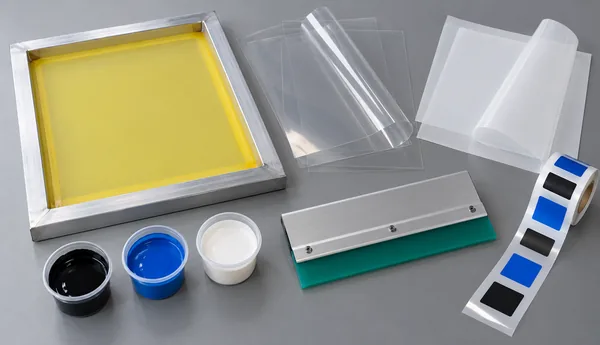
Approve the specification on a representative trial
Use the trial to decide whether the proposed combination meets the agreed requirements. Agree on the following before the screens are made:
- Select the actual production artwork and substrate. Include the features or coverage areas that determine acceptance.
- Identify the candidate meshes and record the associated stencil details. If two constructions are being compared, keep unrelated variables unchanged where practical and record any necessary adjustment.
- Set acceptance criteria in advance. Depending on the job, these may include readable detail, coverage, layer thickness or tests specified by the ink supplier and customer.
- Keep early and later samples from an agreed representative run. Record the ink identification, screen tension, squeegee setup and drying or curing settings alongside the results.
- Approve the complete record and retained reference sample. Require a review before a supplier substitutes another mesh or stencil for repeat orders.
This is a proposed buyer approval procedure, not a report of a Winshol test. The required run length and test methods depend on the application. A short sample cannot establish every condition of a long production run.
If the blade setup also needs review, use the separate industrial squeegee blade specification guide. Keep that decision linked to the screen record rather than changing both without documentation.
Prepare the next enquiry
For a Winshol equipment discussion, send the production artwork, substrate details, exact ink data sheet and any existing mesh and stencil specification. Include the result you need to verify and the screens you intend to reuse. Ask which press configuration and sample evaluation should be considered before committing to replacement screens or a new line.
Keep the approved screen specification, responsibilities and acceptance criteria together. Another buyer should be able to reorder the screen from that record without reconstructing the trial from memory.
Frequently asked questions
1. Is a higher mesh count always better for industrial screen printing?
No. Select a candidate against the artwork and the exact ink supplier’s guidance, then approve it on the intended substrate. A higher count is not a substitute for checking opening size, thread diameter, stencil construction and the required print result.
2. Are mesh counts per inch and per centimeter interchangeable?
They describe the same type of measurement using different units, but the numbers are not interchangeable. State the unit on every order. Because commercial designations can be rounded, retain the manufacturer’s product code and published specification rather than identifying a replacement by conversion alone.
3. Why can two screens with the same mesh count print differently?
Their thread diameter, opening, fabric thickness or weave may differ. The SAATI Hi-R example above shows two 305-per-inch plain-weave meshes with different open areas and theoretical deposits. Stencil construction and press conditions must also be recorded when comparing results.
4. Does theoretical ink volume tell me the finished ink thickness?
No. Use it to compare mesh constructions, not as a guarantee of the printed or cured layer. If thickness is a customer requirement, agree on the measurement method and acceptance limits, then measure the sample produced with the proposed ink, stencil and press settings.
5. Can every color in a job use the same mesh?
Do not make that a purchasing assumption. Review the ink data sheet and artwork for each layer, especially when a job combines fine detail, opaque coverage and an effect coating. Record the approved mesh and stencil for each layer even if the final selections are identical.
6. What should buyers check for metallic or textured inks?
Ask the ink supplier for the recommended mesh opening and any restrictions on count or weave for the exact product. Do not substitute a finer screen merely because it sounds more precise. Approve the intended effect and its consistency over a representative run.
7. What screen information does the machine supplier need?
Provide the complete frame’s outside dimensions and profile, mesh specification, image position and intended print area. Confirm the clamping arrangement and screen requirements against the proposed press configuration. Web width alone does not establish that an existing prepared screen will fit.
8. What should a mesh approval record include?
Keep the supplier and product code, count with units, thread diameter, weave, stencil details and measured screen tension together with the artwork, substrate and ink identification. Add the press settings, agreed test results and retained reference samples. Require review of substitutions before repeating the order.