






Can You Reuse Your Screen Frames on a New Roll-to-Roll Screen Printing Machine?
A screen frame is reusable on a new roll-to-roll screen printing machine only if the holder can secure it in the required orientation and the existing artwork can still print in the right place. Matching the catalogue’s frame dimensions is a useful first check. It doesn’t tell you whether the clamps will reach the frame rails, whether the image will line up with the web, or whether the screen will clear the press as it moves.
Before you order a full set of new screens, send the manufacturer a dimensioned sketch and one representative frame. If the tooling is expensive or hard to remake, include the tallest profile and the job with the least margin around its image.
Separate the aluminum frame from the screen you print with
Reusing a stripped frame saves the frame itself. Keeping an imaged screen also means retaining its mesh, stencil and the position of the artwork within the frame. That second decision needs a print trial. A frame can be sound enough to remesh while the existing stencil is no longer usable on the new press: the image may begin too close to the frame rail, or two colors may not line up to the same reference.
List the tooling moving with the job. Record the frame ID, job or artwork revision, whether the mesh is bare or imaged, and which edge faces the operator or leads in the feed direction. Take a straight-on photo and a side view with a scale. Label the axis along the web and the axis across it. Two catalogue numbers alone don’t tell the reader which way the frame sits in the press.
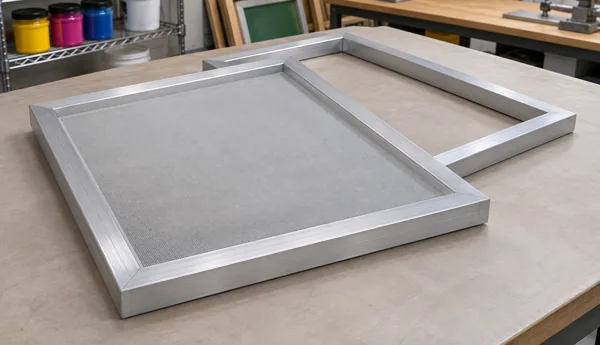
Measure the rails the press will actually hold
| What to record | What the manufacturer needs to check |
|---|---|
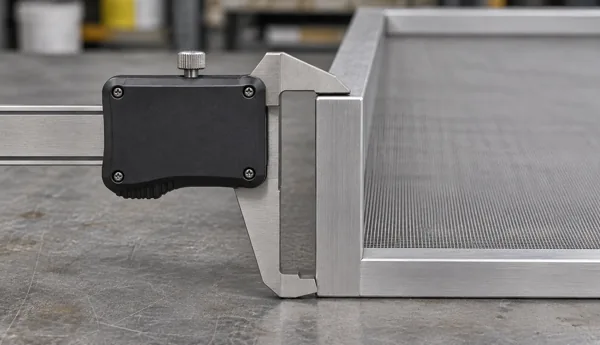
| Outside width and length, plus frame height at the clamp | Whether the frame fits between the locating rails, with enough clamp engagement on the actual profile. |
| Rail cross-section, protrusions and obstructions | Whether the specified clamping surfaces are clear of welds, fasteners or adjustment hardware. |
| Clear inner opening and image distance from two named rails | Whether the existing image can reach its required position without taking the squeegee or flood bar outside its working area. |
| Leading and operator-side edges, plus any locating feature | Whether the screen can be installed in the required orientation and placed against the correct reference each time. |
| Frame condition and screen identification | Whether the trial uses a frame worth keeping; note visible distortion, mesh damage or an obsolete artwork revision separately. |
Frame height matters enough that some manufacturers specify it separately from the outside dimensions. The ATMA RR5060/S technical sheet, for example, gives separate entries for maximum frame outside size and frame height. Its numbers apply to that model, not to a Winshol press. Ask for an approved holder drawing or measured fit on the exact quotation configuration.
Use the catalogue to shortlist, not to approve the transfer
Winshol lists a 550 × 700 mm screen frame and a 330 × 450 mm maximum print area for its WL-350D single-color UV machine. The WL-5080CCD-Y lists an 800 × 1000 mm frame and a 500 × 800 mm maximum print area, with a moving screen, CCD alignment and hot-air drying. The two listings do not establish a common holder or tell you whether a specific rail profile or adapter is approved.
Shortlist the press for the stock, ink and curing process first. Then review the frame on the quoted station. A larger press is not necessarily the better choice just because you already own larger screens. The web width and print area guide explains why the frame opening, usable image and web width are separate checks.
Make the sample trial show more than a frame in its holder
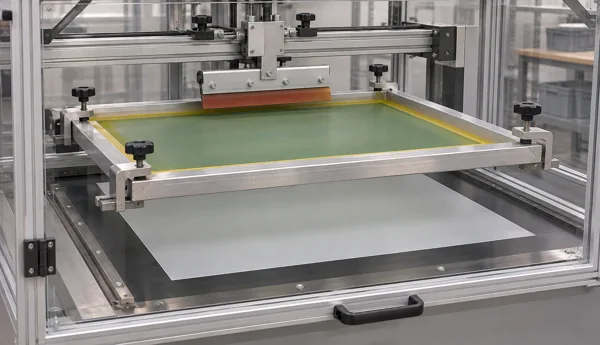
First, have the supplier’s qualified technician confirm loading, seating and clamping on the final holder in the approved setup mode. Next, have the technician verify clearances and motion using the machine maker’s safe procedure. Guards and interlocks stay in service. Do not authorize improvised brackets or changes to guarding just to make old tooling fit.
Then make a short print with the intended stock, ink and screen. Use the job’s actual reference marks or approved reference edge. Measure the first accepted repeat against the artwork, then repeat the check after an agreed removal and refit if the screen will be swapped between jobs. Record image position, coverage at both ends of the stroke and, for a multicolor job, alignment with the other color. A clear motion check allows the print trial; it does not replace it.
Decide frame by frame what moves to the new machine
Keep the imaged screen when the holder, image placement and representative print have all passed. Keep the frame and remake the stencil if the frame is sound and accepted by the holder, but the old artwork position or mesh is unsuitable. Replace the frame if it is damaged, doesn’t seat correctly or needs unsupported hardware. If an adapter is proposed, ask the manufacturer to include it in the configuration and acceptance record rather than treating it as an accessory that anyone can add later.
For a useful enquiry to Winshol, share the shortlist model, frame sketch with the feed direction marked, two photos, the repeat drawing and a sample from the job with the least clearance. Ask the supplier to write down which frame types are accepted, what will be remade and what the machine trial will demonstrate. Use that record to compare tooling costs alongside the press quote.
Frequently Asked Questions
1. Does matching the listed screen frame size prove my frame will fit?
No. The listed size is a starting point. Confirm the frame profile and height where the clamps grip, the locating surfaces, insertion clearance and the required orientation on the exact quoted holder.
2. What should I measure on an existing screen frame?
Record the outside dimensions, height at the clamps, clear opening, rail profile and any protrusions. For an imaged screen, measure the artwork from two identified frame rails and mark which side leads in the feed direction.
3. Can the frame fit while the existing artwork still fails?
Yes. The frame may seat correctly while the stencil sits too far from the required print reference or leaves insufficient working space at an end of the stroke. Proof the job with the actual screen and substrate.
4. Can I keep a bare frame even if I cannot reuse its stencil?
Yes, if the bare frame is sound and the proposed holder accepts it. You may then remesh or remake the stencil to match the new press and job reference. Confirm that plan before committing to a batch.
5. Can the WL-350D UV and WL-5080CCD-Y share my existing screens?
Do not assume they can. Their pages list different frame sizes, and the holder and clamp profile must be confirmed for each quoted configuration with your own frame sample.
6. Does rotating an old frame solve an orientation mismatch?
Not necessarily. Rotation changes which rail is clamped and can change the direction of the image or registration marks relative to the web. Require manufacturer approval for the orientation and verify it with a print.
7. Is a video of the frame being clamped enough for acceptance?
It can show seating and loading, but it cannot establish print position or coverage. Ask for measured prints from the actual job setup and a refit check if the screen will be removed during normal changeovers.
8. When should the supplier quote a new frame or an adapter?
Ask for a new frame when the old one cannot be safely supported or is not sound enough to reuse. Consider an adapter only when the machine manufacturer approves it for the exact configuration and includes it in the trial and quotation.