





When Should You Add Screen Printing to a Flexo Label Job?
Add roll-to-roll screen printing when a layer on the finished label needs more opacity or a thicker deposit than your existing flexo setup can deliver acceptably. Keep the fine text and process colors on flexo if they already meet the brief. Before buying another machine, compare the best flexo-only sample with a screen-added sample on the same stock and container, then see how many acceptable labels each route delivers.
Start with the layer the customer wants to change
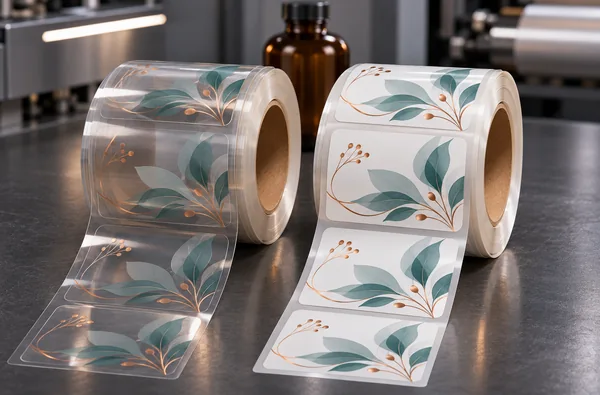
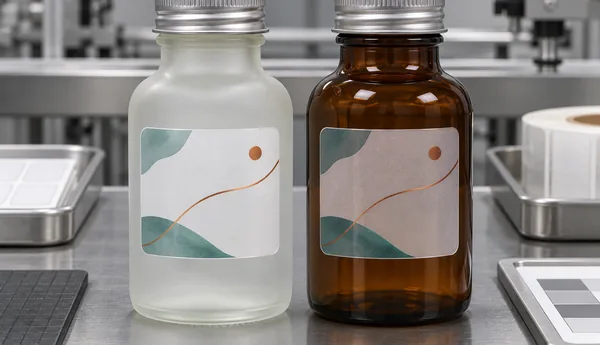
Suppose the teal graphics and small text on a clear label look sharp, but the amber bottle shows through the white behind the logo. That is a white-layer problem. A thicker clear varnish would solve a different problem: giving the logo a raised edge you can feel. Give the trial team those two requirements separately. Otherwise, an attractive sample can win the comparison without fixing the original complaint.
Nilpeter’s process guide describes the use of rotary screen alongside flexo and notes that screen can lay down thicker deposits for effects such as tactile finishes. But an opaque white does not automatically need a screen. Fujifilm’s label ink guide describes a high-opacity flexo white paired with a suitable anilox, the roller that meters ink. Treat it as an example of a flexo alternative to trial, not a promise that it will match your screen sample.
Compare the production routes on the same job
| Route | When it makes sense | What to verify |
|---|---|---|
| Flexo only | The label needs better white coverage but no raised finish, and the current press can trial a different ink or anilox. | Compare opacity on the intended container; check fine edges, overprint and cure at production speed. |
| Flexo with an inline screen station | The job benefits from a dedicated screen layer and an approved combination press or retrofit is available. | Confirm station position, curing capacity and sustained output with both processes running. |
| Flexo plus a separate roll-to-roll screen pass | You want to keep the existing flexo press and have a way to move and re-register the printed web. | Trial the actual roll, including its winding direction and marks; record second-pass setup waste and finished yield. |
The layer order matters. If the screen layer is a white base under the color, a screen-first trial may suit the artwork. If you are adding clear relief over flexo graphics, the screen pass normally comes after the graphics. Check the layer stack for the actual viewing side, especially on clear constructions, and note whether the screen ink lands on bare film, flexo ink or a coating. Those surfaces are not interchangeable when you test adhesion.
Send the supplier a production roll, not a stack of proofs
For a stand-alone screen pass, send a representative reel and identify its core, width, winding direction and printed face. Provide the lane layout, target repeat and the mark drawing. Ask the supplier to show which mark or edge the proposed configuration reads, and to measure the screen-to-flexo offset in both directions at several repeat positions. Include a restart. A single good repeat cut from the middle will not show how much web was thrown away while the operator brought the two images into register.
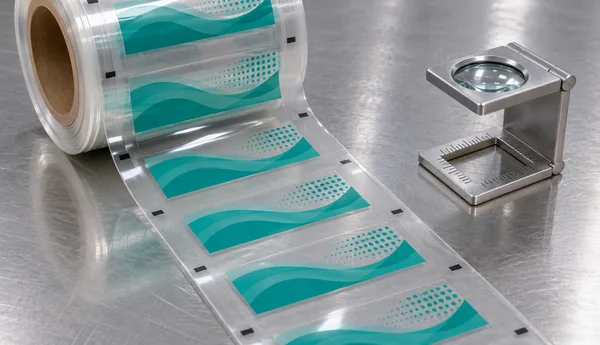
Where a single UV screen layer is enough, the Winshol WL-350D UV is an example of a separate screen press with unwind, inline UV curing and rewind. Its catalogue lists a maximum web width of 350 mm and a maximum print area of 330 × 450 mm. These are separate limits. The listing does not promise compatibility with every existing flexo mark or show a flexo station. Confirm those registration requirements on the quoted configuration. Use the registration-mark guide for the information to send with the roll.
Compare the cost of an accepted label
Judge the samples after rewinding and the planned die-cut or finish. Apply a few to the actual container. Use consistent lighting for opacity checks; if you specify an instrument reading, agree on the backing, method and measurement positions before the trial. For a tactile layer, compare the physical reference after converting and application. A thick deposit that cracks at the bottle radius is not an accepted label.
Ask both suppliers to quote against the same job size and acceptance criteria. Record setup and restart waste, tooling and ink, extra reel handling, machine time on both passes and the number of accepted labels after finishing. Divide the agreed job cost by that last count. If flexo alone passes, there is no need to add a machine for this job. If it fails, the paired trial gives you a practical basis to compare an inline station with a separate screen press.
Frequently asked questions
1. What is the difference between flexo and screen printing for labels?
Flexo transfers ink from a flexible relief plate. Screen printing pushes ink through openings in a screen and can lay down a thicker deposit for selected layers such as tactile varnish.
2. Does an opaque white on clear film always need screen printing?
No. Trial a suitable high-opacity flexo white and anilox first if your press can run them. Check coverage and detail on the intended container before committing to a screen station.
3. Can a separate roll-to-roll screen press print over a flexo reel?
It can if the reel fits, the proposed press can register to the existing image, and the screen ink adheres to the flexo ink or coating. Verify those conditions on the actual production reel.
4. Should flexo or screen printing come first?
Use the layer stack to decide. White beneath the graphics may require a screen-first route; a raised clear finish over flexo graphics usually goes on later. Confirm the viewing side on clear film.
5. What is the main trade-off between inline and offline screen printing?
Inline production avoids a separate rewind and reload between the two print steps, but it requires a compatible station and curing setup. Offline production keeps the presses separate and adds a new register setup and roll handling.
6. What should I send for a second-pass trial?
Send a representative roll, the artwork and layer order, its winding direction and core details, and the repeat and register-mark drawing. Specify the acceptable offset and the finished-label checks.
7. Is the Winshol WL-350D UV a combination flexo and screen press?
No. The listed WL-350D UV is a single-station roll-to-roll screen press with inline UV curing. Evaluate it as a separate screen pass and confirm registration on your preprinted web.
8. How should I compare the cost of the two routes?
Use the same job size and acceptance criteria. Include setup loss, tooling, ink, machine time and handling, then divide by the number of accepted labels after converting.