





What Is a Roll-to-Roll Screen Printing Machine? 5 Checks Before You Buy
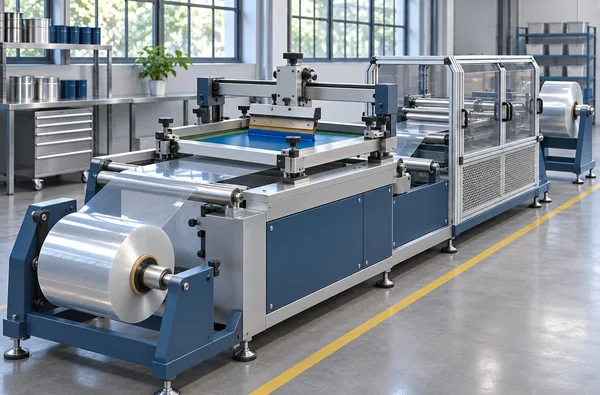
A roll-to-roll screen printing machine prints on flexible material supplied on a roll. It unwinds the material, advances it through one or more printing stations, dries or cures the ink as required, and rewinds the printed material. The material running through the machine is called the web. Label converters use this setup when both the incoming stock and the printed output need to stay in roll form.
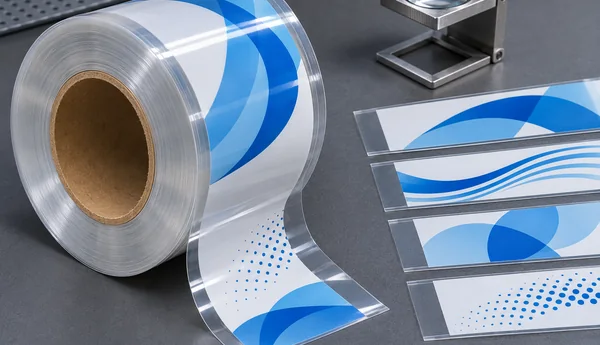
Before you buy, follow one job through the whole line. Can the machine print your stock and artwork, cure the ink, and deliver a reel your next machine can use? For the example below, assume a converter needs to add one opaque white layer to a preprinted clear label roll, then send the reel to a separate die cutter. It is a hypothetical job, not a Winshol trial result.
How the machine works
Unwind → guide and feed → screen print → dry or cure → rewind.
At the print station, a squeegee pushes ink through open areas of the screen to form the image. The quoted line may combine several print and curing stations, depending on the number and sequence of layers. Rewinding preserves the roll format for storage or the next operation; it does not automatically mean the line also die-cuts or slits the labels.
Roll-to-roll is not another name for rotary screen printing. Roll-to-roll describes how the material is supplied and collected. Flatbed and rotary describe the printing mechanism: a flat screen held in a frame versus a cylindrical screen that rotates with an internal squeegee. Both can take roll-fed material. Spartanics’ flatbed equipment is one example; the PRINTING United glossary describes the rotary mechanism. A turning unwind or rewind roller does not make a machine a rotary screen press.
1. Can the machine handle your actual material and roll?
Start with the stock specification and a sample roll. Include the material, thickness, liner if applicable, surface treatment, web width, core size, roll diameter and weight. Tell the supplier which side to print and which side must face out on the finished roll. A width specification tells you whether the stock fits the quoted limit, not whether it will track correctly or accept the ink.
For the clear-label job, load the preprinted film with its actual liner and mark the print side on the reel. Watch the edges during feeding and check for wrinkles at rewind. Get the required core and wind direction from the die cutter’s operator before requesting the quote.
2. Do the artwork and repeat fit the quoted machine?
Put your full production layout on the drawing. Show the image across the web, the repeat measured in the direction of travel, the number of lanes and any registration marks. Ask the supplier to check the drawing against three different limits:
| Quoted dimension | What to compare it with |
|---|---|
| Maximum web width | Full stock width, including the liner and unused edges |
| Maximum print area | The image layout within one print cycle, including any marks printed in that cycle |
| Maximum feed length | The proposed material advance per cycle; confirm it with the repeat layout |
The Winshol WL-350D UV configuration illustrates why the numbers matter: it lists a 350 mm maximum web width, a 330 × 450 mm maximum print area, and a 450 mm maximum feed length. Suppose the clear-label stock is 340 mm wide and the repeat is 430 mm long. Both figures are below their respective published limits, but a 340 mm-wide artwork layout still exceeds the listed print width of 330 mm. Narrowing the layout could bring it within the print area; confirm the margins and registration marks on the revised drawing. The separate 550 × 700 mm screen-frame size is not the printable area.
3. Will the print line up with what comes before and after it?
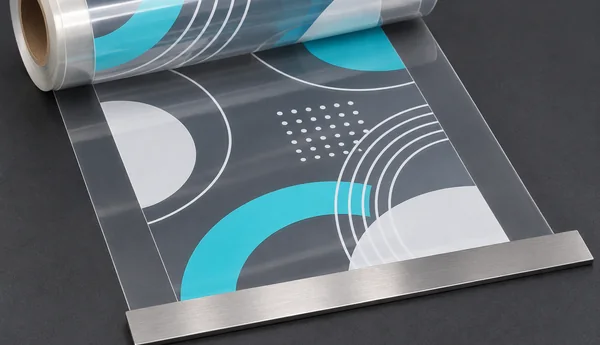
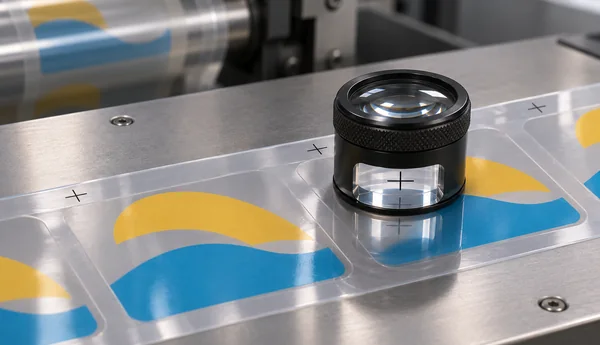
Specify what has to align: color to color, a screen-printed layer to preprinted artwork, or the print to a later cut. Put the relevant marks and tolerances on the drawing. A supplier may be able to demonstrate one type of alignment without proving another.
On this preprinted roll, the new white layer must line up with the existing artwork. Check that alignment on the actual stock, not on a blank roll with an easier target. If both layers need to be screen-printed inline, the Winshol WL-350S is an example of a quoted configuration with two separately controlled print heads and two UV units. The station count is a starting point, not a registration guarantee. Ask for measurements across a trial roll and after a stop and restart, especially if restart waste matters to the order. For print-to-cut, agree whether acceptance will be checked on the press or after cutting on the actual downstream equipment.
4. Does the drying or curing setup match the ink and stock?
Specify the ink system before choosing the dryer. Send the ink supplier’s technical data sheet, the substrate and the intended layer sequence. If the configuration uses UV curing, ask the machine supplier to match the curing setup to the ink requirements. If the ink needs heated drying, confirm that the stock can tolerate the required conditions without distortion. A UV unit and a hot-air oven are not interchangeable specifications.
In the trial, agree on an appropriate acceptance check for the application. For the white layer, check opacity against the agreed sample as well as adhesion. After rewinding, look for ink transfer to the adjacent wrap. Specify when to inspect the roll. A clean-looking strip straight off the press is not enough if the job must pass inspection after rewinding or further converting.
5. How many acceptable labels can the line produce in a measured run?
Ask each bidder for the same trial record: material used, elapsed time, setup waste, rejected pieces and accepted output. Define whether the count is printed labels on the web or finished, usable labels after converting. Do not compare one supplier’s maximum cycles per minute with another supplier’s accepted labels per hour.
In the same example, suppose a 30-minute trial produces 4,000 printed labels but only 3,600 meet the agreed print-stage criteria. The measured result is 3,600 acceptable labels in 30 minutes for that run. It is not a guarantee of 7,200 per hour across a shift. Setup, roll changes and downstream work may not be represented in half an hour. The Winshol guide to roll-to-roll output explains how to make these comparisons on the same basis.
What to send with your RFQ
Send one representative roll, a dimensioned production drawing, the ink data sheet, the planned order size, the alignment and quality requirements, and the specifications for the reel your next process needs. Ask the supplier to return a matching configuration, a list of what is included and a proposed trial with clear pass criteria. If a job does not fit the quoted print window or the supplier cannot demonstrate the required ink and stock combination, resolve that before comparing prices.
If you are considering a Winshol configuration, use the screen printing machine RFQ checklist to organize those details. Include the job you are least willing to compromise on, not just the smallest or easiest sample.
Frequently asked questions
1. Does a roll-to-roll screen printing machine need a circular screen?
No. A roll-fed machine can use a flat screen in a frame or a cylindrical rotary screen. Ask for the print-head mechanism separately from the unwind and rewind configuration.
2. Is roll-to-roll always a better choice than sheet-fed?
No. Roll-to-roll is worth evaluating when the job enters and leaves as a web. If you need to print separate sheets or rigid parts, evaluate the sheet or part handling first rather than choosing a roll-fed machine for its rated output.
3. Can I print a design as wide as the roll?
Not necessarily. Maximum web width and maximum print width are different. Check the drawing against the print window and allow for margins and registration marks where the job requires them.
4. Why is maximum feed length different from print length?
Feed length is how far the web can advance in the proposed sequence. Print length is how much image can fit within the print window. Compare both with the repeat, including the space between images, and ask the supplier to confirm the layout.
5. What should I send if I need to print on a preprinted roll?
Send the actual preprinted stock and a drawing that marks where the new layer must land. Include registration-mark details, the allowed deviation and the inspection method. A trial on blank stock will not verify alignment to existing artwork.
6. Can a two-station machine print any two-layer job?
Not necessarily. The print heads must fit the layout, and the sequence must support the specified inks, curing and registration requirements. Confirm whether the first layer needs to be cured before the second is applied.
7. Does rewind direction matter when buying a printing line?
Yes, if the next machine or customer requires a specific feed direction or printed side facing in or out. Put the desired reel orientation on the drawing and ask for a trial roll in the same format.
8. What is a useful factory acceptance test for this equipment?
Use the same stock, artwork and ink specified in the purchase. Agree beforehand on the run length, registration tolerances, drying or curing checks, rewind condition and accepted-output count. Keep representative samples and record which finishing steps were included.