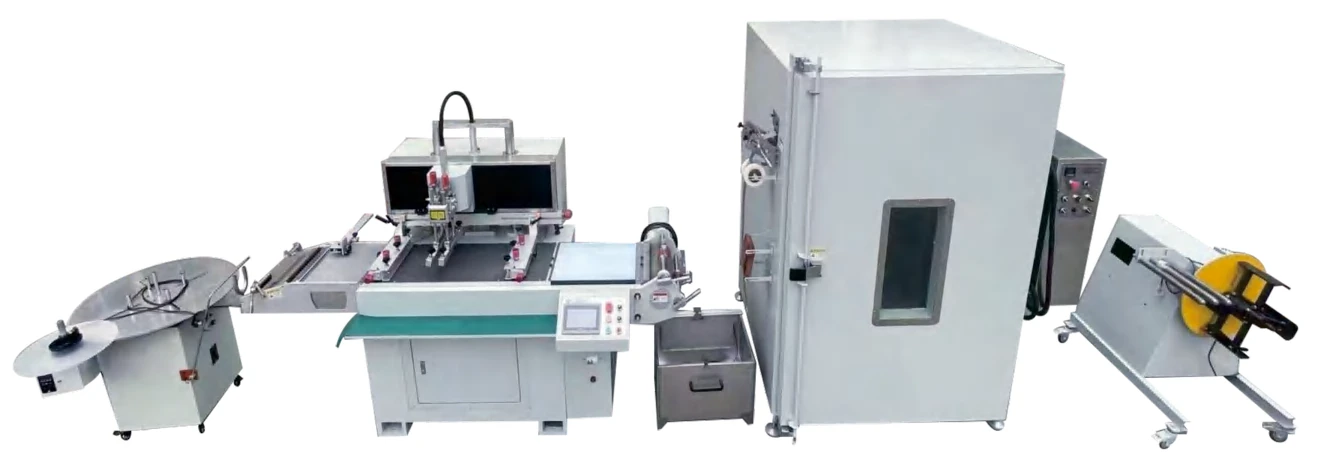
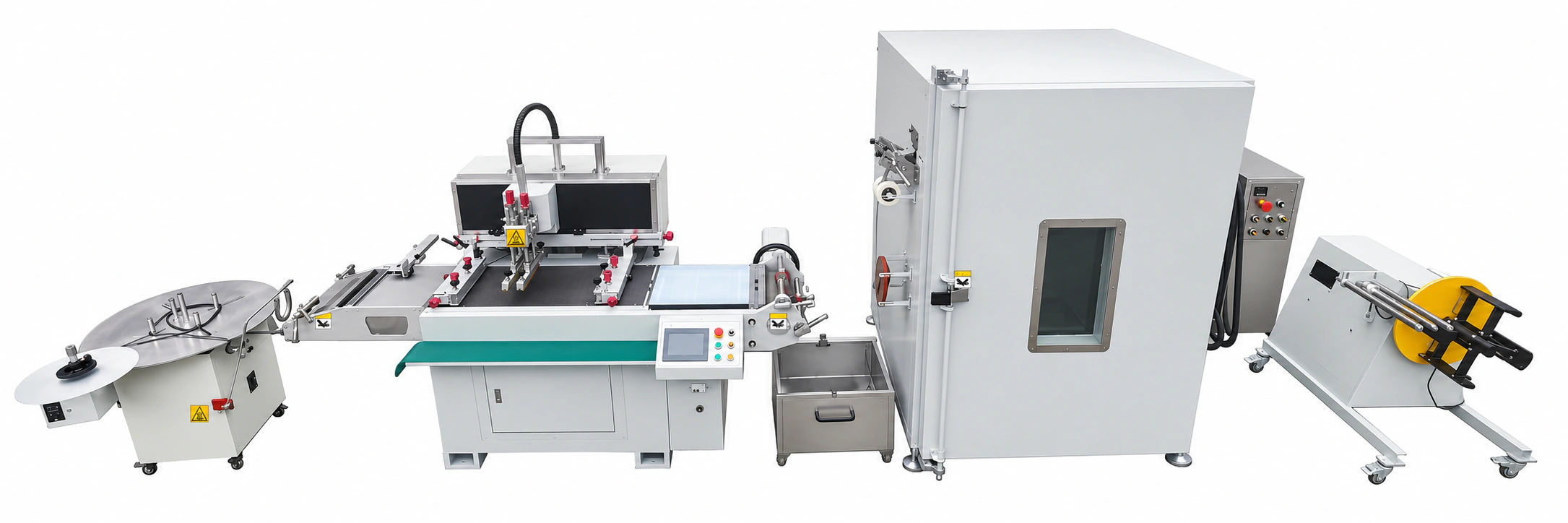
The WL-350D Steel Plate Screen Printing Machine is listed in the catalogue as a right-feed, single-color configuration with oven drying. The application heading identifies electronic-label printing. Use this exact catalogue designation when requesting equipment. The term “steel plate” needs engineering clarification and should not be treated as confirmation that the substrate is steel; the listed equipment includes unwinding and web feeding.
The maximum print area is 330 × 450 mm, with a 350 mm maximum web width, a 450 mm maximum feed length and a 550 × 700 mm screen frame. Submit the artwork and material samples to confirm the usable printing format and required setup.
Two squeegees, two ink-return blades and one tooling box.
This equipment list distinguishes the configuration from the standard WL-350D oven arrangement. Review how the intended material travels through the drying stage and confirm the oven specification in the final quotation.
Confirm the printing setup using samples
Provide the substrate, thickness, artwork and ink information for a sample review. Confirm the required tooling, feeding method, adhesion and drying conditions before selecting the configuration. Assess registration and practical output using the actual print coverage and repeat.
Plan the installation
The main machine measures 2500 × 1100 × 1700 mm and has a listed 380 V supply. Request a complete line layout, oven electrical requirements and operating clearances.
Job-specific materials for the catalogue-listed steel plate screen printing configuration. Submit samples to confirm the substrate, thickness, tooling and oven compatibility before ordering.
Typical applications
Electronic-label printing
Single-color jobs requiring the catalogue-listed steel plate configuration
Processes using a spring-type material-conveying oven
Technical specifications
Model
WL-350D
Configuration
Steel plate, right-feed, single-color
Drying equipment
Spring-type material-conveying oven
Screen frame size
550 × 700 mm
Maximum print area
330 × 450 mm
Maximum web width
350 mm
Maximum feed length
450 mm
Main machine dimensions (L × W × H)
2500 × 1100 × 1700 mm
Net weight
1300 kg
Gross weight
1800 kg
Main machine power supply
380 V
Squeegee servo motor power
0.75 kW
Material-feed servo motor power
1.3 kW
Vacuum motor power
0.37 kW
Product questions
Frequently Asked Questions
1.Which WL-350D configuration is described here?
This is the catalogue-listed WL-350D Steel Plate Screen Printing Machine, specified as right-feed, single-color and oven-equipped. Its equipment list includes a spring-type material-conveying oven. Identify this version explicitly when requesting a quotation.
2.What printing size does this configuration support?
The listed maximum print area is 330 × 450 mm, with a 350 mm maximum web width and a 450 mm maximum feed length. The screen frame size is 550 × 700 mm. Confirm the job layout and tooling with the intended material samples.
3.Which equipment and drying arrangement are included?
The catalogue lists one unwinding unit, one main machine, one material-feeding section and one spring-type material-conveying oven. It also lists two squeegees, two ink-return blades and one tooling box. Agree on the detailed oven and line configuration in the quotation.
4.Does the product name specify an approved steel thickness or tooling method?
The catalogue uses the name Steel Plate Screen Printing Machine but does not provide an approved steel thickness range or a detailed tooling method. Submit the material and application requirements so the correct printing setup, feeding method and tooling can be confirmed.
5.What installation dimensions and power supply are listed?
The main machine dimensions are 2500 × 1100 × 1700 mm, with a 380 V main machine supply, 1300 kg net weight and 1800 kg gross weight. Obtain the complete line drawing and electrical schedule to account for the conveying oven, material access and maintenance space.
6.How can I confirm suitability and production output?
Send the substrate and thickness, artwork, print area and repeat, ink specification, required registration and target output. A sample trial should confirm the printing setup, adhesion, drying and material handling. Agree on the practical production rate for that tested job.