

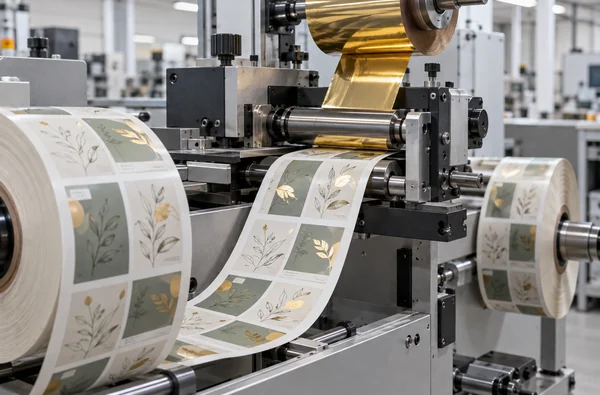
Combining Screen Printing and Cold Foil for Labels
For this job: For a label that combines screen printing and cold foil, specify the printed image, foil area, materials and process order as one job. Then decide whether you need a combined screen-printing and foil line or a foil-finishing unit that connects to an existing printer. The equipment roles differ. A machine name or a metallic sample alone does not establish foil transfer, registration or material compatibility for your artwork.
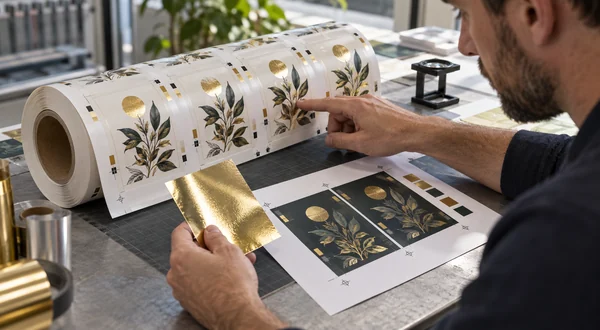
Put the desired label on the table
Send the final artwork with the foil areas marked separately from screen colors. Identify solid coverage, fine lines and any places where metallic detail must align with earlier print or a die-cut edge. Include the print repeat and the direction the web will travel. A small decorative mark and a broad foil block can place very different demands on the proposed setup; the same nominal web width tells little about either job.
Use the production substrate, adhesive or coating and intended foil for the sample review where possible. If the foil and adhesive have not been selected, say so in the request. Ask the supplier to document the consumables used in any demonstration sample so the result can be repeated and evaluated with the finished label.
Decide what the new equipment must actually do
If the factory already has a screen printer and needs a separate foil stage, the integration questions are feed direction, web path, registration reference, curing or drying and rewinding. A combined line has a different scope: the quotation must show every print and foil station and their order. Draw the current machines and the proposed addition on one page. This reveals whether the project is an inline line, an offline finishing step or a completely new workflow.
| Published example | Equipment role | Question for the quotation |
|---|---|---|
| WL-350DW | Roll-to-roll screen printing with automatic registration and vertical cold foil; listed two-lamp UV curing, 350 mm maximum web width and 330 × 450 mm maximum print area. | Which printing, foil and curing steps are included for this particular label? |
| WL-350-LTJ | Horizontal cold-foil finishing equipment for webs up to 350 mm wide. | How will the unit connect to existing printing and material handling? Do not count it as a screen-printing station. |
| WL-500TB-LTJ | Intermittent cold-foil configuration with mark tracking for webs up to 500 mm wide. | How does the proposed artwork, repeat and mark layout affect foil use on a trial run? |
The cold-foil equipment family contains other configurations. The three examples above illustrate roles, not a ranking of quality or output. If WL-350DW is on the shortlist, compare its print-plus-foil path with the single-color WL-350D UV and two-color WL-350S in the WL-350 model comparison.
Registration and foil use need artwork-specific evidence
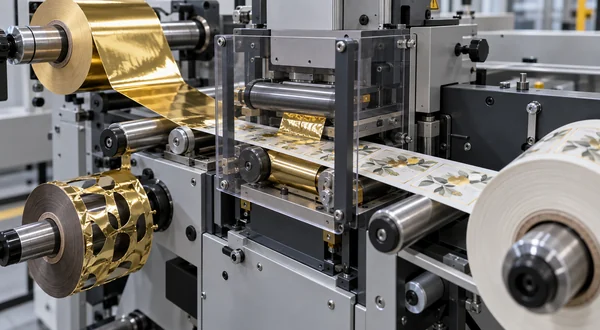
Mark the feature that the foil must align to and how you will inspect it. Is the critical point a thin border around text, a logo over earlier print or a broad metallic field? Supply real preprinted material if the proposed foil stage follows an existing printer. Registration should be assessed after the foil step and after conversion if die cutting can change the relevant appearance.
An intermittent foil machine may reduce unused foil for a suitable repeat, but there is no fixed saving percentage in the published model data. For an honest comparison, ask for a trial record showing the foil width and length loaded, accepted labels produced and foil remaining or discarded. Compare that with your current method using the same artwork and run length. The calculation will be yours, grounded in measured material use.
Use a sample trial to define acceptance
- Supply production label stock, artwork with foil and print layers separated, any preprint, intended foil and adhesive information.
- Agree the sequence of screen printing, adhesive application, foil transfer, curing or drying, inspection and rewinding for the proposed configuration.
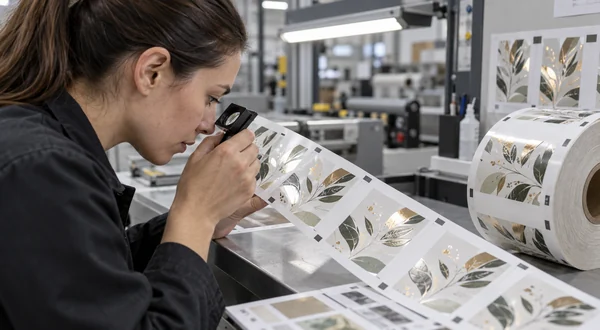
- Check the finished sample for the requested appearance, edge definition, transfer coverage, adhesion and alignment at named points.
- Run the sample through the next real converting step, such as die cutting or application, when that step can expose a problem.
- Record the exact consumables and machine modules used for the accepted sample in the final supply discussion.
If a sample fails, describe the defect rather than simply asking for “better foil quality.” Missing transfer, rough edges, poor alignment and damage after rewinding are different problems. Each points to a different part of the material, artwork or process review.
Compare an inline line with a finishing unit
Suppose a converter already prints two colors and needs a metallic logo. A finishing-unit proposal should explain where the existing printer’s output roll enters the foil process, how marks will be read, and how the finished roll returns to inspection or die cutting. A combined-line proposal should show the color stations and foil station in order, with the curing or drying equipment between them where the proposed consumables require it. Both proposals may be reasonable, but their scope and integration work are different.
Ask for a drawing with the web path, maximum material width and all included modules. Note where operators load foil, remove waste and inspect the label. Then compare the accepted sample and the installed line, not only the metallic appearance of a demonstration print. If the plant has space or utility limits, include them before asking for a final price.
Give artwork feedback the supplier can use
On the trial sheet, mark any area with incomplete transfer, rough edges or visible misalignment. Identify the location along and across the web. Keep the source artwork version with the sample; a small change to a foil line or repeat can make two trial results impossible to compare. If the metallic detail is part of a brand standard, provide a physical accepted reference rather than a screen image whose color depends on the display.
Questions worth asking before you buy
1. Does the WL-350-LTJ print a screen color?
Its published role is horizontal cold-foil finishing. Do not assume a screen-printing station is included. Specify the existing printer or request a combined line if printing must be part of the supply.
2. Will an intermittent foil unit always save a fixed percentage of foil?
No fixed saving is supported by the published WL-500TB-LTJ data. The result depends on artwork, repeat, foil width and the operating method. Measure it on your job.
3. What matters beyond the metallic look of a first sample?
Check transfer consistency, registration and adhesion after the label is rewound and converted. Keep the approved sample and its setup record for the purchase specification.
4. Should screen printing and cold foil be quoted as one line?
If both operations are part of the purchase, ask for a drawing from unwind to rewind that shows the print, cure, foil and inspection stages. If a printer already exists, provide its web path and output-roll details so the foil unit can be evaluated as a separate connection.
5. What artwork should accompany a cold-foil sample request?
Provide the foil mask as a separate artwork layer, with repeat length, foil coverage, image position and any registration marks. Send the material and the upstream printed sample as well. A metallic mock-up alone does not define how the foil must register on the production web.
6. How can I compare foil consumption between two setups?
Run the same artwork, foil width and roll length under recorded settings, then measure foil used and accepted labels produced. Include start-up and changeover waste if those matter to your costing. A percentage quoted without the job conditions is not a reliable comparison.
7. What belongs in the acceptance check after foiling?
Inspect image coverage, edge definition, registration and transfer on labels sampled across the roll. Check adhesion and appearance after the downstream conversion step, not only at the foil station. Keep the approved sample and record the material, foil and operating setup used.
Use the machine RFQ checklist to send the rest of the line details, or contact Winshol with the artwork and material.
Machine roles and dimensions follow the linked Winshol pages and supplied catalogue. Consumable compatibility, foil use and accepted output require an application-specific review.
