

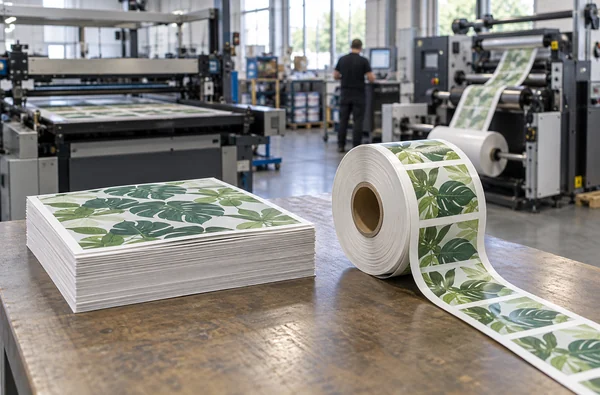
Sheet-Fed vs Roll-to-Roll Screen Printing
In brief: The deciding question in sheet-fed versus roll-to-roll screen printing is how the production material enters and leaves the process. A continuous web needs unwinding, web control and usually rewinding or inline conversion. Individual sheets need reliable loading, positioning and collection. Compare the entire route from incoming material to accepted printed part. Maximum print area alone cannot tell you which format is suitable.
Draw the material path on one page
Before looking at equipment, sketch where material comes from, what happens before the screen print and what must happen afterward. A label stock already supplied on rolls and sent to die cutting on rolls has a different handling problem from pre-cut plastic sheets that will be stacked after printing. If the same design can be bought in either format, include the cost and quality implications of changing the incoming material. A lower machine price may be irrelevant if it requires a new converting step.
Record the actual material construction. For a web, note width, thickness, roll diameter, core, direction of travel and any liner. For sheets, note both dimensions, thickness, surface finish, feed orientation and how they arrive in a stack. Include the condition of the material, not just the nominal size: curl, coating, prior print or marks may affect handling and alignment.
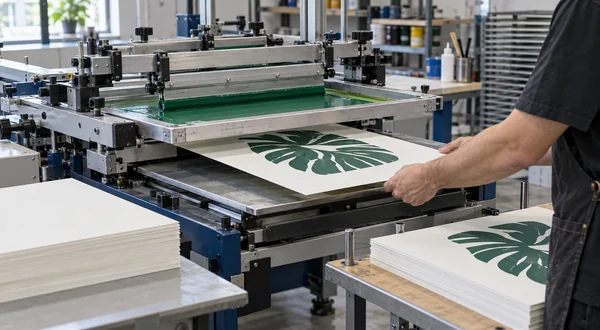
Compare the whole workflow
| Question | Roll-to-roll route | Sheet-fed route |
|---|---|---|
| Incoming material | Continuous web on a roll; confirm width, core, diameter and winding. | Individual sheets; confirm sheet dimensions, presentation and stack height. |
| Image layout | Check web width, image size, repeat length and position across the web. | Check sheet size, image size, margins and feed edge. |
| Registration reference | Identify any existing marks or printed layer and the behavior of the web between steps. | Identify sheet edges, marks or fixtures and how the sheet is positioned for the print. |
| After printing | Plan curing or drying, inspection, rewinding and the next converting machine. | Plan drying, unloading, stacking and the next sheet operation. |
| Factory layout | Allow for the complete connected material path, not only the print unit. | Allow for loading and collection access as well as any separate dryer. |
Neither format is automatically better for a named product. A label can be made through different routes depending on how stock is supplied and converted. The production path answers more than the product label does.
Use model data without making a false comparison
The WL-5070PZ is listed for individual sheets. Its published maximum print area is 500 × 700 mm, maximum material width 500 mm and maximum loading height 330 mm. The published information does not establish that a dryer is included, so any drying and collection arrangement should be confirmed separately.
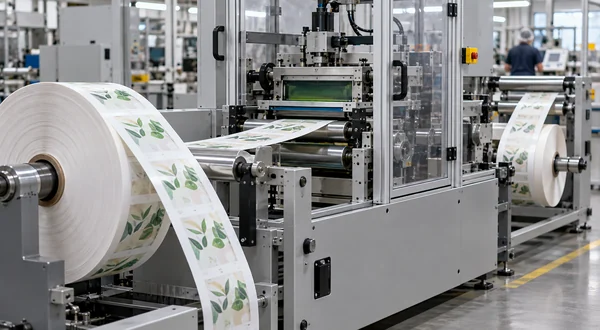
For roll-fed labels, the WL-350D UV lists one screen color, a two-lamp UV dryer, a 350 mm maximum web width and a 330 × 450 mm maximum print area. The WL-350S lists two colors and two UV drying units for the same stated maximum web width and print area. These figures show differences in format and configuration. They do not support a like-for-like claim about finished output or total project cost.
Browse the sheet-fed and roll-to-roll families only after the material path is defined. If an existing line is involved, supply its feed and discharge details so that a proposed machine can be evaluated as part of that line. For a roll-fed label job, the roll-to-roll selection guide shows what to check next: usable web width, print area, color sequence and curing.
When both formats seem possible
Prepare the same artwork and acceptance criteria for two route proposals. Ask each supplier to show how the production material will be supplied, printed, dried, inspected and delivered to the next process. For a sheet route, include the cost of cutting the material before print and handling it afterward. For a web route, include the winding and conversion steps. If a change in format alters registration or coating behavior, test the real material in the proposed form.
A practical comparison records more than a machine quote: material waste during setup, handling labor, changeovers, downstream equipment and the accepted sample. Those figures are job-specific. Request a calculation tied to your run length and production sequence instead of a generic return-on-investment number.
Follow the job after the print unit
Imagine two quotations for the same graphic. One prints a continuous web and returns a roll; the other prints individual sheets and returns a stack. If the customer ultimately needs die-cut labels on a roll, the sheet proposal must explain how printed sheets become that deliverable. If the customer needs decorated flat panels, a web proposal must explain why the material should be purchased and converted as a roll. Neither question can be answered by comparing the two print areas.
Ask each supplier to identify the first operation that is outside its quote. It may be an oven, an inspection table, a rewind unit, a sheet cutter or an additional material-handling stage. Price those missing stages before choosing a route. Also ask how rejected pieces are identified and removed; inspection of a continuous web differs from inspection of a stack, and the choice affects the rest of the production plan.
Run length matters, but there is no single break-even quantity published for these machines. A short repeat order with frequent artwork changes and a long standardized run may value changeover time, handling and material waste differently. Put your actual order pattern into the comparison.
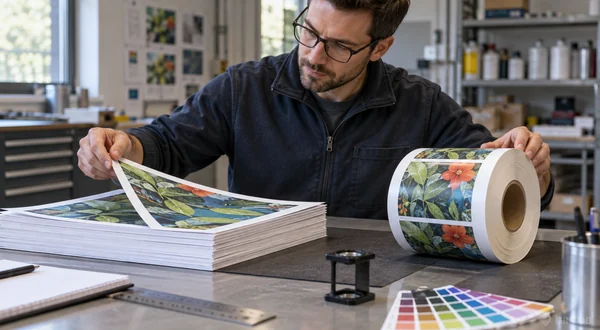
A three-part handoff to the equipment team
- Send representative rolls or sheets and a drawing with material dimensions, image size and print position.
- Describe the upstream and downstream equipment, including how material arrives and how the finished print must leave.
- Define the acceptance checks: appearance, alignment, drying and handling after the next production step.
If any of these is undecided, say so. The equipment team can then compare route options rather than quietly assuming one. The RFQ checklist has a fuller set of questions.
Common questions
1. Can I compare a sheet printer and a web printer by print area?
Print area is one limit, but the feed format, registration, drying and collection path differ. Compare the route that produces the accepted part.
2. Does a sheet-fed printer include drying?
Do not assume so from the WL-5070PZ listing. Ask for the proposed drying equipment and how sheets move to it.
3. What if I may switch from sheets to rolls later?
Tell the supplier at the start. Request separate route proposals or a written statement of what would change. A machine designed for one material format should not be treated as automatically convertible to the other.
4. Does the supplied material format decide the machine route?
It is the starting point. A job supplied as individual sheets needs feeding, registration and collection for sheets; a continuous web needs unwinding, tension control and rewinding. If both formats are commercially possible, price each complete route on the same finished-part requirement.
5. What happens to the printed material after the press?
Map the next operation before choosing the printer. Sheets may need a defined stacking and drying path, while rolls may return to a converter for slitting, die cutting or inspection. The accepted product is the piece after those steps, not merely a good image at the print station.
6. How should I compare the cost of sheet and web production?
Use the same artwork, material specification and annual job volume for both proposals. Include material yield, changeovers, drying, handling and downstream conversion in the comparison. A lower press price does not establish the lower cost per accepted part.
7. What should a trial show if either route might work?
Use representative production stock for each format and agree on the same print and finishing acceptance criteria. Record registration, drying and handling results after the next process step. Ask the supplier to identify which equipment and operators were needed to make each sample.
The model dimensions and configurations above follow the linked Winshol product pages and supplied 2026 catalogue. Confirm the exact equipment, utilities and accepted sample in the quotation.
