


Does Your Film Need Pre-Shrink Drying Before Screen Printing?
Not every film needs a pre-shrink pass. It is worth testing when the roll’s repeat length or cross-web dimensions change during the planned drying and handling sequence, and that change makes the finished print or die cut miss its agreed position. The decision should come from measurements on the production material, not from a general rule about PET, PVC or any other film family.
A pre-shrink oven treats the material before a later precision printing or converting step. It does not replace the ink dryer on the printing line. If the untreated roll already meets the dimensional and finished-part requirements, another heated pass may add work without improving the job.
What problem would a pre-shrink pass address?
Imagine a preprinted film that aligns at the first camera mark but drifts away from the required position farther along the repeat. Moving the new image to match that first mark may fix a local offset. It cannot, by itself, restore the distance between features if the web has changed length or width. Compare the incoming material, the web after its intended heat exposure and the finished part before assigning the problem to the registration system.
Material suppliers treat drying conditions as part of this question. In a screen-printing bulletin for self-adhesive sheets, Avery Dennison discusses temperature, liner moisture and print register, and recommends an unprinted pass through the press and oven for some exact-register sheet jobs. That is evidence for testing the actual material; it is not a temperature or process setting for a roll-fed line. A 3M graphic-film bulletin also lists film shrinkage among possible results of excessive drying heat. Follow the guidance for the specific stock, ink and liner in your job.
Signs that call for a material trial
Start a controlled comparison if you see one or more of these on the intended production route:
- The measured repeat changes after an oven pass, even though the incoming roll is within specification.
- Registration looks acceptable beside a mark but exceeds the finished-part tolerance farther from it.
- Die-cut or laminate references no longer line up after printing and drying.
- The web develops curl, wrinkles, edge waves or other surface changes as the heat treatment is increased.
These symptoms do not prove that pre-shrink drying is the answer. Web tension, winding, guiding, mark quality, artwork dimensions and ink drying can also affect the result. Check the material’s actual dimensions before choosing a correction. If the web remains stable while the whole image shifts by a similar amount, review the positioning setup first. If distances between marks or features change, investigate the material and process conditions.
Measure the web before deciding
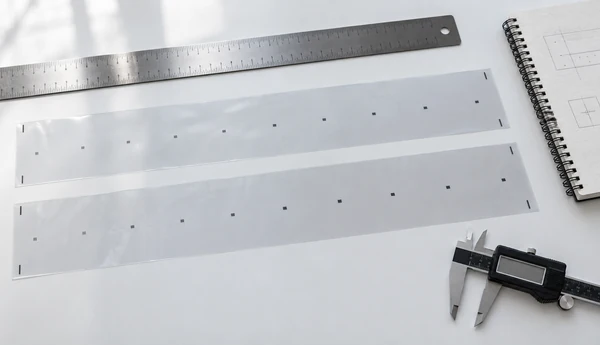
Mark a representative sample of the production roll so the same distances can be measured at each stage. Include a length along the feed direction and at least one distance across the web. If the job has multiple lanes, measure near both edges and the center rather than relying on one label. Record the measurement method and the tension applied while measuring; a loose film and a stretched film will not give a fair comparison.
| Stage | What to record |
|---|---|
| Incoming roll | Material and liner, lot, thickness, web width, marked repeat and cross-web distances |
| After an unprinted trial pass | Actual heat and web-handling settings, dimensions after cooling, and any curl or surface damage |
| After the proposed print and drying sequence | Dimensions, mark-to-image error and die-cut reference at the finished-part inspection points |
| After rewinding or the agreed waiting period | Whether the dimensions and finished registration remain acceptable when the job is handled as it will be in production |
Use the same reference marks and measuring conditions for the untreated control and the treated sample. For example, a marked 500.0 mm length that measures 499.2 mm after a trial pass has changed by 0.8 mm, or 0.16%, under those test conditions. That example is arithmetic, not an acceptable-shrinkage limit for any film. Judge the measured change against the customer’s print, cut and application tolerances.
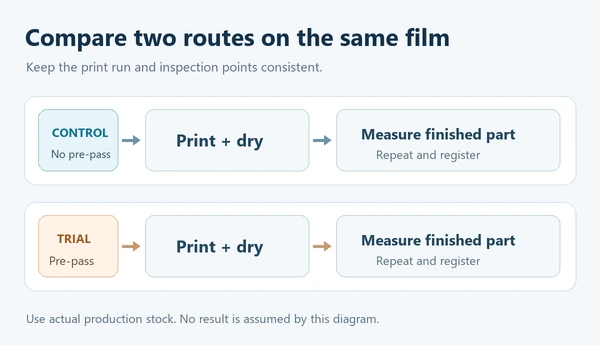
Compare two routes on the same production stock
Run an untreated control and a trial with a proposed pre-shrink pass. Keep the later print sequence, ink, registration method and inspection points the same where practical. Record the treatment’s temperature profile, web speed, tension, number of passes and cooling or conditioning time. Ask the film and ink suppliers whether the proposed exposure stays within their material and processing guidance.
Inspect more than the first printed label. Compare samples from the start and steady portion of the run, then measure at the points where the finished job will be accepted. A useful result is a repeatable reduction in dimensional change, with a finished print that also meets the agreed register, surface and ink-performance requirements. If the extra pass creates curl, liner damage or inconsistent winding, it has not solved the job simply because one distance became more stable.
If both routes miss the tolerance, separate the causes before adding equipment. Review web tension and guiding, the camera’s reference mark, the dryer setting and the compatibility of the stock and ink. Our CCD registration-mark guide covers the artwork and sample information needed to test visual alignment. The UV versus hot-air guide covers the ink and dryer decision.
Match any proposed oven to the full line
Winshol lists the WL-500-YSS-KX pre-shrink drying oven for film-processing work. Its published specifications include a 500 mm maximum web width, four heating zones and 60 m of material storage length. The 60 m figure describes material held in the arrangement; it is not a promised exposure time or the machine’s floor length. The catalogue does not provide a reliable working-temperature figure for a process recommendation. Confirm the operating range, material path, speed and installation drawing for the quoted configuration.
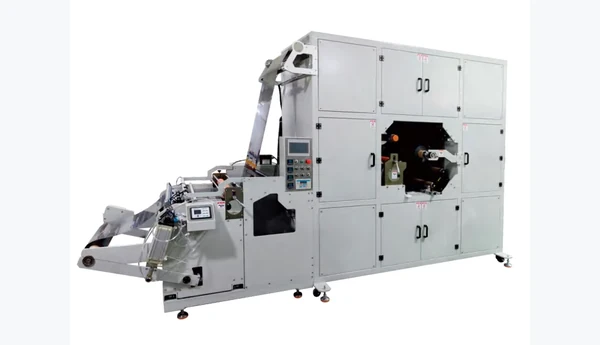
The width check belongs to the whole proposed line. For example, the WL-5080CCD-Y screen printer lists a 520 mm maximum web width and CCD visual registration with hot-air drying. That printer’s 520 mm rating does not make a 520 mm roll fit a separate oven listed for 500 mm. Show the actual roll width and routing in a line drawing before combining machines. The two models also serve different stages: preconditioning the web and registering a new print are separate decisions.
What to send for a useful recommendation
Send the equipment team the actual film and liner specification, roll width and thickness, plus samples from the intended lot. Include a dimensioned drawing with feed direction, repeat, lane positions, existing marks and the finished-part points where print or cut alignment will be judged. State the allowed dimensional change or positional tolerance if the customer has defined one.
Add the full sequence: any existing print, proposed pre-shrink pass, new screen-print layer, ink and dryer, rewind, lamination and die cutting. Report where the drift first appears and attach measurements from both untreated and treated samples. The team can then quote a material trial and a line layout around the actual problem instead of assuming that every film needs an oven.
Common questions
1. Does every PET or other plastic film need pre-shrink drying?
No. Film construction, liner, prior processing and the proposed heat and tension history all matter. Use the material supplier’s limits and a trial on the production stock to decide.
2. Can CCD registration correct a film that changes size after drying?
A camera can position a print relative to a visible reference. Do not assume that positioning removes a change in spacing between features across the repeat or web. Measure the finished part at more than one point.
3. Is one unprinted oven pass enough to approve the process?
No. It can reveal how the material responds, but the later print, drying, rewind and finishing steps must also meet the acceptance drawing. Compare the treated roll with an untreated control.
4. What percentage of shrinkage is acceptable?
There is no useful universal percentage for every label or film. Translate the customer’s register and die-cut limits into allowable changes at the measured points, then test the complete process against them.
5. Does 60 m of material storage specify the oven’s dwell time?
No. The WL-500-YSS-KX listing gives material storage length, not a guaranteed residence time. Confirm the actual web path and operating speed for the proposed setup.
6. Can a 520 mm web run through the WL-500-YSS-KX because the next printer accepts 520 mm?
The oven is listed for a maximum web width of 500 mm. A wider roll needs a different confirmed material path or a narrower production web; the downstream printer’s rating cannot expand the oven’s limit.
7. If pre-shrink treatment improves registration, is the machine choice settled?
Check that the improvement repeats across the roll and that the film, liner, ink and finished label remain acceptable. Then review the proposed line’s width, routing, power and installation requirements with the equipment team.
If you have a film sample and measured register drift, send both through Winshol’s contact page and ask for a controlled material trial.
