

How to Estimate Roll-to-Roll Screen Printing Output: Good Labels per Hour
To estimate good labels per hour, start with the web length the line actually advances at an approved print setting. Divide that length by the label repeat, count the labels in each repeat, then allow for time when the line is stopped and labels rejected at inspection. The result is an estimate for a specified job. A catalogue speed, on its own, cannot tell you how many finished labels will pass inspection.
This matters when comparing a new screen printing line with a delivery schedule. A narrow, single-lane label and a two-lane job may travel through the same machine at the same web speed and produce different counts. UV curing, registration and finishing can change the speed that is usable on the customer’s stock. Get the artwork and material in front of the equipment team before asking for an hourly figure.
Decide what you are counting
“Output” can mean printed web, printed images, die-cut labels or packed rolls. Pick one before doing the arithmetic. If the proposed machine prints a continuous roll and die cutting happens elsewhere, the press trial can measure acceptable printed images. It cannot yet prove the number of finished labels after converting.
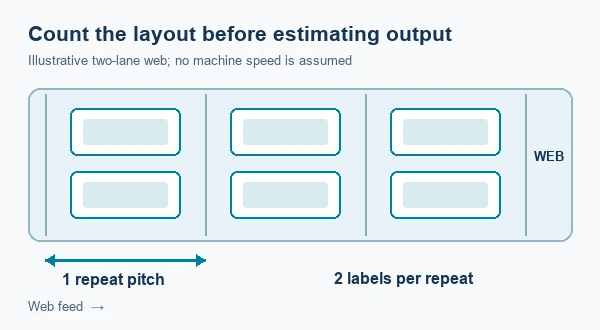
The layout gives you the count per repeat. A 125 mm repeat with two acceptable label images across the web has two labels per repeat. Extra artwork, registration marks and waste matrix do not become saleable labels. If one image will be rejected at the required edge or cut position, do not count it simply because it fits on the drawing. Our web width versus print area guide explains why a roll that fits through a machine may still be too wide for the proposed print layout.
For a multi-layer job, count the finished label once, after all required passes and inspection. Adding the impressions from each color would overstate the number of labels shipped.
Calculate a first estimate
Use the effective web advance measured over complete operating cycles at the approved job setting. For an intermittent machine, the instantaneous speed during a feed stroke is not the same as the average advance across printing, dwell and feeding. Measure the length advanced during a representative steady-running period and divide it by that period’s minutes.
Good labels per clock hour = (effective web advance in m/min × 1,000 ÷ repeat pitch in mm) × saleable labels per repeat × 60 × running fraction × accepted fraction.
| Input | Record it this way |
|---|---|
| Effective web advance | Metres advanced divided by minutes at the approved running setting; include the machine’s normal cycle pauses. |
| Repeat pitch | Distance along the feed direction from one repeated image position to the next, taken from the approved layout. |
| Saleable labels per repeat | Count the images that will meet print and finishing requirements across every lane. |
| Running fraction | Minutes spent at the approved production setting divided by total clock minutes in the period being estimated. |
| Accepted fraction | Accepted labels divided by all labels produced in the same period, checked at the agreed inspection stage. |
Keep the two time measures separate. Normal programmed dwell belongs in the effective web advance. Stops for roll changes, adjustments and faults belong in the running fraction. Counting the same pause in both places would make the estimate too low.
A worked example, not a machine rating
Suppose a trial measures 10 m/min of effective web advance at a setting that passes the job’s print and cure checks. The approved artwork has a 125 mm repeat and two acceptable labels per repeat. During the clock hour, the line runs at that setting for 45 minutes; 96% of the labels pass the agreed final check.
- Repeats per running minute: 10,000 ÷ 125 = 80.
- Labels per running minute: 80 × 2 = 160.
- Gross labels per running hour: 160 × 60 = 9,600.
- Estimated accepted labels per clock hour: 9,600 × (45 ÷ 60) × 0.96 = 6,912.
Every number in this example is hypothetical. In particular, 10 m/min is not a Winshol model specification or a promised speed. If the 96% figure was measured only at the printer but the buyer needs die-cut labels, use a finishing-stage acceptance figure instead.
Find the speed the job can actually hold
The fastest motion a machine can make may not be a useful production setting. On the actual label stock, increase the setting only while the required image, registration and ink condition continue to pass. A web that prints cleanly but arrives at rewinding with uncured ink has not passed the job. Neither has a cured image that drifts outside the die-cut reference. For its own screen-printed graphic films, 3M’s production bulletin describes abrasion and tape-adhesion checks after curing. Use the test method specified for your actual ink and stock; the bulletin does not set a universal speed for other materials.
Screen printing lines differ in how they feed the web and dry the ink. UV and hot-air routes have different checks; the choice depends on the ink, substrate and full process. The UV versus hot-air guide sets out the selection questions. Use the ink and material suppliers’ instructions for the actual combination, and agree on a finished-sample test before setting a speed.
The other equipment matters too. A printer, oven, cold-foil unit and downstream finisher should be assessed as one proposed route. If a later stage needs a slower web, the faster rating of an earlier stage will not set finished-label output. Confirm web width, material path and the actual configuration on a line drawing. The roll-to-roll machine selection guide covers those first checks.
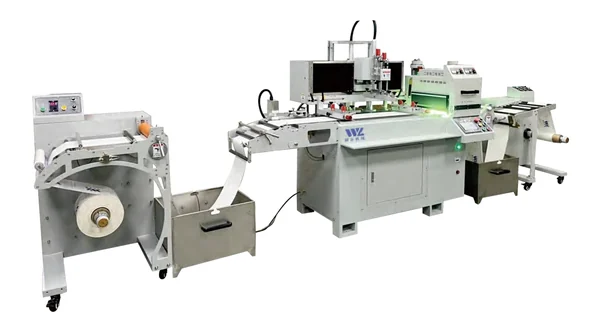
Winshol’s WL-350D UV roll-to-roll screen printer page identifies a single-color UV configuration, a maximum web width of 350 mm and a maximum print area of 330 × 450 mm. These dimensions help screen the artwork. They do not establish good labels per hour for a particular material and repeat. Ask for a job-specific trial instead of converting a motor-speed entry into finished output.
Measure a sample run without hiding the losses
Bring production stock from the intended material construction and a dimensioned artwork file. Include the repeat, lanes, print area, required color or ink deposit, registration marks, finishing route and acceptance limits. A sample made with a different liner or a simplified image may be useful for setup, but it is a poor basis for a delivery promise.
Before the run, agree on what counts as an accepted label. Check the start, a steady section and the end of the sample. Keep rejected strips with the reason for rejection. Count setup waste separately from steady-running waste; a short job can spend a large share of its clock time in setup, while a long run may be dominated by stable production.
| Trial record | Why it belongs in the output calculation |
|---|---|
| Material, liner and roll width | Confirms that the tested web is the one the buyer will use. |
| Artwork version, repeat and lanes | Fixes the number of potential labels in each web repeat. |
| Ink, dryer and required finishing stages | Identifies the full route whose output is being estimated. |
| Web length and timed steady-running interval | Gives the effective advance, including normal cycle pauses. |
| Clock time, running time and stop reasons | Separates programmed motion from roll changes and troubleshooting. |
| Accepted and rejected counts at the agreed stage | Supplies the good-label fraction and shows where losses occur. |
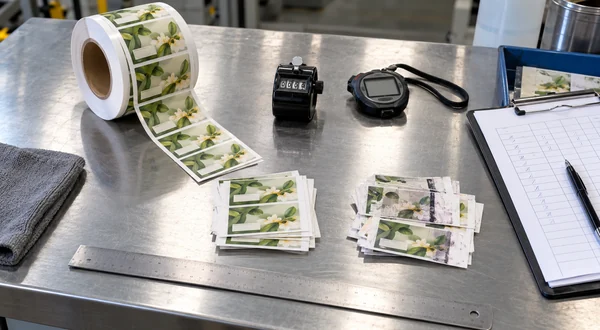
The resource center’s sample-trial checklist gives a short sequence for recording materials, settings and finished samples. If the trial is only a few metres, report the observed run separately from the longer-shift estimate. A brief smooth interval can establish that the image is printable; it cannot reveal the frequency of roll changes or cleaning over a full shift.
Turn the result into a quote that can be checked
Ask the supplier to show three numbers for the proposed job: accepted images during the measured steady run, an estimate per clock hour using stated running and acceptance fractions, and the stage at which acceptance was checked. Include the sample length and run duration. That makes two quotations easier to compare than a single “maximum speed” value.
For planning a shift, multiply the accepted labels per clock hour by the available production hours only after accounting for planned setup and changeovers. If the customer needs 40,000 finished labels, compare that requirement with finished-stage yield and the realistic time available on the line. Do not use printed-web output as a substitute for packed-label output.
Send the material, artwork, planned order size, pass criteria and existing upstream or downstream equipment with the inquiry. The screen printing machine RFQ checklist covers the wider equipment brief. For an output estimate, the most useful addition is a timed trial record with accepted and rejected counts. It leaves less room for a speed figure to be mistaken for a shipping promise.
Common questions
1. Can I calculate good labels per hour from a catalogue’s maximum speed?
Only a rough upper bound for a defined layout. A maximum figure does not establish the speed at which this stock, ink, registration and finishing sequence pass inspection. Measure effective web advance at an approved setting and record the losses.
2. How do I convert metres per minute into labels per hour?
Multiply metres per minute by 1,000, divide by the repeat pitch in millimetres, then multiply by saleable labels per repeat and 60. Apply the measured running and accepted fractions to estimate good labels per clock hour.
3. Does a two-lane layout always double output?
It doubles the potential count per repeat if both lanes fit the usable print and finishing area and both pass inspection. Edge clearance, registration and cutting can make one proposed lane unusable. Check the actual layout and samples.
4. What speed should I use for an intermittent screen printer?
Use web length advanced divided by elapsed minutes during a representative steady-running interval. Include its normal print and dwell cycles. Do not use the brief feed-stroke or motor speed as the average web advance.
5. Should setup waste and roll changes be included?
Yes, when estimating output per clock hour or per shift. Keep them separate from steady-running speed so the buyer can see why a short order and a long order yield different hourly averages.
6. Can the printer’s output figure stand for finished labels?
Only if the quoted count is checked after every required finishing stage. A printed roll may still lose labels during die cutting, inspection or rewinding. Name the acceptance point in the quotation.
7. What if the print looks good at a faster setting but the ink fails a cure test?
That faster setting is not approved for the job. Retest within the ink and substrate suppliers’ requirements and count output at a setting that passes the agreed finished-sample checks.
8. What information should I send to get a useful output estimate?
Send production material and liner details, web width, artwork with repeat and lane layout, ink and drying route, required finishing stages, order size and written acceptance limits. Ask the supplier to record trial duration, web length, stops and good counts at the specified inspection stage.
