






Automatic Screen Printing: Sheet-Feeding and Delivery Checks Before Purchase
Before buying an automatic screen printing machine for cut sheets, test how the proposed setup separates the stock, responds to feed faults and delivers printed sheets to the next process. A good first print is not enough to judge the feeder. Use your production stock and keep a record of feed faults, damaged sheets and operator intervention. Confirm which handling equipment is included in the quotation.
This guide concerns individual sheets, not continuous webs. If you are still deciding between formats, start with the sheet-fed versus roll-to-roll comparison.
Start with the sheets that will reach the machine
Send more than a nominal size. Record thickness, stiffness, surface finish, feed orientation and the condition of the incoming stack. Include earlier printing, coatings and visible curl. A clean, flat demonstration sheet may not represent the stock arriving from your own supplier.
Where production uses several material variants, identify them separately. Ask which variants the trial covers and which still need evaluation. Do not turn a successful result on one stock into approval for the whole purchasing specification.
Confirm the feeder configuration before testing it
“Automatic” does not identify the separation mechanism, detection functions or collection equipment. Ask the supplier to explain how the quoted arrangement picks up a sheet, separates it from the stack, supports it and transfers it into the print position.
The equipment lists differ between manufacturers. Sakurai’s MS-80DDS information distinguishes its standard front-pickup arrangement from optional ultrasonic double-sheet detection and antistatic equipment. ATMA’s SPS FVF FP57 information describes a particular thin-sheet feeding configuration, including adjustable suction and air-blow arrangements and ultrasonic double-sheet detection. These are examples from those manufacturers, not features attributed to Winshol.
Winshol’s WL-5070PZ is listed for individual-sheet printing. Its specific feed-detection, delivery and downstream drying arrangements must be confirmed in the proposal. Ask for the included equipment, options and exclusions in writing. The screen-printing equipment overview can help you identify the stages outside the press itself.
Build the trial around observable handling problems
| Trial area | What to observe or ask | What to record |
|---|---|---|
| Sheet separation | Does the actual stock separate consistently through the agreed run? | Missed feeds, overlapping sheets and adjustments. |
| Fault response | Which faults are detected, and what stops or happens next? | Detection function, machine response and affected-sheet handling. |
| Surface contact | Where do supports, transport components or other sheets touch the printed face? | Contact locations, marks and conditions when they appear. |
| Delivery | Can sheets reach the agreed collection point or next process without damage? | Discharge condition, pile alignment and operator intervention. |
| Restart | How is normal operation restored after a fault or reload? | Recovery steps and sheets requiring inspection. |
Observe separation through the agreed loading conditions
Watch more than the first few sheets. Agree how the trial will cover loading and replenishment, and note any changes to feed settings. If the supplier adjusts suction, air or another control, record the setting change and the reason. Only discuss controls actually fitted to the proposed machine.
Count manual corrections as well as machine stops. If an operator has to straighten the stack repeatedly or remove difficult sheets, record that work instead of excluding it from the trial result.
Have the supplier demonstrate fault handling safely
Ask what happens when a sheet is missing, overlapping or outside the accepted presentation. Not every machine detects every condition. Establish whether the response stops the process, gives an alarm or requires another action, and how the operator identifies affected material.
The supplier should control any fault demonstration using its approved safe procedure. Do not manually insert double sheets into a moving mechanism, reach into the feed path or bypass guards or interlocks. If a condition cannot be safely demonstrated, record the evidence supplied and the remaining verification needed.
Follow the printed face all the way to collection
Look at both sides of the sheet after delivery. Note scratches, pressure marks, smearing, bent corners and changes to flatness. Trace where the surface touches transport components or another sheet, rather than assuming a mark originated at the print station.
Define the discharge point. Is the quoted machine handing a sheet to a conveyor, a separate dryer, an operator or a collection arrangement? Who supplies the next stage? Confirm space, orientation and transfer responsibilities before accepting the equipment scope.
Drying or curing must suit the actual ink and substrate. A sheet arriving neatly in a pile is not proof that it is ready to stack or pack. For sticking between printed surfaces, use the separate guide to blocking and sticking; the handling trial should record the condition at the agreed handoff, not replace ink-process validation.
Keep a trial record that explains the result
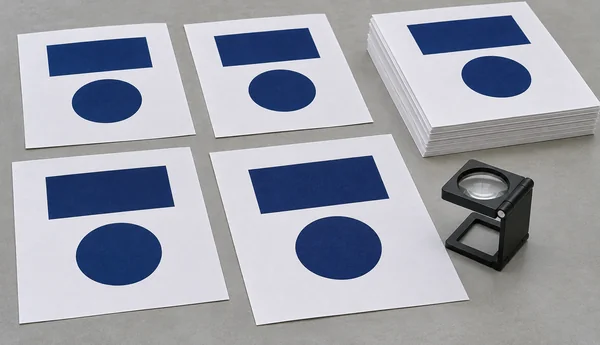
Record sheets introduced, accepted output, rejected output and material still unprocessed or awaiting review. Reconcile the counts so missing sheets do not disappear into a general “successful run” statement. Alongside the counts, list faults, adjustments, interventions and observed surface damage.
Keep the material specification and tested equipment configuration with the result. Agree acceptance criteria for your job in advance; there is no universal pass rate or demonstration length suitable for every sheet. A short successful run is evidence about those recorded conditions, not a guarantee of long-term production performance.
Ask the supplier to identify unresolved variants and the next acceptance step. Send Winshol your stock details, artwork and downstream process with a request for a sheet-handling trial and itemized proposal. The RFQ checklist provides the wider quotation inputs; the trial record should settle how the proposed feeder and delivery arrangement handle those inputs.
Frequently asked questions
1. Is an automatic screen printer suitable for every type of sheet?
No. Sheets with the same dimensions can behave differently because of stiffness, curl, surface finish, static or previous printing. Ask the supplier to evaluate representative production stock in the proposed configuration.
2. Does automatic feeding mean double-sheet detection is included?
No. Ask whether the quoted machine detects overlapping sheets, which materials the detection method supports and what happens after detection. Confirm the function in the equipment schedule and a supplier-controlled demonstration.
3. Should the trial use blank sheets or preprinted sheets?
Use the material in the condition in which it will enter production. If the job includes an earlier coating or printed layer, include it in the trial so that feeding and surface-contact risks are visible.
4. How should a buyer check the response to a misfeed?
Ask the supplier to demonstrate the relevant fault response using its approved safe procedure. Agree what should stop, how affected sheets are identified and how the machine returns to operation. Do not insert sheets into a moving mechanism or bypass protection.
5. Does the WL-5070PZ include a dryer or automatic stacker?
Do not assume either is included. Confirm the quoted feeding, discharge, drying or curing, and collection equipment separately, together with the handoff between those stages.
6. What should a sheet-handling trial record?
Record the stock and machine configuration, sheets introduced, accepted sheets, rejected sheets and sheets left unprocessed or under review. Note feed faults, handling marks, operator interventions and adjustments so the counts and observations can be reconciled.
7. Does a short successful demonstration prove production reliability?
No. It shows how the tested material behaved under the recorded conditions. Longer operation, material variation and repeated loading can reveal issues that a short demonstration misses. Agree the trial scope and remaining acceptance steps before ordering.
8. What should I send Winshol for a sheet-fed proposal?
Send the sheet specification, artwork, feed orientation, representative stock, earlier coating or print details, and the next process after printing. Ask for a written feeding and delivery scope, a material trial and an itemized list of included and excluded equipment.