







How to Evaluate Screen Printing Changeover Time Before Buying a Machine
Ask the supplier to demonstrate a defined change from production job A to job B, with agreed start and finish events. Record preparation outside the stop, the people involved, trial material and the quality checks needed before job B is released. A quick screen replacement alone does not show how long the complete line takes to resume acceptable production.
This guide proposes a buyer’s demonstration protocol for industrial film and label screen printing. The procedure needs project-specific agreement; it does not report Winshol test results or promise a changeover time. Agree the procedure and limits for the quoted configuration before the demonstration.
Choose a changeover that represents your orders
When comparing proposals, give each supplier the same pair of job specifications. Identify what stays in place and what changes: artwork, screen, ink, material construction, repeat, registration references, drying settings and participating stations. An artwork-only change on the same stock should not be compared with a change that also requires cleaning, a new roll and a different drying recipe.
Use your actual order pattern to choose the demonstration. If repeat orders matter, include a return from job B to job A using the retained setup record. If several kinds of change are common, record them separately rather than combining unlike trials into one average.
INO’s industrial flatbed screen-printer information discusses screen changeovers and positioning as ways to reduce setup waste. Those are that supplier’s descriptions, not evidence that a Winshol configuration includes the same features. Ask each supplier which tasks its quoted equipment performs and which remain manual.
Agree exactly when the clock starts and stops
For this proposed protocol, start at the last accepted output from job A at the agreed inspection point. Mark when the first job B sample passes the immediate checks, then mark completion of the agreed confirmation run. Record these as separate events. Record actual machine-stop and restart events separately. The full changeover window includes adjustment and confirmation running; it is not the same as stopped-machine time. One acceptable sample can appear before the settings hold consistently through the confirmation run.
Specify the length or sample count of that run, the inspection positions and the required operating condition in advance. This guide supplies no universal number: the buyer and process specialists must choose a useful check for the material and risk. If a sample subsequently fails a required test, retain the timing record but mark the changeover as not fully qualified.
Some approvals occur later, after conditioning, storage or another conversion stage. Record their completion separately and state whether material remains on hold meanwhile. Avoid describing an immediate appearance check as final product release.
Keep preparation visible, even when the machine is running
The Lean Enterprise Institute’s explanation of SMED separates tasks requiring a stopped machine from preparation that can happen while it runs. For the demonstration, list preparation separately so its labor remains visible when it happens before the stop.
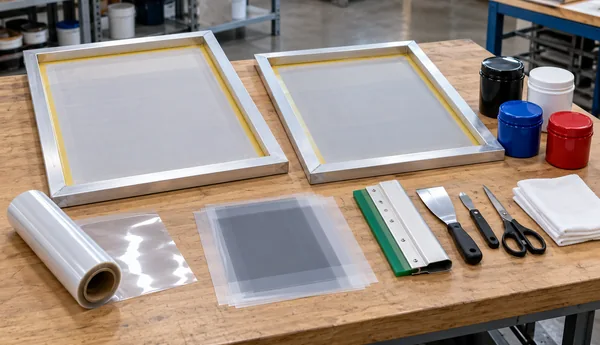
List what was ready before job A ended: screens, mixed ink, tools, roll handling equipment, artwork files and approved settings. Record who prepared them and the time spent. Note borrowed equipment or extra staff that will not be available on your production shift.
Minitab’s changeover form guidance recommends splitting an activity into separate entries when part occurs during the stop and part outside it. Follow that approach rather than placing the entire task in whichever column produces the shorter result. External preparation must still follow the equipment supplier’s safe working procedure; a timing exercise is not permission to work inside an operating machine.
Use one record for the demonstration
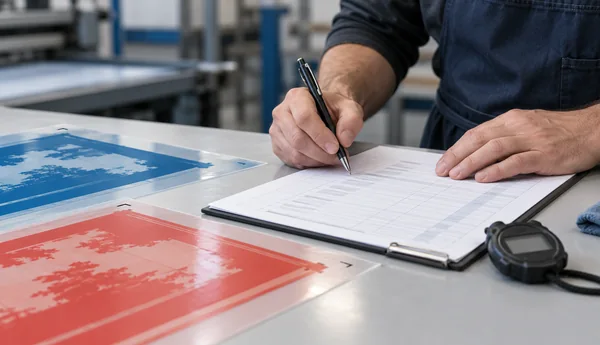
The following fields are a proposed comparison sheet. Complete the agreed method before timing either supplier.
| Record | What to capture | Why it matters |
|---|---|---|
| Change definition | Job A and B revisions; every changed item and station | Establishes whether two demonstrations cover the same work |
| Starting condition | Last accepted A sample; machine and material state; prepared items | Shows work completed before timing began |
| Activity log | Task, person, start, finish and inside/outside-stop classification | Separates elapsed changeover window from total labor |
| First acceptable B sample | Timestamp, sample identity and immediate test results | Identifies the first demonstrated acceptable setting |
| Confirmation run | Agreed run length, settings, sample positions and results | Checks whether the setting holds over the specified run |
| Material account | Setup scrap, unused or reusable stock, retained samples and material awaiting review | Prevents unapproved trial output being counted as saleable |
| Later release checks | Outstanding tests, responsible reviewer and final decision | Keeps timing separate from product approval |
| Exceptions | Interruptions, assistance, substituted materials and repeated attempts | Preserves the conditions behind the result |
Do not confuse elapsed time with labor
Record parallel activities on the same timeline. Two people working at once can shorten the elapsed changeover window while using more labor. Add each person’s task time separately. Measure stopped-machine time from the stop and restart events, rather than by adding parallel task durations.
For a hypothetical example, one person prepares ink for 12 minutes before the stop while another later spends 8 minutes changing the screen. Those two entries represent 20 person-minutes of work, but they do not establish a 20-minute changeover window. The event timestamps determine the elapsed result. These numbers illustrate the record only and are not Winshol performance data.
Ask who operated the controls, handled materials and approved samples. If the buyer’s planned staffing differs from the demonstration, identify the work that must be reassigned and what needs another trial. The trial record should state the staffing needed to reproduce the result.
Account for trial material and unsuccessful attempts
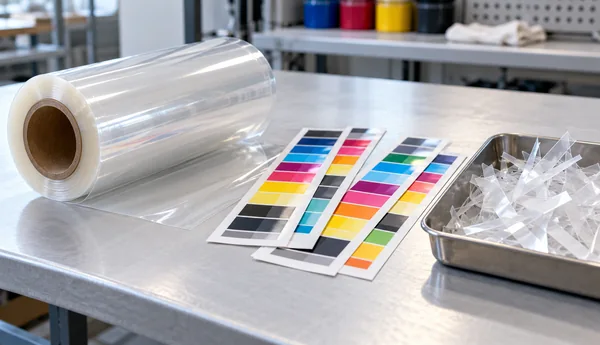
Identify the boundary between the final job A material, setup material and job B output. For roll-fed work, agree how the relevant lengths will be measured; for sheet-fed work, count sheets on the same basis. Separate discarded material, samples retained for inspection and output awaiting release. List unused or reusable material separately from discarded setup stock. Material awaiting inspection is neither confirmed scrap nor approved saleable output. Keep the units consistent between suppliers.
Record adjustment loops, cleaning and rejected checks rather than restarting the clock after the difficult work is finished. If a rehearsal precedes the timed demonstration, disclose it. A repeat trial can show improvement, but retain both records and explain what changed.
The existing accepted-output guide explains how setup losses enter capacity planning. Here the narrower decision is whether the changeover demonstration itself is comparable and reproducible. Do not turn a single demonstration into a guaranteed shift rate.
Agree the purchase scope after reviewing the record
Ask which items responsible for the observed result are included in the proposal: fixtures, screen holders, handling aids, stored-setting functions, spare tooling or training. A feature shown during a demonstration should be identified in the quotation if the purchase depends on it. Confirm how settings are documented and recovered; do not assume automatic recipe storage.
Winshol’s OEM/ODM and custom-engineering page describes application-specific testing and acceptance criteria. Send the two job specifications, proposed timing events, staffing plan and release checks for review. Ask Winshol to confirm which change can be demonstrated on the proposed configuration and what preparation the buyer must supply.
Use the machine RFQ checklist for the wider quotation. Attach the changeover record as a separate acceptance item, with unresolved conditions clearly marked. Any time or waste commitment needs written agreement tied to that defined scope.
Frequently asked questions
1. What should screen printing changeover time include?
Define it before the demonstration. For the protocol here, record the last accepted job A output, the first acceptable job B sample and completion of the agreed confirmation run. Keep outside-stop preparation and later product-release checks visible as separate records.
2. Is screen replacement time enough to compare machines?
Only if screen replacement is the entire operation being compared. A full job change may also require ink handling, cleaning, material changes, registration, drying adjustments and inspection. List the included tasks and compare the same change on both proposals.
3. Should preparation completed before the stop be counted?
Record its labor and resources separately from the measured changeover window. Prepared screens, ink and tools can shorten the stop, but the buyer still needs the people, time and equipment to prepare them during normal production.
4. Why record a confirmation run after the first acceptable sample?
One sample shows that the immediate checks passed at that point. A defined confirmation run checks whether the setting holds over the agreed material length or sample count. Set its conditions before the trial and retain the individual results.
5. How should two operators working together be recorded?
Use a shared timeline for the elapsed changeover window and separate task records for each person’s labor. Use stop and restart events to measure stopped-machine time; adding simultaneous tasks does not give elapsed time. Identify any difference between demonstration staffing and the planned production team.
6. Does SMED mean the supplier must finish within ten minutes?
No. The name describes a setup-reduction target, not a verified capability or automatic purchase requirement. Agree a job-specific acceptance limit only after defining the change, equipment, preparation, staffing and quality checks.
7. Can a timed trial pass while later quality tests remain unfinished?
The timing can be recorded, but final product release remains pending. Identify outstanding tests and the responsible reviewer. If the material later fails a required check, retain the timing evidence without describing the changeover as fully qualified.
8. Does Winshol publish a guaranteed changeover time for this protocol?
The public sources cited here do not establish one. Send the two jobs and proposed demonstration method for configuration-specific review. Any agreed time, preparation assumptions and acceptance conditions should be written into the project scope.