


Which Screen Printing Machine Fits Your Flexible Packaging Film?
For roll-fed flexible packaging film, identify the layer you want to screen print and the package that will be made from the web. Fit the artwork, roll width and repeat to the press, then test the selected ink under its proposed UV system. The first printed sample is a start; approval comes after the web has passed through the converting steps the order requires.
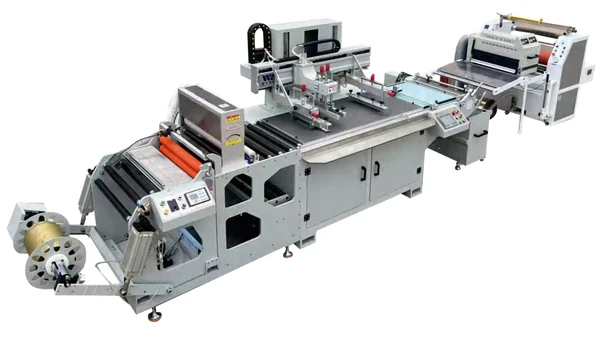
Winshol lists the WL-6090D and WL-850D for flexible packaging applications. Both combine roll-fed screen printing with UV curing and cold-foil equipment, but their formats and listed UV arrangements differ. Choose between them using a production web and a documented trial. The catalogue does not establish ink compatibility, registration tolerance or accepted output for your package.
This guide concerns printing on a flexible web before it is converted. If the incoming material is already a formed pouch, first confirm whether the proposed operation belongs on the flat web or needs another type of equipment.
Define the printed layer and the finished package
A useful job drawing shows the whole package, even when the screen press prints only one layer. Mark its outside and inside surfaces, the new artwork, and anything already printed on the incoming web. Locate any clear window, metallic detail, opaque white, tactile varnish or functional coating intended for the screen stage. Layers produced by a flexographic, gravure or digital press belong in the process plan, but they do not use a station on the proposed screen line.
State whether the package is a single film or a laminate. A design printed on the outer surface has different handling and abrasion demands from an image printed in reverse and protected within a laminate. Sun Chemical’s flexible-film packaging overview distinguishes surface printing from reverse printing for adhesive lamination. That distinction helps define the trial; it does not qualify a particular screen ink for either construction.
The drawing also needs the product that will be packed and the operations after printing. A clean image on an open web may behave differently after lamination or pouch forming. Have the converter identify seal areas, fold lines, gussets and regions that rub against filling equipment. Decoration in a critical seal area needs the package designer’s and material suppliers’ approval, backed by the relevant tests.
| Job detail | Put this in the enquiry |
|---|---|
| Material | Film or laminate grade, thickness, printable side, treatment or coating, roll width, core and outside diameter. |
| Artwork | Image dimensions, print repeat, orientation, colors, screen-printed layer and registration marks. |
| Ink and finish | Named ink or coating, target deposit, drying or cure instructions, and any foil or overprint. |
| Finished package | Surface or reverse print, later lamination, slitting, forming, sealing and intended contents. |
| Acceptance | Approved appearance, adhesion, register, winding, converting and package-use tests. |
Check the film before comparing press dimensions
“Packaging film” is too broad for a machine enquiry. BOPP, PET and PE webs can differ in surface treatment, dimensional response and winding behavior. Two films made from the same polymer may have different coatings or seal layers. Record the exact grade, printable side, treatment level and storage conditions supplied by the film maker. Check the rolls used in the trial against that specification.
The Torayfan CBP product record describes one side with Ultra High Surface Energy treatment and the other with corona treatment. It is designed as an outside-print or buried web for specified packaging uses. That level of detail is what the material brief needs. Ink suppliers set their own substrate conditions: Marabu’s UVRS technical sheet calls for treated or coated PE and PP in its listed uses and recommends preliminary trials. UVRS is a rotary screen ink for label materials; its data sheet does not approve it for a Winshol flat-screen line or a flexible food package. Obtain an ink recommendation for the actual film and printing process.
The film’s stretch and heat limits also matter. It touches guides, supports and rollers before and after printing, and the new image may face another layer in the rewound roll. Map those contact points. Then run enough material to inspect creases, scratches, blocking and changes in image position after curing. A short hand-fed demonstration is unlikely to expose a winding problem.
If the package is reverse printed, show the later adhesive and laminating film. Obtain written agreement from the ink and adhesive suppliers on the proposed layer stack and curing conditions. Test bond performance after lamination as well as adhesion to the film immediately after printing.
Fit the artwork to web width, print area and repeat
Three catalogue figures serve different purposes. Maximum web width is the largest roll width listed for the machine. Maximum print area limits the image that can be laid down in one print. Maximum feed length limits the listed advance per cycle. The artwork still needs edge margins, register marks and a practical web path. Our web width versus print area guide explains the basic layout check.
Put one complete repeat on a drawing in the intended feed direction. Include the pouch panel, side gusset or fold, eye marks, trim allowance and any clear area that must stay unprinted. Show whether production uses one across-web image or several lanes. For registration to upstream graphics, supply the preprinted roll and its mark specification.
A wider press is not automatically the better choice. The WL-850D lists a wider web and image width than the WL-6090D, while the WL-6090D lists a longer maximum print and feed length. Orientation may change which design fits. Ask Winshol to mark the usable image and tracking margins on the production drawing rather than reading a single maximum number as the approved layout.
Match the UV system to the ink and film
The WL-6090D catalogue describes two-lamp UV drying. The WL-850D lists an LED UV drying unit. Those descriptions do not give the full lamp spectrum, irradiance at the web, exposure time or heat load for a proposed ink deposit. Request the UV-system specification and review it with the ink supplier.
GEW’s UV LED technical guidance explains that an ink, coating or adhesive needs an appropriate combination of wavelength, irradiance and energy dose within its process window. It also says there is no universal LED setting that works for every formulation. That is why “UV-curable” on an ink label is not enough to approve the WL-850D’s listed LED arrangement, and the WL-6090D’s lamp count is not proof of cure at the planned print thickness.
Trial the heaviest deposit in the job, including any opaque areas. Record the cure conditions required by the ink maker and wait until the film reaches the agreed test condition before judging the print. Check adhesion and residual tack. Rub and blocking tests on a rewound sample reveal how the ink behaves in the actual web construction. Repeat the affected checks after overprinting, foil transfer or lamination.
If your chosen ink requires solvent evaporation or hot-air drying, ask for a separately specified drying route. Neither catalogue’s UV equipment should be treated as a solvent dryer. Our UV curing versus hot-air drying guide gives the general distinction; the ink maker’s instructions and the film’s limits decide the job-specific route.
Compare the two Winshol configurations
Use the numbers below to form a shortlist. They are catalogue maxima, not guarantees that a particular film, ink, foil or package will run at a quoted speed.
| Listed specification | WL-6090D | WL-850D |
|---|---|---|
| Application listed | Flexible packaging printing and finishing | Flexible packaging screen printing and cold foil |
| Maximum web width | 610 mm | 820 mm |
| Maximum print area | 600 × 900 mm | 800 × 800 mm |
| Maximum feed length | 900 mm | 800 mm |
| Screen frame | 800 × 1100 mm | 1100 × 1200 mm |
| UV arrangement listed | Two-lamp UV unit | LED UV unit |
| Cold foil | Listed in the configuration | Listed in the configuration |
| Power entry available in catalogue | Main machine and UV dryer: 380 V | Main machine: 220 V; confirm auxiliaries |
The WL-6090D product page is the starting point for a web up to 610 mm wide when the full artwork fits its 600 × 900 mm print area and 900 mm feed limit. The WL-850D product page warrants review for a wider web or image, within its 820 mm web, 800 × 800 mm print and 800 mm feed limits. A long repeat that fits one format may fail the other even when the web width fits both.
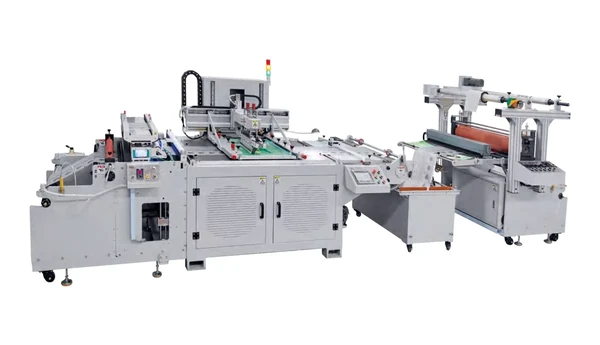
The quotation should show the equipment layout, supported roll diameter and core, tension and web-guiding arrangements, ink delivery, cure specification and electrical scope. Neither catalogue entry states a numerical registration guarantee or accepted production yield. The WL-850D entry also leaves the LED wavelength unspecified. Resolve these points in the written proposal and trial plan.
Treat cold foil as a separate process decision
Both listed machines include cold-foil equipment. Decide first whether the package needs metallic decoration and where it sits in the finished construction. A non-foil job should have its own quotation and process drawing; the presence of a foil unit in a catalogue configuration does not make foil a required stage.
For a foil job, identify how the adhesive is applied, when it is cured, how the foil is pressed and released, and whether another layer covers it. State the foil image area and its relationship to the printed design. The foil supplier should confirm a compatible foil-and-adhesive combination for the selected film and printing route. For context, UNIVACCO’s web-fed foil data specifies recommended UV adhesives and a modified flexographic press for its own material. That data does not certify the same foil on either Winshol screen configuration.
Inspect transfer edges, missing or unwanted foil, adhesion and rub resistance. Then fold, laminate or form the sample as the customer will. If foil crosses a crease or a sealing area, use the finished package to decide whether it belongs there. Request a sequence drawing that assigns each adhesive, curing and transfer operation to a named piece of equipment.
Run the web long enough to expose handling problems
One clean panel says little about a roll-fed process. Retain samples from setup, steady operation and after a stop and restart, with each sample’s across-web position marked. Compare dimensions and image position after curing and again after the intended holding period.
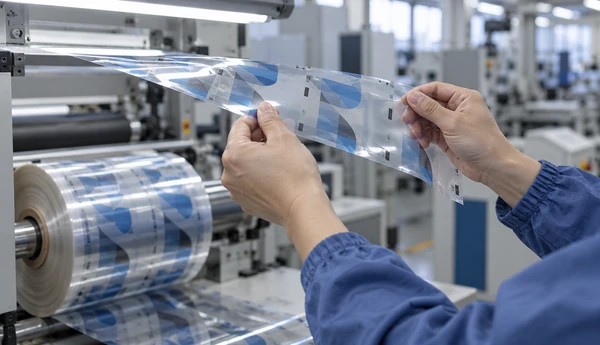
Look at the rewound roll before slitting. Check telescoping, wrinkles, trapped air, scuffed print and ink transfer to the reverse side of the film. Use the winding orientation and tension planned for production. If the package will be laminated, retain a roll segment for that operation. A print can pass a flat-sheet adhesion check and still show marks where layers have pressed together in the reel.
Agree on the trial speed and the amount of accepted output to record. The manufacturer may quote a mechanical speed, but production output depends on the ink, cure, repeat length, handling and rejected material. Record the complete run conditions alongside the samples so a later quote can be tied to an actual process.
Approve the converted package, especially for food uses
Follow samples through the steps the order actually requires: slitting, lamination, pouch forming, heat sealing, filling or packing. Assign each step to the press supplier, converter or customer in the trial plan. Test the finished package against agreed appearance and performance requirements, including seal integrity where applicable. The screen press and cold-foil unit do not by themselves make a complete pouch line.
Food packaging needs a separate suitability and compliance review for its final construction. Sun Chemical’s sensitive-packaging guidance notes that flexible food packs commonly require migration-compliant inks and testing, and that set-off can occur in a printed reel. It also points to the role of the laminate and adhesive. Do not infer food-contact suitability from “UV,” “LED,” or “low migration” in a machine or ink description. Give the ink, film and converter suppliers the intended contents, contact side, storage conditions and destination market, then obtain the required approval and testing plan.
For a non-food package, the end-use test still matters. A cosmetic refill pouch, detergent sachet and dry-goods overwrap do not face the same contents, storage or handling. Ask the customer which failures would make the package unusable and include those checks in the acceptance criteria.
Build an acceptance trial around the actual job
Use production-grade material, final artwork or a representative worst-case image, and the selected ink and foil products. Set pass/fail limits before the demonstration. Keep a sample from each stage with its date, position on the web and machine settings.
| Trial stage | Evidence to retain |
|---|---|
| Incoming film | Grade, thickness, treated side, roll size and surface condition. |
| Printed web | Image dimensions, register to existing graphics, ink deposit, defects and cure test results. |
| Rewound roll | Winding quality, blocking, scuffing and transfer to the reverse side. |
| Foil stage, if used | Transfer position, edge quality, adhesion and appearance after later operations. |
| Converted package | Lamination or slit result, forming and seal performance, plus any agreed end-use or compliance tests. |
When a run fails, change one defined variable and repeat the affected checks. Film treatment, ink, lamp setting and foil adhesive can each change the outcome. Approval should refer to one documented construction and process, rather than samples made under unrelated conditions.
Send a quotation request that can be answered
Send the roll and package specifications, full-size artwork, print-repeat drawing, named ink and foil materials, and the planned downstream process. State which layer the screen press must print, which operations are already completed upstream, and whether cold foil is required. Include the target accepted output and a sample quantity for the trial.
Ask Winshol to return a marked layout, a stage-by-stage process route, the proposed UV equipment specification, utility requirements, roll handling limits, the trial plan and a list of operations outside the quotation. Our screen printing machine RFQ checklist covers general purchasing details; add the film, conversion and package-use tests from this guide.
Frequently asked questions
1. Which Winshol machine should I consider for a wider packaging web?
The WL-850D lists an 820 mm maximum web width, compared with 610 mm for the WL-6090D. Check the artwork against their separate print areas and feed limits. A wider web alone does not prove the design fits or that the film runs acceptably.
2. Is the WL-850D always better because it is wider?
No. Its listed maximum print and feed length is 800 mm; the WL-6090D lists 900 mm in that direction. Film handling, curing and the required repeat also matter. Compare a marked production layout and printed samples.
3. Can either machine print a finished pouch?
These are roll-fed printing and cold-foil configurations. A finished pouch may also need slitting, lamination, forming, sealing and filling. Show those operations separately in the process and quotation.
4. Can I use the same UV ink on both models?
Do not assume so. The WL-6090D lists a two-lamp UV unit and the WL-850D lists LED UV. The ink supplier must confirm suitability for the actual light source and film, followed by a cure and adhesion trial at the planned deposit and speed.
5. Do I need cold foil for every flexible packaging job?
No. Use it only when the approved design calls for foil and the supplier has specified a compatible adhesive and film route. Ask for a process drawing and a quotation that reflects the stages your job needs.
6. What if my artwork fits the web width but exceeds the print area?
It does not fit the listed one-pass image format. Check whether a permitted orientation or a revised artwork solves the problem. Do not treat the maximum web width as a printable width; submit the complete repeat for confirmation.
7. Is UV-printed film automatically suitable for food packaging?
No. Food-pack suitability depends on the selected inks, cure, film and laminate construction, possible set-off in rolls, intended contents and the applicable requirements of the destination market. Arrange the finished-package review and migration testing required for the job.
8. What is the most useful machine acceptance sample?
A converted package made from a representative production run. Keep printed-web and rewound-roll samples as well, so a failure found after forming or sealing can be traced to the relevant stage.
Choose against the finished-package result
The answer to “which machine fits?” depends on a specific film, image and package. WL-6090D and WL-850D offer different format and UV starting points; neither catalogue entry replaces a material trial. Decide which layers the proposed line will print, verify cure and web handling, and approve the converted package under its intended use conditions.
Send Winshol the film specification, full repeat drawing and acceptance plan to request a configuration and sample run for your packaging job.