

How to Choose a Screen Printing Machine for Scratch-Off Labels
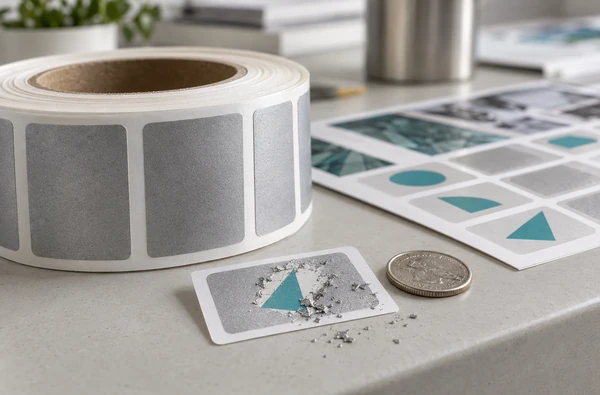
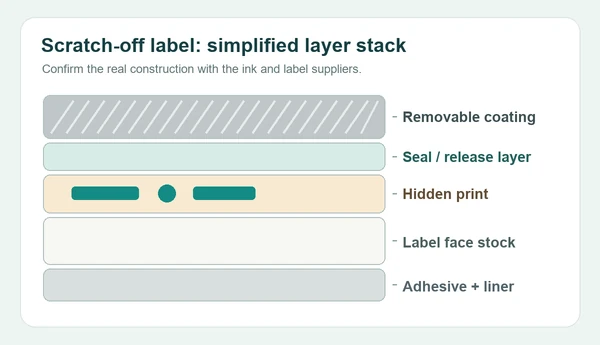
Start with the finished scratch-off label: a hidden image or code, a protective release layer, and an opaque coating that the customer can remove. Count the layers that your screen press must print. Then match their inks to the drying system and web format. The sample must hide the message, scratch cleanly, and survive winding and converting before the machine choice is settled.
Winshol’s WL-350D UV, WL-350S, and WL-350-3C are one-, two-, and three-station roll-fed UV configurations to compare. The WL-350-3C catalogue lists scratch-off coating among its applications. That listing is a starting point for a material trial, not a qualification for every scratch-off ink or label stock.
Specify the complete scratch-off label
A coated card, a pressure-sensitive paper label, and a film label can need different surface preparation and finishing. Draw the actual construction from the face material through the hidden print and removable coating before comparing machines.
| Part of the construction | What to specify |
|---|---|
| Label stock | Exact face material, surface coating or treatment, adhesive, liner, web width, and roll format. |
| Hidden print | How the information is printed, its location, and whether every piece carries the same image or a variable code. |
| Seal or release layer | Product and application method; the required barrier between the hidden print and removable coating. |
| Scratch-off coating | Ink series, color, coverage area, opacity requirement, and removal method. |
| Later operations | Any overprint, die cutting, waste stripping, rewinding, application, or packing step. |
Mark which layers are already printed when the roll reaches the proposed screen press. If variable codes are printed upstream, identify the register mark or other reference that the scratch panel must follow. Also specify the point at which the customer will scratch the label: on the liner, after application to a package, or after a period in storage. Those details affect the acceptance test.
The hidden print and protective layer must stay put. The top coating must stay intact during distribution, then come off when the customer scratches it. Specify both behaviors in the job brief.
Confirm the seal layer and ink system together
The layer beneath the scratch coating controls how the concealed information survives removal. Treat it as part of the ink system, even if another press applies it. Ask the ink supplier which seal or release coating works with the hidden print, face stock, and chosen scratch-off ink. Record who supplies and applies each layer.
Nazdar’s SCF solvent-based scratch-off ink data sheet describes coated card stock with a UV-curable clear layer beneath the removable ink. KOLORCURE’s UV-curable scratch-off ink data sheet also calls for a seal coat over the graphics and a trial on the actual substrate. These are distinct ink systems with their own instructions. Neither document certifies a Winshol machine or proves suitability for every pressure-sensitive label film.
A release layer is a functional surface
Check more than whether the clear layer looks transparent. It must protect the hidden print, accept the scratch coating in the specified way, and let that coating come away without tearing the message or face material. Test the selected combination after it has fully dried or cured and after the finished product has been stored for the intended interval.
If the proposed job uses a supplier-approved UV release coating, ask how the line will verify its cure before the scratch layer is applied. Nazdar’s OP Series release-coating sheet identifies a UV-curable release varnish for scratch-off work and calls for checks of cure, adhesion, rub resistance, and other specified properties on the printed web. That product is an example of a release layer; its sheet does not establish a universal screen-printing recipe.
Choose the drying route before counting stations
The ink’s drying method sets the equipment route. A UV formulation needs compatible lamps and a verified cure at the chosen coating deposit. A solvent formulation needs the drying and air handling specified by its supplier. UV units alone do not establish a solvent drying route.
| Ink route to investigate | Evidence from an ink supplier | Equipment question |
|---|---|---|
| UV-curable scratch-off ink | KOLORCURE describes a two-part UV screen ink and requires the cure conditions to be established under production conditions. | Are the proposed lamps, web path, and exposure suitable for this exact ink and coating deposit? |
| Solvent-based scratch-off ink | Nazdar SCF dries by solvent evaporation and specifies air circulation to remove vaporized solvent. | Where are drying, extraction, and any required process controls provided? |
| Seal or release coat | The chosen product may have its own curing or drying requirement, separate from the scratch layer. | Is there a compatible stage before the removable ink is printed? |
The KOLORCURE technical sheet gives a starting UV exposure range for its own ink and instructs printers to inspect a completely cooled print. Do not transfer that range to another ink or assume the catalogue’s lamp count supplies it. Request the lamp specification and an actual cure trial with the proposed coating thickness.
The Nazdar SCF sheet describes a solvent ink for card stock. It warns that excessive heat can impair scratch-off behavior and says evaporated solvent needs air circulation. If a supplier proposes that route for a roll-fed label, require a separate review of the substrate, drying equipment, ventilation, and regulatory requirements. A Winshol UV-only configuration should not be quoted as a complete solvent-ink process without that engineering scope.
Our UV curing versus hot-air drying guide provides a general comparison. For scratch-off labels, the selected ink and seal layer decide which route is relevant.
Count the screen-printed operations
Count each layer applied on the proposed screen line. Include the seal coat if it is screen printed. A hidden message printed on another press remains part of the job, but it does not use a station on this line. A decorative overprint may add another operation if the ink supplier approves the combination.
| Example route | Screen operations to plan | Question for the supplier |
|---|---|---|
| Preprinted hidden image; seal applied elsewhere; scratch coating screen printed | One | Can the coating register to the preprinted image and cure or dry on the proposed line? |
| Preprinted hidden image; seal and scratch coating both screen printed | Two | Is there a compatible drying stage between them? |
| Hidden image, seal, and scratch coating all screen printed | Three | Are all three inks and their sequence compatible with the same configured line? |
| Added decorative or protective screen layer | One further operation | Does the new layer preserve concealment and clean removal? |
These are planning examples, not machine approvals. If a one-station machine handles several operations through return passes, specify how the web is rewound, reloaded, and registered. A two- or three-station proposal needs a drawing of the complete inline sequence. Compare accepted finished labels after every required operation, rather than impressions from the first station.
The single-color versus multicolor screen printing guide explains the return-pass comparison for other label work. Scratch-off jobs add the seal and removal tests to that decision.
Compare Winshol’s roll-fed UV configurations
Use the catalogue to screen station count and format. The following specifications describe the listed UV versions. None gives a guaranteed opacity, scratch force, registration tolerance, or accepted output for a scratch-off label.
| Catalogue item | WL-350D UV | WL-350S | WL-350-3C |
|---|---|---|---|
| Screen-printing stations | One | Two | Three |
| Listed UV equipment | One two-lamp unit | Two units, two lamps each | Three units, two lamps each |
| Maximum print area | 330 × 450 mm | 330 × 450 mm | 330 × 450 mm |
| Maximum web width | 350 mm | 350 mm | 450 mm, as listed |
| Maximum feed length | 450 mm | 450 mm | 450 mm |
| Listed dimensions, L × W × H | Main machine: 2500 × 1100 × 1700 mm | Main machine: 4300 × 1100 × 1700 mm | Machine: 9500 × 1200 × 1700 mm |
The WL-350D UV offers one screen station with inline UV drying and roll handling. It is a candidate for one separately verified UV operation, or for a documented multi-pass route. Specify the UV version; other WL-350D catalogue variants use different drying arrangements.
The WL-350S lists two independently controlled print heads and two UV units. Discuss it when two approved UV-compatible screen operations can be run in the proposed order. A seal coat followed by a scratch ink is only an example after both products and the interstage cure have passed a trial.
The WL-350-3C lists three screen stations, three UV units, guided unwinding, and rewinding. Its product record includes scratch-off coating applications. The listed 450 mm web width does not enlarge the stated 330 × 450 mm maximum print area. Ask for a layout and trial of your actual stock and artwork before assigning the three stations.
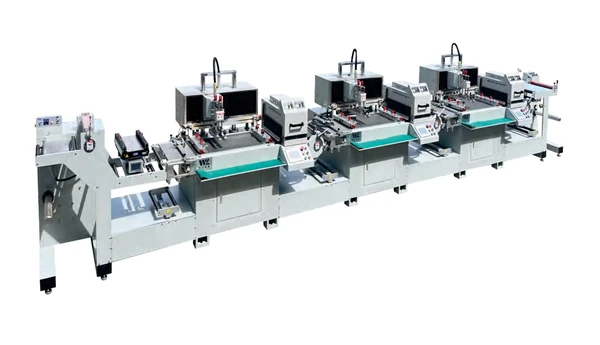
The catalogue does not specify the UV lamp spectrum or the full electrical and auxiliary requirements for your job. Ask the supplier to confirm these against the ink maker’s instructions. A solvent-based top coat needs its own reviewed drying route.
Check format, registration, and roll handling
Put the hidden message, scratch-panel boundary, register marks, and die-cut outline on one drawing. Give the panel enough agreed coverage around the message; a shifted edge can reveal part of a code while the center still looks opaque. Mark where alignment will be measured on the finished label.
Compare web width, label pitch, and all handling margins with both the listed web limit and print area. A 450 mm web specification does not mean a 450 mm wide printed panel. The web width versus print area guide explains the distinction. Include the actual roll diameter, core, print side, liner, and any preprinted register marks in the enquiry.
Review samples from the beginning, middle, and end of a representative run, including after stops and restarts. Then inspect the rewound roll. The coating may pass an immediate scratch test but rub onto neighboring layers, block in the roll, or crack at a later converting step. Test the complete route that the customer will receive.
Test both concealment and removal
Use real hidden artwork or representative codes for the trial. A blank panel tells you little about read-through. Check concealment under the customer’s lighting and, if relevant, against a strong backlight. Set a separate test for deliberate removal.
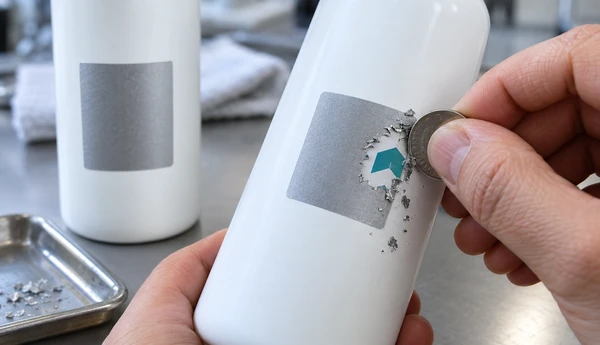
Use the customer’s intended removal method, such as a fingernail or coin, on samples that have reached the agreed conditioning time. Record whether the message remains legible and undamaged, whether the coating releases at the panel edges, and how much residue it leaves. Check for premature scuffing from normal packing and transport. There is no universal number of scratches or opacity value in the machine catalogue to substitute for these agreed criteria.
The KOLORCURE sheet recommends testing the actual substrate and allowing at least 24 hours before assessing its product. The Nazdar SCF sheet calls for scratch-off evaluation soon after printing and over the expected life of the item. Follow the selected supplier’s instructions and add any longer storage interval required by your customer.
Approve converting and the finished label
Identify who will die-cut the labels, strip waste, rewind finished rolls, inspect variable information, and apply the labels. A screen press’s rewinder does not establish that those downstream operations are included. Ask for a line drawing that shows each handoff.
Die cutting must leave the hidden image and scratch panel intact. Waste stripping should not lift or scuff the coating. Application to a curved or flexible package can stress the printed layers, while the adhesive and liner affect dispensing. Include actual converted and applied labels in the trial when those steps are part of the order.
| Trial stage | Evidence to keep |
|---|---|
| Material and artwork approval | Stock code, hidden artwork revision, panel boundary, marks, and layer sequence. |
| First stable print | Registration, coating coverage, cure or dryness, and seal-layer integrity. |
| Run samples | Samples after setup, during steady operation, and after a stop and restart. |
| Conditioned samples | Concealment, intentional removal, hidden-image legibility, residue, and normal rub resistance. |
| Finished rolls and labels | Blocking, scratches, die-cut result, waste stripping, dispensing, and applied appearance. |
Keep approved samples from each stage. If the stock, seal coat, scratch ink, or dryer setting changes, repeat the affected checks before treating the new construction as equivalent.
Send a complete job pack for the quotation
Send the exact face stock and liner, label size, web and reel dimensions, print repeat, hidden image or code, and scratch-panel artwork. Mark the layers already printed and those the new line must apply. Include the ink and release-coat technical sheets if products have been selected, plus the customer’s concealment, removal, storage, and converting requirements.
Ask Winshol for a layer-by-layer process drawing, drying and utility scope, station assignment, expected installation layout, and a trial plan. The trial should report accepted finished labels after all required operations. The screen printing machine RFQ checklist can help organize the general machine information; add the scratch-off tests from this guide to the request.
Frequently asked questions
1. Can a UV screen printer make a complete scratch-off label?
It can be considered for UV-compatible screen-printing stages, but the complete label may also need hidden-data printing, a seal layer, die cutting, and inspection. Confirm each operation and its equipment in the proposed line. Test the selected ink and stock before accepting the UV configuration.
2. Is a seal or release coat always needed?
Use the construction specified by the selected ink supplier. The Nazdar and KOLORCURE examples both call for a layer beneath their scratch inks, but its product, application method, and cure differ. Approve the exact combination by checking concealment, removal, and protection of the hidden print.
3. Can the WL-350-3C print solvent-based scratch-off ink with its UV units?
The WL-350-3C catalogue lists UV units. A solvent-based ink such as Nazdar SCF dries by solvent evaporation and requires a reviewed drying and air-handling route. Ask for a separately engineered configuration if that ink is proposed; do not treat UV lamp count as proof of solvent drying capability.
4. How many printing stations do I need for a scratch-off label?
Count the layers that this screen line must apply. A preprinted hidden image with a seal applied elsewhere may leave one screen operation. A screen-printed seal and scratch coating require two. More screen-printed layers or a return-pass route change the requirement.
5. How do I check that the hidden code cannot be read before scratching?
Print representative codes beneath the proposed coating and inspect them under agreed lighting, including backlighting if relevant. Check the full panel and edges after curing, winding, and normal handling. Set the pass/fail standard with the customer before the trial.
6. What proves that the coating will scratch off cleanly?
Test conditioned samples using the customer’s intended method. The concealed print should remain legible and undamaged after the top layer is removed. Record residue, edge release, and any coating that came off during ordinary handling.
7. Does a 450 mm web width mean the WL-350-3C can print a 450 mm wide scratch panel?
No. Its listed maximum web width is 450 mm, while its maximum print area is 330 × 450 mm. Check the panel width, pitch, registration marks, and margins against both specifications and the proposed layout.
8. Should the trial include die cutting and label application?
Yes, when those steps are part of the customer’s finished product. A coating can pass on a flat printed web and fail during waste stripping, rewinding, dispensing, or application. Review the final converted label and the applied package sample.
Choose the process that passes the finished-label test
Set the hidden print, release layer, and removable ink first. Match their drying needs, then choose the station count. Use the Winshol specifications to narrow the format and run the full construction on the actual label stock.
Send Winshol the artwork, material specifications, ink data sheets, and acceptance criteria. Request a process drawing and trial that finishes with converted labels ready for the customer’s scratch test. The approved sample should define the equipment scope in the quotation.