






Static Control for Roll-to-Roll Screen Printing: A Buyer’s Guide
Specify static control as a measured part of the screen-printing line, not simply as “one anti-static bar.” Identify where charge is present, which material carries it and what problem it causes. Then agree on equipment placement, operating conditions, maintenance and an acceptance test with the machine supplier and static-control specialist.
A quotation that lists an anti-static bar still leaves several decisions open. Where will it work, what will be measured and who will maintain it? Resolve those points against the actual label stock or flexible film before accepting the package.
Establish whether static is part of the problem
Static can affect screen printing, but it is not a diagnosis for every defect. Meech’s screen-printing application guidance describes effects such as poorly defined edges, ink bridging and material being attracted back toward the screen. That guidance concerns wide-format screen printing; its sheet-handling layout should not be copied unchanged onto a roll-fed press.
Start with the location and timing of the symptom. Record the material lot and running state alongside a repeatable static measurement at an appropriate location. Preserve affected and acceptable samples. Before ordering a retrofit, have the process team check whether the evidence points to charge, ink, stencil, drying or web handling.
Ink transfer between wound layers calls for the checks in the separate label-blocking guide. It should not be labelled a static fault merely because the reel is difficult to unwind. Likewise, the pinholes guide distinguishes different kinds of missing or unwanted ink before proposing a cause.
Map the web path before choosing a mounting point
Draw the route from unwind to the next operation after rewinding. Mark the print stations, dryers, contact rollers and places where the web separates from another surface. The marked locations guide the assessment; they are not an instruction to install a bar at every one.
Simco-Ion’s printing and coating guidance shows why the whole route matters: material can acquire charge at separate process stages, and a treatment at one point does not establish the condition farther downstream. Its silkscreen section also describes substrate attraction to the screen or bed. These are industry mechanisms, not reported test results from a Winshol line.
Allow for the actual running cycle
Tell the specialist whether the web moves continuously or indexes through a print cycle. Provide the intended operating range, the web width and the available mounting space. Include changes in roll diameter if the proposed location faces the rewind roll. Ask the equipment supplier to identify which conditions its proposal covers.
Use photographs for the initial discussion and dimensioned drawings for the proposed installation. Keep emitters, cables and brackets clear of moving parts and the machine’s guarding arrangements. Installation and electrical work belong with qualified personnel, not an improvised operator adjustment.
Grounding, neutralisation and cleaning are different jobs
Simco-Ion’s technical FAQ explains the distinction between conductors and insulators: grounding can provide a path for charge on a conductor, while charge held on an insulating surface cannot simply migrate away by the same route. Air ionisation provides a different means of neutralising surface charge.
| Measure | Question it addresses | What still needs checking |
|---|---|---|
| Grounding and bonding | Are conductive components connected as required by the equipment and safety design? | The condition of an insulating web; grounding the frame is not proof that the film is neutralised. |
| Active ionisation | Can the proposed device neutralise the charged material at the relevant station? | Coverage, clearance, operating conditions and measured performance on the web. |
| Web cleaning | How will unwanted particles be removed from the material? | Surface compatibility, collection of removed particles and the cleanliness result. |
| Environmental control | What temperature and humidity conditions will the process experience? | Performance across that range; humidity is not a substitute for validation. |
The distinction between neutralisation and cleaning matters when dust is the complaint. Meech’s web-cleaning FAQ describes several removal methods, including contact and non-contact approaches. Ask how a proposed system deals with existing particles, not only their attraction to the film. For a delicate surface, include the cleaning method in the material trial.
Put the integration details in the quotation
Add these static-control details to the quotation. They identify what the equipment package must cover and what remains the buyer’s responsibility.
| Item to settle | Information from the buyer | Confirmation to request |
|---|---|---|
| Material and treatment area | Web construction, width, coatings, printed side and relevant material variations. | Which surfaces and width the proposed arrangement will address. |
| Operating conditions | Feed cycle, intended running range and expected temperature and humidity. | The conditions covered by the selection and acceptance test. |
| Mechanical fit | Line drawing, available clearances, nearby rollers and access restrictions. | Mounting drawing, working distance, service access and compatibility with guarding. |
| Interfaces and supply | Existing machine configuration and site utilities. | Who supplies the device, power unit, brackets, wiring, controls and installation. |
| Monitoring and maintenance | Required operator response and maintenance arrangements. | What the indicators or alarms actually report, plus the cleaning and verification instructions. |
| Acceptance | Actual substrate, observed problem and required finished result. | Measurement method, test states, agreed limits and retained records. |
Do not specify a working gap from a generic photograph. Meech’s ionisation FAQ notes that effective distance and settings depend on the equipment and that contaminated emitters can reduce performance. Ask for the selected device’s current instructions and a layout suitable for both operation and cleaning. Moving a bar closer to the web is not always an improvement.
Review solvent-related risks separately
If the process uses flammable inks, cleaners or other substances, involve a qualified safety specialist before selecting equipment for the area. A standard industrial ioniser is not evidence that an installation is suitable for an explosive atmosphere.
The UK Health and Safety Executive’s printing guidance identifies dangerous-substance assessment, ignition sources, ventilation and suitable equipment in classified areas as important controls. Its legal requirements are UK-specific. The destination site must apply its own applicable rules and assessment; this article does not specify a hazardous-area design.
Agree on a test that can be repeated
Before the purchase trial, agree on the measurements and the production result that will count as acceptance. The responsible team must also establish safe measurement access.
Keep measurement geometry consistent
Fraser’s measurement guidance explains that a nearby roller can change the apparent field reading. Material that appears to have little charge while against a roller can produce a different reading after it enters a free span. Follow the selected instrument’s instructions for distance and positioning; do not compare readings taken under different geometry as if they were equivalent.
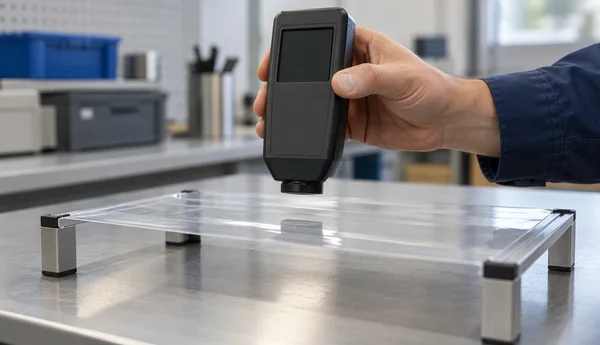
Identify each measurement point on the layout. Record the meter, distance, web side, operating state and ambient conditions. If the proposed arrangement covers the full web, agree on the cross-web locations to be checked rather than accepting a single convenient centre reading.

Link the measurements to the job
- Establish a baseline on representative production stock. Record the symptom, its location and the agreed measurements. Do not disable a safety control to create a comparison.
- Include the operating conditions that matter to the order, such as normal running and an agreed restart condition. Record any settings that change between comparisons.
- Compare the readings with the print, handling or cleanliness result. If the reading falls but the defect remains, keep investigating rather than approving the process from the meter alone.
- Have the machine supplier, static-control specialist and buyer agree on the method and limits for the application. There is no universal voltage threshold proposed here.
- Retain the layout, selected equipment, settings, measurements, accepted samples and maintenance instructions. State when another verification is needed after a material or layout change.
Simco-Ion’s support FAQ recommends checking charge on the material before and after treatment; power at the emitter alone does not demonstrate neutralisation. Ask what each status light or alarm reports, and how an operator should respond.
These steps are a suggested procurement and acceptance approach, not a report of a Winshol test. Quality acceptance also does not establish freedom from ignition risk; that requires its own assessment.
Discuss the complete line with Winshol
Winshol’s roll-to-roll machine range is relevant to label and film projects. The WL-350D UV product page, for example, describes a line with unwinding, screen printing, UV drying and rewinding. That published configuration does not establish that a static-control package is included.
For an equipment enquiry, send the material construction, ink and drying information, line layout and any existing measurement record. Mark the location where the problem appears and provide representative samples. Ask Winshol which aspects can be reviewed within the proposed machine project and which require a specialist supplier. Confirm the final responsibilities and acceptance conditions in the quotation.
Frequently asked questions
1. Does every roll-to-roll screen printer need an anti-static bar?
Not automatically. Ask for measurements and a review of the actual material path before specifying equipment. The decision should consider charge at the relevant stations, the observed print or handling problem and the proposed operating conditions. A standard accessory list is not an assessment of your job.
2. Will grounding the machine remove static from plastic film?
Grounding conductive machine components is important, but it does not necessarily drain charge held on an insulating film. The film may need a separately assessed neutralisation method. Have qualified personnel review the grounding and static-control arrangements; do not treat an ionising bar as a replacement for protective earthing.
3. Is an ionising bar the same as a web cleaner?
No. Neutralising charge and removing particles are separate tasks, even when equipment combines them. If contamination is the concern, ask how particles will be removed and collected, whether the method suits the film surface and how cleanliness will be checked after treatment.
4. Can higher humidity replace static-control equipment?
No. Simco-Ion’s support FAQ notes that unacceptable charge can persist even at relatively high humidity. Record the expected environmental range and validate the proposed process under the conditions the factory will actually experience.
5. Should a bar go before printing or after the dryer?
Placement depends on where charge is present and where it creates a problem. Ask for a measurement-based layout review rather than choosing one position for every line. Contact and separation farther along the web path can leave another location needing attention after an earlier treatment point.
6. What static-voltage limit should be written into acceptance?
There is no single limit proposed here for every film and screen-printing line. Agree on the instrument, measurement geometry, operating conditions and process-specific limits with the relevant specialists. A reading near a roller is not directly comparable with one taken on a free web span. Quality criteria do not replace a separate ignition-risk assessment.
7. How can a buyer check whether the installed bar works?
Ask for recorded measurements at agreed locations before and after treatment, together with the operating conditions and the printed or handled result. A power light alone does not demonstrate neutralisation of the web. Include maintenance instructions and a safe, repeatable verification method in the handover.
8. What should be sent with a static-control enquiry to Winshol?
Send the web construction and width, ink and drying details, a line-layout drawing, the operating sequence and the problem location. Add available measurement records, defect samples and photographs showing possible mounting space. Identify any solvent-related or other environmental restrictions, and ask who will assess and supply each part of the proposed integration.