

Screen Printing Machine RFQ Checklist
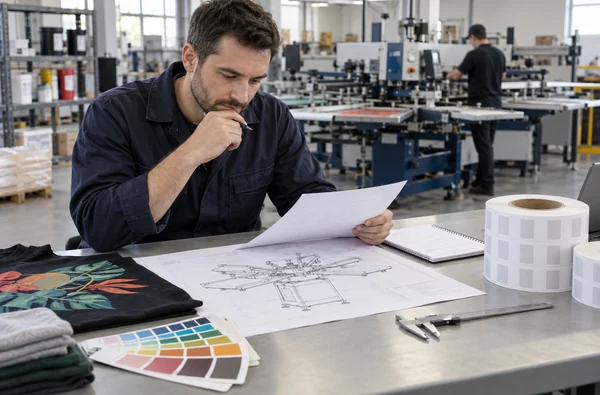
What to send: A screen printing machine RFQ should describe the job before it names a model. Give the supplier the production material, artwork, material format, registration target, ink and drying requirements, expected operating pattern and factory constraints. Attach a physical sample when possible. Mark unknowns clearly; an unanswered engineering question is safer than a guessed specification that becomes part of a quotation.
The one-page brief a supplier can act on
Use the fields below as a copyable template. For each field, write a value, attach a file or say “to be confirmed.” Separate requirements from preferences. A required 500 mm printed image is different from a preference for a particular model family.
| Field | What to send | What it lets the supplier check |
|---|---|---|
| Finished product | Product use, required printed or foil effect and the next conversion step. | Which process stages belong in the proposed line. |
| Material | Substrate name, construction, coating or treatment, thickness and production sample. | Feeding, printing, drying and handling on the real material. |
| Format | Roll width, core and diameter, or sheet dimensions, feed edge and stack details. | Whether roll-to-roll or sheet-fed handling fits the job. |
| Artwork | Editable design, image width and length, repeat, number of colors and any foil area. | Print area, stations, feed length and process sequence. |
| Registration | Existing marks or features, tolerance drawing and inspection method. | How registration should be tested. |
| Ink and finish | Ink or adhesive identifier, data sheets, proposed curing or drying route. | Consumable and dryer configuration for a sample trial. |
| Production pattern | Typical run length, changeover frequency, target accepted output and shift plan. | A job-based capacity discussion rather than an unsupported catalogue conversion. |
| Factory | Installation country, available footprint, power, ventilation and existing equipment. | Line layout, utilities and connection to the current workflow. |
Five attachments that prevent a second round of guessing
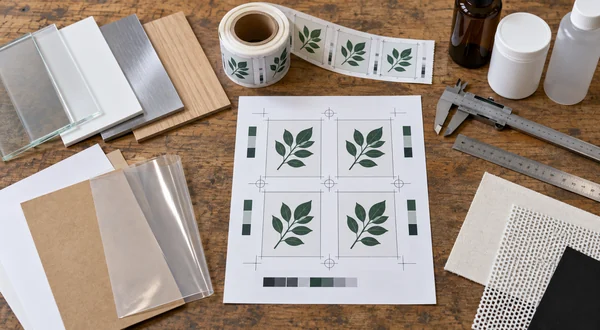
- Artwork with dimensions. Mark the printable image, registration features, direction of travel and any foil layer separately. A preview image without measurements is hard to engineer from.
- Production material. Send a sample roll or sheets from the actual supplier, ideally including an example with earlier print or coating if the job uses one.
- Consumable information. Include the ink, coating, adhesive or foil information you already have. If nothing is selected, say what visual and functional result is required.
- Process sketch. A simple diagram of current equipment, incoming material and the next operation clarifies whether the quote is for one machine or a connected line.
- Acceptance drawing. Identify the measurements and sample checks that determine whether the installation does the job. A phrase such as “high accuracy” is not a test criterion.
What a complete quotation should answer
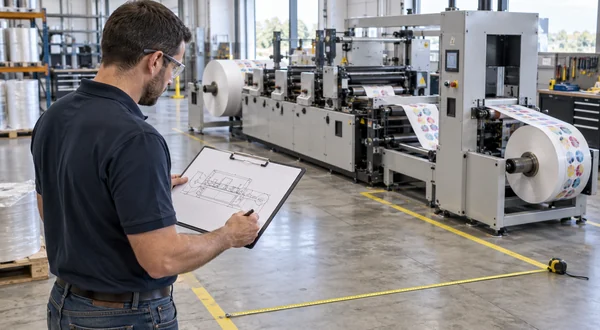
Ask the supplier to identify every supplied module: printing stations, unwind and rewind, dryers, foil units, inspection arrangements and optional equipment. Require the material width, print area and feed length for the exact configuration quoted. Those limits describe different things and should appear separately.
Request a line drawing with total installed footprint and a utility schedule. A main-machine dimension does not cover every connected unit. Ask for the electrical supply, ventilation or compressed-air requirements applicable to the proposed line, plus installation, training, documentation, warranty and service scope for the destination country. Keep the response in writing so competing proposals can be compared against the same brief.
Turn a sample into an acceptance plan
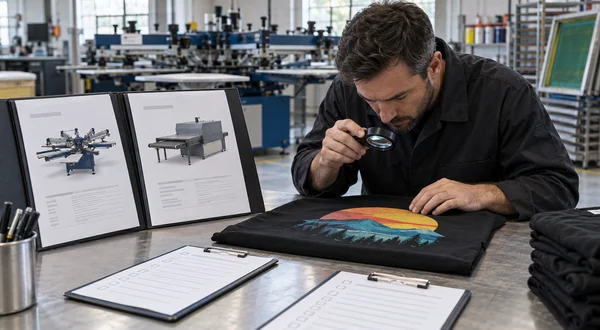
State the material and consumables to be used for a trial, the artwork version and the operating sequence. List how print appearance, registration, curing or drying and handling will be judged. If a later operation such as lamination or die cutting matters, make it part of the evaluation. Retain the accepted sample and its setup record. This is much more precise than accepting a generic demonstration made with unrelated stock.
For output, agree whether the target means impressions, metres of web or accepted finished pieces per hour. Include the repeat length and the number of colors. Published machine speed entries can use units that do not define the finished product, so ask the supplier to show the basis of any output estimate.
Copy-and-paste inquiry example
We print [product] on [material construction and thickness], supplied as [roll or sheets]. The material is [width or sheet size]. Artwork attached: image [width × length], repeat [length], [number] screen colors, with [foil or other finish if any]. The new print must align to [specific mark or feature] within [tolerance and measurement method, or “to be agreed by trial”]. Ink or adhesive: [product or undecided]. The next step is [rewind, die cut, laminate, stack or other]. We expect runs of [length or pieces] and need a proposal for [accepted output basis]. Our factory is in [country] with [space, power and relevant existing equipment]. Please propose a configuration, identify all included modules and utilities, and explain the sample trial and acceptance checks you recommend.
The example uses placeholders deliberately. Fill them with verified job data. Do not copy the bracketed text into a purchase specification.
Direct the RFQ to the right equipment family
You can ask for a process recommendation without naming a model. Use the material format and the operation you need as a starting point, then attach the job details that let an engineer test the fit.
| Equipment family | Start here when | Include in the brief |
|---|---|---|
| Roll-to-roll machines | Roll-fed labels or film | Web construction, width, print repeat and winding direction |
| Registration systems | Printing to existing marks or images | A real marked sample, mark position and the required finished alignment |
| Screen printing and cold foil | Print plus foil, or a separate foil stage | Foil artwork, adhesive route, curing and current line sequence |
| Sheet-fed machines | Individual sheets | Sheet size and stiffness, print image and feed or delivery requirements |
| Specialty machines | Unusual surface or visual effect | Article shape, target effect, sample and acceptance criterion |
| Drying and web handling | Drying, guiding or rewinding stage | Ink or coating, web path, thermal limits and neighboring equipment |
If more than one family looks relevant, describe the complete line from incoming material to finished roll or sheet. The quotation should identify the proposed configuration and what still needs a sample test.
Common RFQ questions
1. Do I need to know the machine model before asking for a quote?
No. Give the application and hard limits first. You can reference a model you have seen, but ask the supplier to confirm whether that configuration suits the production material and artwork.
2. What if the ink or substrate is not finalized?
Mark it as open and describe the required finished result. Ask what samples and supplier data are needed to choose the curing or drying route. A premature assumption can make two quotations appear comparable when they are not.
3. How do I compare two prices?
Put each proposal beside the same list of supplied modules, material and print limits, utilities, trial requirements, installation scope and accepted output basis. An omitted dryer or rewind unit can explain a price gap more clearly than the model names.
4. Which dimensions should appear in the first RFQ?
List the actual sheet or web size, the printed image width and length, and the repeat or feed length where applicable. Mark the image position on a drawing. Those measurements answer different fit questions and should not be combined into one ‘machine size.’
5. How do I specify sample acceptance before a trial?
Describe the finished result and how you will inspect it: registration point, visual coverage, adhesion and any downstream handling that matters. State the allowed variation where you have a defined requirement. Agree on the sample material and measurement method before the trial starts.
6. What factory information helps prevent an incomplete quote?
Send the available floor space, power supply, ventilation or exhaust constraints, and the direction in which material must enter and leave the line. Add any existing dryer, printer or inspection unit that the new machine must connect to. Ask the supplier to confirm final utility requirements for the quoted configuration.
7. Should I request a production rate in labels or sheets per hour?
Yes, but tie it to one defined job and an agreed basis for accepted output. Provide the artwork repeat, colors, material, curing route and inspection criteria. Ask the supplier to state setup and changeover assumptions separately from the running rate.
A simple comparison sheet for two quotations
After the suppliers respond, make a two-column comparison using your original RFQ as the reference. Record the exact machine model and every included option. Next to the quoted material width, print area and feed length, write your required value so that a dimensional mismatch is visible immediately. Add the proposed sample test, the accepted output basis and any condition attached to that output. Leave a blank cell blank; do not assume the missing item is included.
Keep commercial and technical questions distinct. Lead time, payment and warranty belong in the comparison, but they cannot resolve an untested substrate or an unspecified dryer. Send a short clarification list back to each supplier and ask for a revised written proposal where the scope changes. The aim is to make the same job visible in both quotations.
Browse the machine catalogue for possible families, then send the completed brief to Winshol. If the job is a roll-fed label, the roll-to-roll guide explains the format checks in more detail.
This checklist organizes an engineering conversation. Final machine compatibility, output and supply scope require review of the actual materials, artwork and written quotation.
