

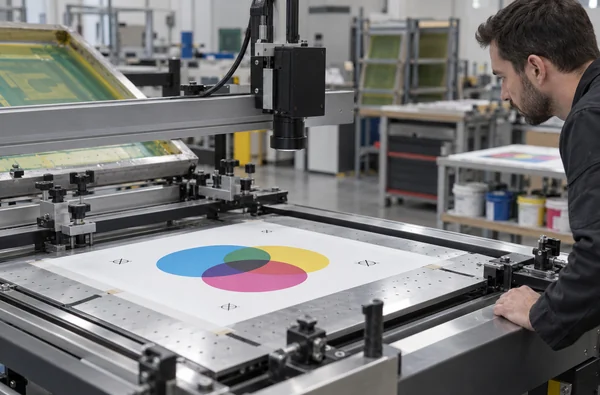
CCD vs Three-Point Registration in Screen Printing
The practical answer: CCD visual registration and three-point registration are different ways of positioning a screen print relative to a reference. Choose between them by examining the actual material, the feature being matched, the direction of feed and the finished-part tolerance. Neither method has a universal accuracy figure. A fair comparison uses the same artwork and substrate, followed by an agreed measurement on printed samples.
First identify the reference, not the camera
“We need accurate registration” leaves the important question unanswered: accurate to what? The next screen layer may have to line up with printed marks, a previously printed graphic, a cut edge, holes or a fixture. Those references are not interchangeable. A visual system needs a visible feature it can locate reliably; another job may be better evaluated around its physical positioning method. Send a marked drawing that shows the reference and the printed feature to be measured.
For a preprinted film, provide samples from a normal production run, including the variation you actually see between rolls. If the reference is on one side of the web and the critical image is far away, note that distance. A registration result measured near a mark may not describe the far edge of a large image, particularly after the material has passed through heat or tension changes.
Build a registration brief that can be tested
| Question | Useful evidence | What it reveals |
|---|---|---|
| What must align? | Layered artwork and a drawing of the finished part. | Which feature, edge or mark defines acceptance. |
| Is the reference visible and repeatable? | Production samples showing mark size, contrast, placement and variation. | Whether visual detection should be trialled with the real material. |
| How is material presented? | Roll direction, web width, sheet size or fixture drawing. | Feed orientation and machine layout to review. |
| How will error be measured? | Named measurement points, allowable deviation and inspection method. | A shared pass/fail rule for the sample trial. |
Specify whether the tolerance applies to one point, the whole printed image or a downstream converted part. Write the unit and measurement method next to the number. Without that detail, two suppliers can quote the same “registration accuracy” while testing different things.
Where substrate movement enters the decision
A reference mark cannot compensate for every change in the material. Film can change dimension between printing steps; tension and drying conditions can also change where the mark sits relative to the rest of the artwork. If the web has already been printed, compare a sample before and after the preceding process. If it is a sheet job, include how sheets arrive and how consistently they are cut or positioned.
Consider a large graphic with a tight alignment requirement at both ends. A camera may find a mark precisely, yet the image can still deviate at the opposite end if the substrate has changed size. That is a process question, not a reason to dismiss camera registration. The trial should inspect the points that matter on the finished item.
Examples from the current Winshol catalogue
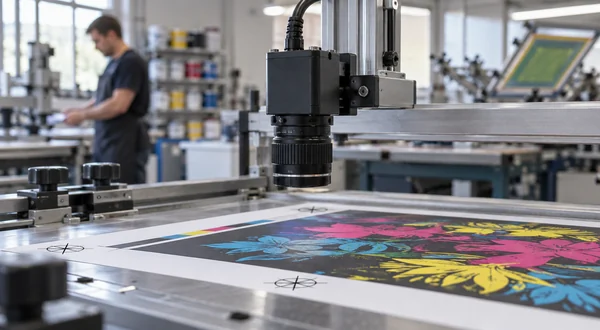
These listings show how configuration and feed direction differ. They do not state a guaranteed numeric registration tolerance.
| Model | Published registration | Maximum web width | Published layout detail |
|---|---|---|---|
| WL-5080CCD | CCD visual registration | 520 mm | Right-side feeding, moving screen and hot-air dryer; maximum print area 500 × 800 mm. |
| WL-5080CCD-Y | CCD visual registration | 520 mm | Left-side unwinding, moving screen frame and hot-air dryer; maximum print area 500 × 800 mm. |
| WL-5080DW | Three-point registration | 510 mm | Separate single-color oven-equipped configuration; maximum print area 500 × 800 mm. |
The two CCD models list a 520 mm maximum web width; the three-point WL-5080DW lists 510 mm. For a roll close to either limit, send the actual web width and mark position before treating it as a fit. The published widths do not specify the edge space available for guiding or registration.
The two CCD examples should not be treated as the same layout with a different suffix. One is listed with right-side feeding; the other has left-side unwinding. Check where material comes from and where it must go in the customer’s plant. The registration machine family provides a wider starting list.
A sample test that answers the buying question
- Supply the same production material, preprinted samples where relevant, original artwork and a drawing of the registration feature to each proposed process review.
- Agree the printing and drying sequence. Include the line conditions used before this print step; otherwise the sample may not reflect production material.
- Mark the measurement positions on the finished sample. Inspect several samples from a run, including the start and end, rather than accepting one well-aligned sheet or label.
- Record the machine configuration and the inspection method. If the material changes shape in a later drying or conversion step, inspect after that step as well.
Ask for the result in the language of your own drawing: “new white layer to existing black border at points A and B,” for example. That is more useful than a general claim that a machine is “high precision.” If a numerical acceptance limit is essential, put it in the project specification and have it confirmed in writing.
Make the comparison fair
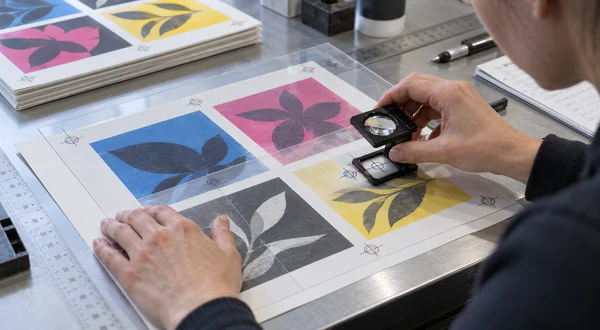
If you compare a CCD proposal with a three-point proposal, give both teams the same material batch and artwork version. Tell them how the material was preprinted, dried or cut. Ask each to return a sample and a short setup record, including feed direction, reference used and the points measured. A trial with a clean laboratory mark and another with variable production preprint cannot support a fair conclusion.
Inspect more than one position across the image and more than one piece in the run. If an error appears only at the far edge or after the dryer, that pattern matters. Record it without assigning a cause too soon. The supplier can then review whether the reference, material behavior or line configuration needs to change.
For purchasing, ask which registration method and feed orientation are actually included in the quoted machine. The published model descriptions show distinct configurations; options and acceptance terms belong in the written scope. This prevents a demonstration on one arrangement from being mistaken for a commitment on another.
Common questions
1. Does CCD automatically give better registration?
Not on every job. It is a visual registration method. Mark quality, substrate stability, feed and the measurement point all affect the finished result. Compare test samples against the same acceptance rule.
2. Can a three-point machine be described as CCD assisted?
No. The published WL-5080DW configuration identifies three-point registration, while the WL-5080CCD and WL-5080CCD-Y identify CCD visual registration. Quote the configuration actually offered.
3. What if there are no registration marks?
Show the existing artwork or physical features that could serve as a reference, and ask the equipment team to review them. Do not assume a camera can locate a feature that has not been tested for contrast and repeatability.
4. How should a registration tolerance be written in an RFQ?
State the permitted offset in both feed and cross-feed directions, and show where it will be measured on the finished piece. Include the sample size and inspection method. A single tolerance number without a measurement point is difficult to test consistently.
5. Why can a print look aligned near the mark but drift farther away?
The mark may be detected correctly while sheet movement, material stretch or artwork geometry changes the position elsewhere. Measure several positions on the same sample and send the marked results to the equipment team. That separates a mark-reading issue from a handling or layout issue.
6. What should I send for a CCD registration trial?
Send production material, the actual artwork, existing print or marks, and a drawing of the required alignment. Identify the feed direction and the point at which the finished part will be judged. A trial on a convenient substitute material may not answer the production question.
7. Can I choose the registration method from the catalogue tolerance alone?
Use the published machine data to form a shortlist, then test the job against its own acceptance rule. The relevant result is the measured offset on your material after printing and handling. Ask for the trial conditions to be recorded with the sample.
Send the artwork, samples and tolerance drawing with the machine RFQ checklist. If the registration problem involves a roll-fed label, the roll-to-roll selection guide covers the rest of the line.
Model descriptions and dimensions follow the linked Winshol product pages and supplied catalogue. The final registration method and acceptance limit require a project-specific trial and quotation.
