

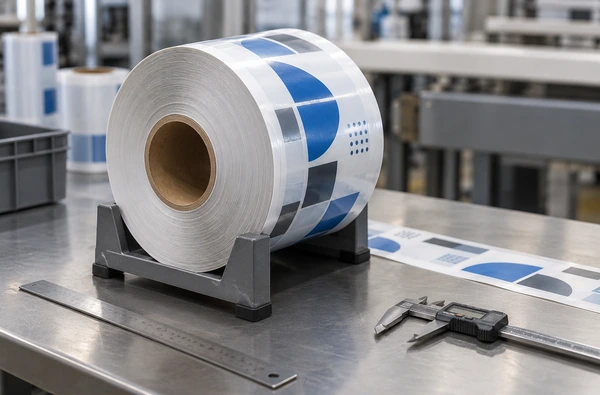
When Should You Add a Web-Guiding Rewinder to a Roll-to-Roll Screen Printing Workflow?
A printed roll can look fine beside the press, then arrive at the next operation with edges that step in and out. Another job may have tidy roll edges but an image that wanders across the web. Those jobs need different fixes. A separate web-guiding rewinder is worth evaluating when the incoming roll needs preparation or the finished roll needs controlled edge alignment and winding. It cannot go back and correct an image already printed out of position.
Winshol’s WL-500JPDJ web-guiding rewinder is auxiliary equipment for roll-fed material. Its catalogue lists one guiding unit, a length counter and a maximum web width of 500 mm. Decide where an additional rewind pass would fit in your production route, then test whether it improves the roll delivered to the next station.
Find out which position is moving
First, name the reference that matters. A roll edge, the centerline of the web, a printed line and a registration mark are different references. They may move differently. Avery Dennison’s edge-position-control bulletin describes edge, center and printed-line guiding as separate approaches. The sensor reference on the proposed equipment should match what the next operation needs to locate.
Measure the incoming roll before changing the press. Take short samples near the outside, middle and core. Check both roll faces for telescoping and photograph edge steps. If the material is preprinted, measure the distance from a consistent print feature to each web edge. Then repeat the relevant measurements immediately after printing and after any separate slitting or rewinding step. Use the same machine side and artwork reference each time.
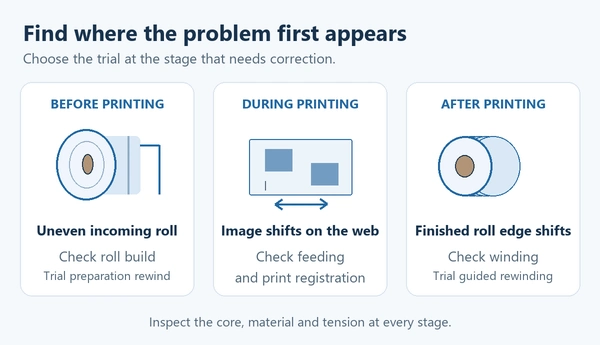
| What you see | First place to check | What a separate rewinding pass may change |
|---|---|---|
| Incoming roll has uneven edges, a displaced core or loose wraps | Stock preparation, core seating and unwind behavior | It may prepare a more even roll if the material and existing damage permit. Test the prepared roll on the press. |
| Printed image shifts sideways relative to a sound web edge while the press runs | Press feeding, guide reference, registration and web path | An offline rewinder cannot move ink already printed. Review the press or its integrated guiding arrangement. |
| Image position is sound, but the finished roll builds with stepped or telescoped edges | Rewind position, core, tension and roll build | A guided rewind stage may improve edge alignment. It will not repair an unstable ink layer or a poor slit. |
| Edges look even, but a later die cutter misses its print reference | Print-to-cut registration and the reference used by the cutter | Check whether the cutter follows an edge, centerline or printed mark before specifying a guide. |
Before attributing a telescoped roll to edge position alone, inspect the core, web thickness and winding tension. Maxcess’s winding-defect guide identifies all three as possible causes. A guide can position the web at the rewind; a shifted core or uneven material still needs its own remedy.
Understand what the guide can control
In a typical guide, a sensor reads a chosen web position, a controller compares it with the target, and an actuator makes a lateral correction. The place where the correction happens matters. Maxcess’s Fife guiding brochure distinguishes an unwind stand that shifts the supply roll from a rewind stand that aligns the arriving web with the winding roll. BST describes unwind and rewind guides as a way to control edge position and roll build. Ask Winshol which sensor reference and correction mechanism the quoted WL-500JPDJ uses; these general descriptions do not specify its components.
An offline machine adds a separate pass. Before printing, it can be trialed as a roll-preparation step. After printing, it can be trialed to deliver a roll with a more consistent edge to slitting, die cutting or another customer process. If the web drifts during the print stroke itself, trace the feed and registration path on the press. Our CCD versus three-point registration guide addresses that machine-selection question.
Guiding and tension are related but should not be treated as the same adjustment. Avery Dennison’s tension-control bulletin links poor tension control with wrinkles, misregistration and loose or tight rolls. It also explains that unwind and rewind conditions change as roll diameters change. An edge can be centered at the winding point while the roll is still too tight, too soft or uneven through its depth. Judge both edge position and the finished roll’s condition.
Decide whether an extra rewind pass earns its place
Consider a separate pass when incoming rolls repeatedly cause setup interruptions, yet the supplied material is otherwise usable. Trial a prepared roll and an unprepared control roll on the same artwork. Record how long threading and registration take, where the web runs, how many metres are rejected at startup, and whether the improvement persists as the roll diameter falls. Judge the prepared roll by its behavior on the press.
The second case is downstream handling. If the print passes inspection at the press but the roll delivered to a die cutter, laminator or customer telescopes, test a guided rewind after the ink has reached its specified handling condition. Measure edge alignment at the first wraps, middle and outer wraps. Then run the roll through the actual next process. A roll that looks square on a pallet can still wander when it unwinds.
An extra pass costs operator time and exposes the web to another set of rollers. For scratch-sensitive film, inspect both surfaces before and after the rewind trial under the customer’s normal light. For recently printed material, check ink transfer, blocking and rub resistance after cooling and winding. The process is worthwhile only if the accepted roll quality or downstream efficiency compensates for the added handling. The project’s guide to accepted labels per hour explains how to record output at the stage that matters to the buyer; a rewind step should be included in that route when it is required for delivery.
Some defects call for another action first. A rough slit edge will remain rough after guiding. Thickness variation across a web can affect the way a roll builds even when its edge is held in position. If printed images move relative to registration marks, review the press’s feed, tension zones, artwork and registration method. If the ink scuffs during the proposed rewind, approve the drying and handling condition before asking the rewinder to run faster. Keeping these observations separate prevents a good roll-edge result from concealing a bad printed product.
Check the WL-500JPDJ against the actual job
The WL-500JPDJ catalogue entry lists a 500 mm maximum web width, a web-guiding unit and a length counter. Its listed maximum speed is 50 m/min; that is a machine rating, not an approved speed for a particular film or printed label. The listed power supply is 220 V, rated power is 1 kW, and main machine dimensions are 1000 × 700 × 1200 mm. Allow additional space for loading reels and operating the machine.
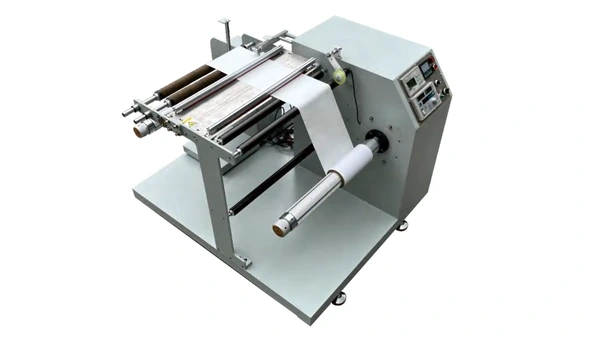
The catalogue heading says WL-500JPDJ. Its English caption and specification table abbreviate the name to WL-500JP. Refer to both when requesting a quotation so that the supplied configuration is unambiguous.
Several buying limits need written confirmation because they are not defined in the supplied table: maximum starting and finished reel diameter, reel weight, compatible core sizes, material thickness range, operating tension range and numerical guiding accuracy. Also ask which reference the guide uses on your material and how the length counter is calibrated. Do not infer an edge-position tolerance from the presence of a guiding unit.
Check width in two ways. First, compare the full material width with the rewinder’s 500 mm maximum. Then compare the artwork, edge margin and any registration marks with the printer’s usable width. A web that fits the rewinder is not automatically printable on the proposed press. The web width versus print area guide explains why those dimensions must be checked separately.
Run a comparison that includes the next operation
Use two rolls from the same material specification, with the same width, coating, liner and core. Keep one as the current-process control. Guide and rewind the other under agreed conditions. Label both rolls and record the start diameter, core size, material orientation and any pre-existing edge damage. If only one roll is available, keep clearly identified sections from before and after the trial; do not describe them as equivalent production runs.
Agree on the pass criteria before starting. A useful trial record includes the reference being guided, allowable edge variation, roll-face appearance, winding tightness, surface condition, counted length and the amount of unusable material. Note the setting and roll diameter when each sample is taken. Record stoppages and changes to tension or speed, especially if the result improves only after repeated adjustment.
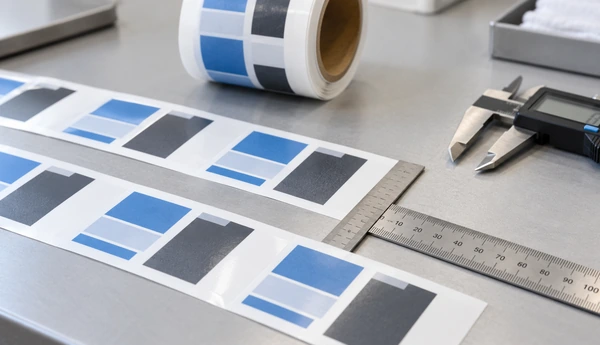
Inspect the trial roll near the core, in the middle and at the outside. Then load it into the actual printer or finishing equipment. Does it thread without a large lateral correction? Does the printed image stay where the next station expects it? How much web is rejected before stable running? For a post-print rewind trial, check that the image and ink surface still pass after the roll has been stored and unwound again. Report the outcome at the customer’s acceptance point, not only at the rewinder exit.
A short trial may show that the material can be guided at one diameter. It does not prove the same edge quality across a full reel or at the catalogue’s maximum speed. Ask for a run length that includes meaningful changes in roll diameter, or state that the result is a limited demonstration. Keep failed sections so the equipment team can distinguish edge motion, poor winding and substrate damage.
Send a quotation brief that defines the handoff
Provide the material construction and thickness, web width, edge condition, core inside diameter, reel diameters and weights. Add the direction of winding, which surface faces outward, the required length count and the next process that will receive the roll. Mark the required reference on a sample: operator-side edge, drive-side edge, centerline or printed line. State the maximum allowed deviation and how it will be measured.
Send a simple process sketch showing whether the separate pass is before or after printing. Include current photographs of acceptable and rejected roll faces, a print-to-edge measurement if relevant, and the operating speed you hope to use. Ask Winshol to confirm the final reel limits, guiding method, tension arrangement and practical trial speed for that stock. The broader machine RFQ checklist covers installation and sample-trial details. The supplier can then quote against an observable roll result instead of the phrase “better tracking.”
Common questions
1. Can a separate web-guiding rewinder fix print misregistration?
It cannot correct ink that has already been printed out of position. Identify whether the image moves relative to the web edge, a printed reference or another color while the press runs. Address that movement in the printing and registration process.
2. Is web guiding the same as web tension control?
No. A guide controls lateral position against a selected reference. Tension affects how the web travels and how the roll builds. A job can need both controls, and a tidy edge does not prove that the roll has acceptable winding tension.
3. Should I rewind before printing or after printing?
Trial before printing when poor incoming roll build is causing feeding or setup problems. Trial after printing when the image passes at the press but the delivered roll edge or winding quality fails. Some workflows need neither separate pass.
4. Will the WL-500JPDJ run every 500 mm-wide material at 50 m/min?
The catalogue lists 500 mm as maximum web width and 50 m/min as maximum speed. It does not guarantee that speed for every film, coating, ink or roll size. Establish a working setting with the intended material and finished-roll criteria.
5. What does its length counter tell me?
The listed configuration includes a length counter for material processed during rewinding. Confirm its measurement method and acceptable counting tolerance for your job. It does not, by itself, certify the number of good printed labels.
6. Can edge guiding repair a telescoped roll?
It may help align material during a new rewind pass, but first inspect the core, web thickness, tension and any damaged wraps. Severely damaged stock may not produce an acceptable roll simply by running through a guide.
7. Are WL-500JPDJ and WL-500JP different models?
The supplied catalogue uses WL-500JPDJ in the heading and WL-500JP in the English caption and table for the same entry. Give the supplier both references and request the final configuration in writing.
8. What should a supplier demonstrate before I buy?
Ask for a roll made from your production material at a recorded setting. Inspect its edge and surface at several diameters, then run it through the next printing or finishing operation. Agree on the acceptable edge position, winding condition, counted length and material loss before the trial.
