





How to Specify Screen Printing Stencils: Emulsion, EOM and Exposure Checks
A screen printing stencil order should identify the emulsion or film, its compatibility with the ink and cleaning products, the required dry stencil build, and the evidence used to approve exposure. Add the artwork revision, inspection points and a representative production trial. Keep those details with the mesh and frame specification so the next screen maker can reproduce the approved construction.
This guide is for industrial label and film producers buying prepared screens, qualifying a screen-making supplier or transferring a job to another press. It concerns the photo-stencil on the mesh. Screen preparation and the curing of printed ink are separate operations.
Define what the screen supplier must deliver
Start with a production-size drawing. Mark the smallest positive lines, reverse openings, text and edges that determine whether the job passes. Identify the layer being printed and the substrate that will receive it. A stencil for an opaque graphic and one for a fine functional pattern may need different approval criteria.
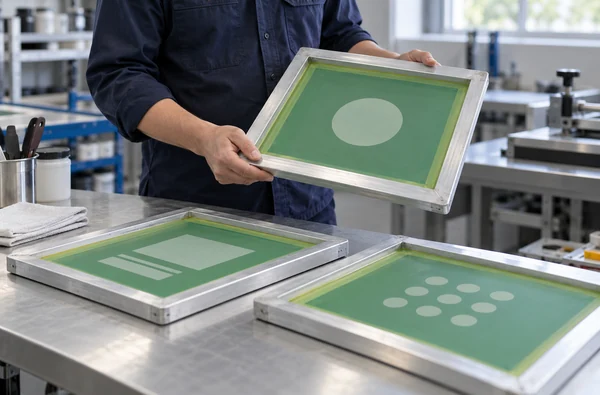
Specify whether the order covers coated screens awaiting imaging or exposed, developed screens ready for the press. For ready-to-print screens, assign responsibility for artwork orientation, image position, blockout, inspection and protective packing. Keep one approved artwork revision attached to the order.
The mesh selection guide covers fabric construction. Carry that approved mesh record into the stencil enquiry rather than changing mesh and stencil together without a documented reason.
Compare direct emulsion and capillary film for the job
Direct emulsion is applied as a liquid to the mesh. Its coating and drying procedure help determine the resulting stencil. Capillary film starts with a supplied coating thickness and is adhered to the mesh before exposure and development. In either route, approve the completed screen, not just the material in its container or roll.
Ask a direct-emulsion supplier how it controls coating variation across the image and between replacement screens. For a film proposal, ask for the exact film grade, nominal thickness, recommended mesh and application method. Do not assume that nominal film thickness equals measured emulsion over mesh on the finished screen.
Ulano’s CDF Vision technical sheet illustrates the product-specific choice: it pairs film grades with mesh ranges, identifies compatible ink families and describes adhesion to wet mesh. That is evidence for one film system, not proof that every capillary film suits every ink or that it outperforms direct emulsion.
Compare the two routes using the same artwork and acceptance conditions. Include screen-making time, rejected screens and repeat-order consistency in the comparison. Compare the cost of accepted, ready-to-print screens rather than the price of a sheet or container alone.
| Quote item | Direct emulsion | Capillary film |
|---|---|---|
| Material identity | Name the emulsion and any required sensitizer. | Name the film grade and supplied thickness. |
| Preparation record | Ask for the coating and drying procedure. | Ask for the mesh compatibility and application procedure. |
| Acceptance | Compare measured finished-screen properties, developed detail and the same production trial. Neither route is approved from its material designation alone. | |
Check the ink and cleaning products together
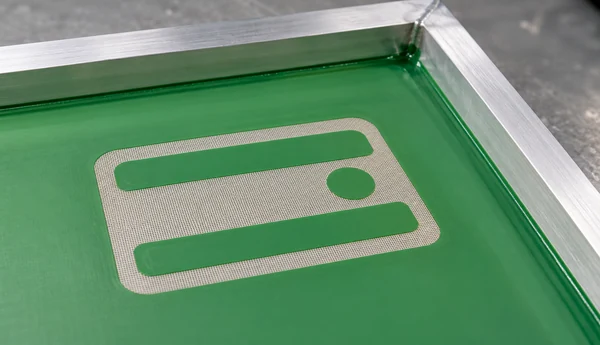
Send the screen maker the exact ink series, color, approved additives and press-cleaning products. Identify any wash used during production, how often the stencil is cleaned and whether screens are retained for repeat orders. The stencil will encounter those products throughout production, including during pauses and cleanup.
The label “dual-cure” or “photopolymer” does not settle compatibility. For example, SAATI’s Grafic HU data sheet, revision 2, October 2024, names several ink families for that particular direct emulsion and gives its own preparation and reclaiming instructions. Request the equivalent current document for the proposed product.
Have the supplier confirm the actual ink-and-cleaner combination. Include planned screen reuse or reclaiming in that review. The CDF Vision sheet warns that strong screen openers or ink washes can make its stencil difficult to reclaim. A choice that survives printing but prevents the planned reuse of the mesh may change the purchasing decision.
Specify dry stencil build and surface quality separately
Record EOM as a measured result
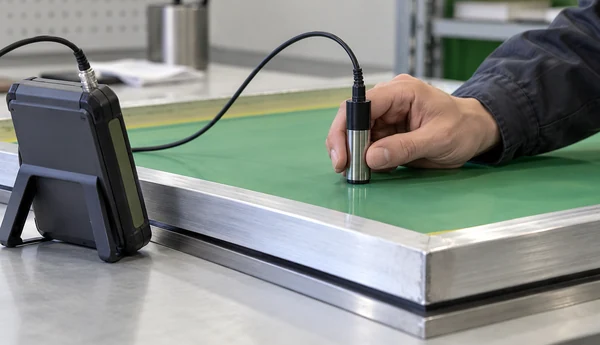
EOM means emulsion over mesh: the stencil build beyond the mesh thickness. State the unit, measurement method and agreed sampling positions. Keep the dry-screen reading separate from the thickness of the ink later printed on the substrate.
DeFelsko’s screen-printing measurement guidance describes zeroing its suitable probe on stretched mesh, then measuring the coated screen to obtain EOM. It recommends multiple readings to account for variation. The stretched mesh matters because its thickness can differ from the fabric supplier’s unstretched value.
For procurement, ask for a measurement map covering agreed positions around the image, together with the instrument and preparation condition. Have the screen maker and process team agree on the acceptable range. A coating instruction such as “two coats” is useful process information, but it does not replace a measured result.
Keep Rz distinct from thickness
Rz describes surface roughness. SAATI’s stencil roughness-meter data sheet links print-side roughness to edge definition and the stencil’s contact with the substrate. Thickness and surface profile therefore answer different inspection questions.
When surface measurement is needed, agree on the instrument, parameter, units, measurement locations and procedure before comparing suppliers’ results. Do not accept a sheet headed only “roughness” if one supplier reports Rz and another reports Ra. Tie the chosen range to acceptable prints on the actual substrate rather than imposing a universal value.
Keep the inspection record simple: dry mesh reference, EOM readings, any required surface measurements and photographs of the critical developed features. Measure printed ink thickness separately if the customer requires it.
Approve exposure for the actual imaging route
Record whether the screen uses a film positive, an ink or wax mask, or direct exposure. Identify the exposure equipment and the stencil product. Copying the exposure time from another screen leaves the mesh, coating and imaging conditions uncontrolled.
The Grafic HU sheet gives different sensitivity-guide criteria for film-positive and direct-to-screen routes. That is a useful warning against putting one step number into every purchase specification. Follow the selected stencil supplier’s instructions and retain the test result.
SAATI lists a 21-step guide and an exposure calculator as separate tools. The former provides a developed-step result; the latter helps compare resolution and definition at different exposures. Ask for both exposure evidence and inspection of the job’s critical features. A step result alone does not show whether the required reverse text or narrow opening survived.
Include a test print in qualification. Ulano’s CDF Vision instructions explicitly include actual printing in exposure evaluation. Keep the developed-screen inspection and the printed sample together so that acceptance does not stop at an attractive image on the mesh.
Inspect the prepared screen before releasing it to production
The following is a proposed receiving check, not a universal stencil-manufacturing procedure. Agree on its limits with the screen supplier:
- Match the screen ID, artwork revision, ink layer and emulsion or film designation to the order.
- Check image orientation and position against the frame drawing.
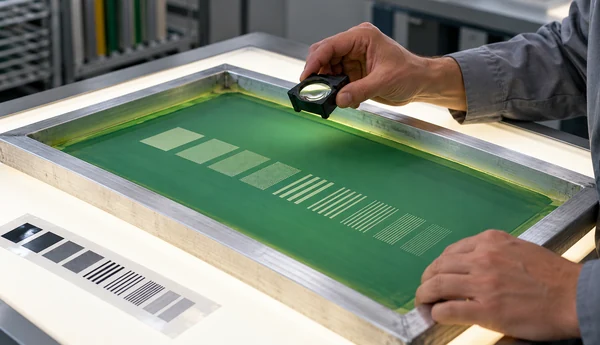
- Inspect critical openings and edges under the agreed magnification; look for unwanted openings or residual material.
- Confirm the required dry condition, cleanliness and absence of handling damage.
- Retain the measured stencil record and exposure check, with any exceptions resolved before use.
SAATI’s stencil quality-control guidance treats moisture as a separate check before exposure. A recorded drying time is not the same evidence as a confirmed dry condition. Let the selected material’s instructions determine the drying and storage procedure.
Check durability during the intended run
Agree on a representative run that includes the planned ink, substrate, squeegee setup, pauses and cleaning routine. Retain samples early and later in the run, then compare the critical features and coverage. Record any growing edge defect, unwanted opening or loss of detail, and inspect the stencil before assigning a cause.
If screens will be cleaned, stored and reused, include that cycle in qualification. Set the run length and inspection frequency around the order pattern. A few good impressions cannot establish an arbitrary lifetime guarantee.
Approve the stencil specification with the print samples and setup record. For repeat orders, require review of changes to the product grade, coating or film route, imaging method and agreed measurements. Keep that record available when another buyer places the replacement order.
Confirm the press interface with Winshol
A qualified stencil must also fit the quoted press. Winshol’s WL-350S two-color roll-to-roll model lists a 550 × 700 mm screen frame and a 330 × 450 mm maximum print area. Those dimensions do not establish a universal emulsion, EOM or exposure setting.
Send the frame drawing, image location, approved screen record, artwork, substrate and ink data with the machine enquiry. Confirm the clamping arrangement and who supplies initial and replacement screens. Use the machine RFQ checklist for the wider equipment scope, and contact Winshol to review the proposed press and material trial.
Frequently asked questions
1. Is mesh count enough to order a replacement screen?
No. Include the mesh identity, frame and artwork drawing, stencil product, measured build, exposure approval and required inspection. A replacement with the same nominal mesh count can still differ in stencil construction or image position.
2. Is capillary film always better than direct emulsion?
Choose through a comparison on the actual job. Check chemical compatibility, the finished stencil, preparation consistency and production results. A supplied film thickness can simplify part of the process, but it does not remove application, exposure and development checks.
3. What EOM value should I specify?
Agree on a range with the screen maker for the selected mesh, stencil system, ink and artwork. State the measurement method and sampling locations. Do not copy a general percentage or nominal film thickness into the order without qualifying the resulting screen.
4. Does the EOM measurement tell me the printed ink thickness?
It describes the stencil build, not the finished ink layer. If printed thickness matters, define a separate measurement on the specified wet, dried or cured print. Keep both records linked to the same screen and press trial.
5. Why specify Rz as well as stencil thickness?
They describe different properties. Where edge quality is critical, surface-profile measurement can help control the approved stencil condition. Agree on the roughness parameter and method; do not treat an Rz reading and an Ra reading as interchangeable results.
6. Can every screen use the same exposure time or step target?
No. The stencil product, coating, mesh and imaging route must be considered. Use the material supplier’s exposure method and inspect the developed features. Retain a printed qualification sample rather than accepting a timer setting alone.
7. Should press-wash chemicals be included in stencil approval?
Yes. Identify the actual cleaners and the planned cleaning cycle, including whether the screen will be reused or reclaimed. Ask the stencil supplier to review them with the ink, then include the intended routine in the representative trial.
8. What should accompany a prepared screen at delivery?
Request its ID, artwork revision, mesh and stencil product identification, agreed dimensional and measurement checks, exposure record and inspection result. Add handling and storage instructions. Retain the accepted print and change-control record for later replacements.