





Contact vs Non-Contact Web Cleaning Before Roll-to-Roll Screen Printing
Choose a web cleaner by the contamination it must remove and the surface it must leave intact. Contact systems and non-contact systems can both be relevant to a roll-to-roll screen-printing project. The choice needs a trial on production stock, including the intended web movement and finished-print acceptance criteria.
This guide concerns particle removal before printing. The purchasing decision is whether the proposed stage removes the relevant contamination while preserving the film, coating and print result. Cleaner supply and integration must be confirmed for the quoted line.
Identify what needs removing before comparing equipment
Keep a sample of the incoming web and a sample showing the problem. Record the material designation, coated side, lot and where the contamination first appears. Separate loose particles from a mark or residue that seems attached to the surface. Ask the material and cleaning suppliers to confirm what the proposed process can remove.
Teknek’s contact-cleaning guidance identifies dry unattached contamination as a suitable target. It also notes that materials shedding large quantities of particles may call for vacuum or a hybrid approach. Describe both particle type and loading in the trial brief.
A particle-removal stage should not be specified as a substitute for surface treatment, the correct ink or adequate drying. If the complaint is missing ink, first use the screen-printed label pinholes guide to distinguish the defect. A clean web can still print badly for a different reason.
Compare how particles are removed and collected
“Contact” covers more than one design. The table below focuses on an elastomer-roller approach versus non-contact airflow cleaning. Brush and contact-vacuum designs need their own assessment rather than being treated as identical to an adhesive-roll system.
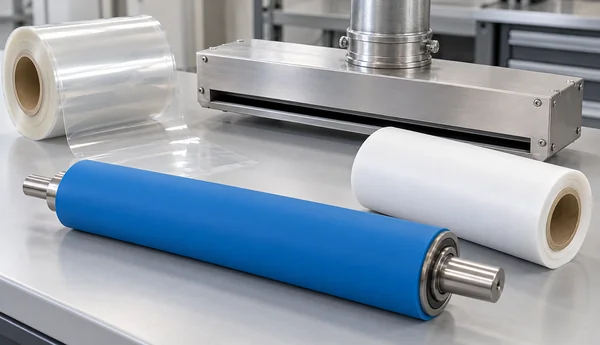
Teknek describes an elastomer roller picking particles from the material and transferring them to an adhesive roll. Its applications include films and roll-to-roll materials. Meech’s selection guide describes non-contact systems using airflow and static control to remove and collect contamination; it identifies sensitive surfaces, web dimensions, speed, tension and access as selection factors.
| Purchase question | Elastomer contact cleaning | Non-contact airflow cleaning |
|---|---|---|
| What touches the material? | A cleaning roller contacts the selected face. Confirm compatibility with its coating or finish. | The cleaning head is intended to work without touching the web. Confirm the required gap and web support. |
| Where do the particles go? | Ask how pickup and transfer to the adhesive collection roll are maintained. | Ask for the removal, extraction and collection arrangement, not just an air nozzle. |
| What belongs in the trial? | Removal performance, surface condition, handling and the condition of the collection materials. | Removal performance, surface condition, web stability and the specified airflow arrangement. |
| What belongs in the cost comparison? | Approved rollers and adhesive consumables, servicing tasks and access time. | Specified air-handling equipment, filters, utilities, servicing tasks and access time. |
Use this checklist to compare the actual quotations; it does not rank the two methods. Have each supplier identify its proposed components. A film described simply as “PET” is not enough to establish whether contact is acceptable; its coating, exposed face and quality requirements still matter.
Approve the actual surface, including the handling result
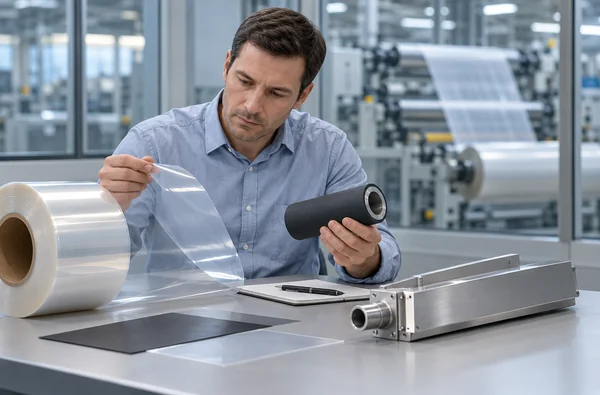
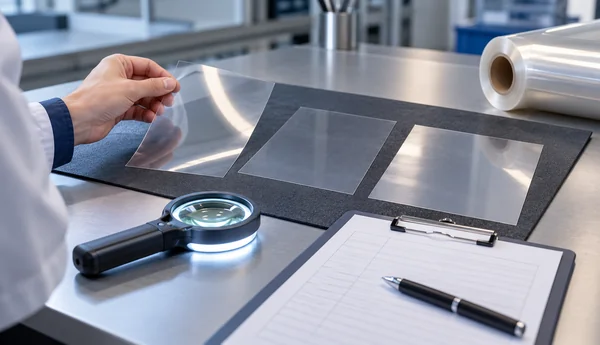
Send a production roll or representative material agreed with the suppliers. Identify which face must remain untouched, which face will be printed and whether the construction includes a liner or existing print. Include a physical sample of the surface condition the customer accepts.
Inspect both particle removal and any new marks after cleaning. For a sensitive construction, agree on the examination conditions before the demonstration. A change in lighting between the incoming and cleaned samples makes comparison less useful. Follow the web through printing and rewinding as well: approval at the cleaning head alone does not establish the finished result.
Thin material deserves a specific handling check. Teknek’s thin-material discussion describes the risk of material wrapping around contact rollers and the role of the selected roller design. Its examples are not universal limits for every web. Have the supplier demonstrate the proposed arrangement on the construction you intend to buy.
The scratch-sensitive film guide covers the wider task of locating damage along a press. Use it if the mark first appears elsewhere in the line.
Put the whole cleaning stage on the line drawing
Show the movement the cleaner will actually see
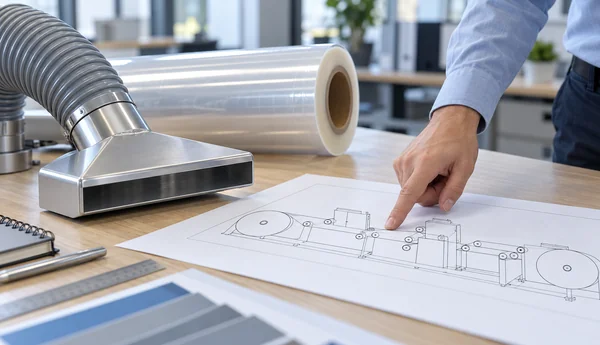
Mark the proposed cleaning position, neighbouring rollers, print face and direction of travel. Give the suppliers the minimum and maximum web widths and the intended operating sequence. For an indexing press, describe running, dwell and restart rather than supplying only a maximum speed.
Ask the cleaner supplier to confirm its operating conditions and the machine supplier to review the proposed interface. Include web support, access for threading and the space needed for service. Do not select a working distance, roller load or airflow setting from a photograph.
Include collection and service access
Request a complete supply list: cleaning head, collection arrangement, required utilities, controls, mounting components and installation responsibility. Where extraction equipment is proposed, include its location and the route to the cleaning head in the review. Where consumables must be renewed, ask how an operator reaches them safely.
Static control may be part of the cleaning package, but it does not by itself establish particle removal. The static-control buying guide explains that separate assessment. Any electrical installation, guarding or exposure assessment belongs with qualified personnel and the applicable site requirements.
Compare maintenance against the real contamination load
Ask for the current instructions for the exact quoted configuration. Teknek’s service guidance calls for preventive maintenance and operator training, including knowing when to refresh adhesive and cleaning rollers. The purchasing brief should identify those tasks without inventing a replacement interval.
For a fan-driven system, request the filtration and maintenance instructions too. Meech’s air-handling guidance relates filter maintenance to contamination conditions. Compare the proposals using the same production assumptions, not one supplier’s best-case operating cost against another’s full service allowance.
During the trial, record any cleaning, consumable change or interruption. Ask which actions an operator may perform and which need service support. Carry the agreed maintenance tasks into the handover documentation so that a good demonstration can be repeated after the equipment arrives.
Write an acceptance record that can be repeated
The following is a proposed procurement method, not a report of a Winshol test. Set application-specific limits with the buyer, material supplier, cleaning specialist and machine supplier.
- Define the result. State what contamination is unacceptable and how it will be inspected. Agree on sampling area, lighting, magnification where relevant, and the finished-print defect criteria.
- Record a baseline. Retain incoming material from the trial lot. Label the web face and sample position. Do not disable a safety control to create a comparison.
- Run representative conditions. Use the agreed web construction and operating range. Include a normal stop and restart if these are part of production.
- Inspect across the width. Compare samples before and after cleaning at agreed locations. Check for particles, new marks and handling changes, then inspect the printed and rewound material.
- Retain the complete record. Keep accepted and rejected samples, settings, maintenance actions and the quoted equipment configuration. Specify when a material or process change requires another review.
Keep the samples as well as the photographs. A lower particle count with persistent print defects calls for further investigation. New surface marks are also a failed result if they exceed the agreed limit.
Discuss the cleaning requirement with the line suppliers
For a Winshol screen-printing enquiry, send the material construction, artwork, ink and drying requirements together with the contamination evidence and marked layout. Ask which interfaces can be reviewed within the machine project and which need a cleaning specialist.
Confirm who supplies, installs and supports each item. A cleaner should appear explicitly in the agreed scope if it is to be included. Use the machine RFQ checklist for the wider project information, then contact Winshol with the proposed trial and acceptance requirements.
Frequently asked questions
1. Should a roll-to-roll screen-printing line use contact or non-contact web cleaning?
Choose against the actual surface and contamination, then prove the result in a representative trial. Contact cleaning can be suitable for films as well as other materials. A delicate coating may favour a non-contact approach, but the proposed cleaner still needs to demonstrate particle removal without unacceptable handling or surface changes.
2. Does an anti-static bar replace a web cleaner?
No. Neutralising charge and removing particles are different tasks. A cleaning system may include static control, but the purchase specification should also explain how contamination is detached, collected and kept away from the next process. Ask for a cleanliness result, not only an electrical status indication.
3. Can a web cleaner solve every pinhole or adhesion problem?
No. A particle-removal trial addresses contamination within the cleaner’s stated scope. It does not establish that the ink, stencil, substrate treatment or curing process is correct. If particles are reduced but print defects remain, continue the defect investigation rather than accepting cleaning as the complete remedy.
4. What should be tested on a coated or scratch-sensitive film?
Use the production construction and the relevant face of the web. Compare particle removal and the surface before and after cleaning, then inspect the printed and rewound result. Agree on the lighting, magnification and unacceptable marks in advance. Include the intended operating range and a normal stop and restart where applicable.
5. Why does intermittent web movement matter when choosing a cleaner?
Give the cleaner supplier the running, dwell and restart sequence of the indexing press, alongside the intended speed range. Ask which of those conditions its proposal covers. The trial should include that sequence, with the agreed web support, tension and surface inspection, rather than only a continuous-motion demonstration.
6. Should the cleaner remove particles from one side or both sides?
Decide from the material construction and the route through the line. Identify the print face, any exposed adhesive or sensitive coating, and the surfaces that will contact subsequent rollers or the opposite web face. Ask the suppliers to justify the proposed coverage and check both faces in the acceptance samples.
7. How should maintenance costs be compared?
Request a list of consumables, replacement parts, cleaning tasks and required utilities for the quoted configuration. Record the service actions during a representative trial and use the supplier’s maintenance instructions. Do not apply a universal adhesive-sheet or filter-change interval to every material and contamination load.
8. What should be sent to Winshol for a line review?
Send the web construction, width range, ink and drying process, operating sequence and a marked line layout. Include contamination samples or scaled photographs and the required finished-print result. Ask Winshol and the cleaning specialist to confirm the review scope, proposed interfaces and supply responsibilities; a cleaner is not assumed to be included in a press quotation.