







Screen Printing Ink Viscosity: Measurement and Control for Film Printing
Specify screen printing ink viscosity together with its measurement method. A number without the instrument, test conditions and ink preparation history is a weak basis for comparing samples or accepting a printing trial. There is no single viscosity target that fits every film, ink and screen-printing process.
Before a machine trial, agree a repeatable measurement method with the ink supplier and link its results to printed film. The record below is intended for that discussion. Ink recipes and any automatic control equipment need separate confirmation.
Decide what the reading needs to tell you
A receiving check asks whether an ink batch matches an agreed reference. A press-side check asks whether the prepared ink remains inside a qualified operating window. A laboratory investigation may ask how the ink responds to different shear conditions. Choose the check around the decision you need to make.
Ask the ink supplier which purpose its published value serves. Is it a specification for ink as supplied, a method for prepared ink, or a typical laboratory result? Confirm the exact ink series and shade. Do not turn a typical value into a contractual acceptance limit without agreement.
Shear thinning and thixotropy describe different effects
Shear thinning means that viscosity decreases as shear rate increases. Thixotropy includes a time-dependent change under shear and recovery after it is removed. The terms should not be used interchangeably. A measurement taken immediately after mixing may therefore answer a different question from one taken after a controlled rest. The BYK rheology guide explains these distinctions and measurement approaches.
Choose a method the buyer and supplier can reproduce
BYK identifies flow cups as suitable for Newtonian fluids and explains the limitations of uncontrolled shear during an efflux measurement. A cup reading should not be assumed to characterize a non-Newtonian screen ink. Where an ink supplier has validated a particular cup check for routine control, keep that exact method and its limited purpose.
| Method | Useful question to ask | Limit to record |
|---|---|---|
| Specified flow-cup check | Has this cup, temperature and timing procedure been validated for this ink? | Do not convert its time to a rotational result using an unsupported general formula. |
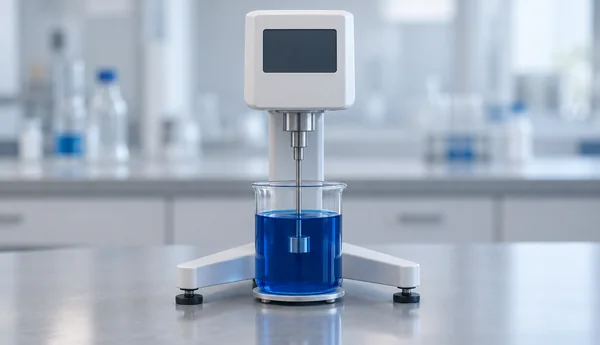
| Rotational spindle measurement | Can both parties use the same instrument configuration and sample preparation? | Record the setup with the result. RPM alone is not a universal shear rate. |
| Defined-geometry rheometer study | Does the investigation need a flow curve or a controlled time sequence? | Agree the geometry and program with a competent laboratory; do not treat a laboratory curve as a complete press simulation. |
BYK also notes that a spindle in a container may not provide a uniquely defined shear rate. If the report gives a shear-rate value, ask which geometry and calculation support it. If it only gives rotational speed, retain that description.
Put the measurement conditions on one controlled sheet
The Brookfield DVE operating manual, particularly its measurement procedure and Appendix B, identifies setup and sample conditions that affect comparability. Use the manual for the actual instrument in your laboratory, not settings copied from another model.
The following is a proposed procurement record, not a universal test standard. Have the ink supplier and the party performing the trial complete and approve it before comparing results.
| Record field | What to enter or attach |
|---|---|
| Ink identity | Supplier, ink series, shade, lot, technical-data-sheet revision and sample identifier. |
| Sample state | As supplied or prepared for printing; mixing procedure, rest time and elapsed time since preparation. |
| Any addition | Approved additive identity, measured amount, calculation basis and time added. Record no addition when applicable. |
| Instrument setup | Instrument/model and range, spindle or geometry, speed or defined shear-rate program, container and required accessories. |
| Sample conditions | Volume or fill condition, actual sample temperature, conditioning procedure and timing of the reading. |
| Result and validity | Reading, unit, torque or other applicable validity indication, repeat readings and any departure from the method. |
| Linked print evidence | Press-trial identifier, substrate lot, screen specification, preparation record and retained print sample identifier. |
| Decision | Agreed acceptance or review limit, who reviewed the result and the action taken. |
Keep one revision-controlled method for the job. If a supplier changes the instrument or container, ask for a comparison before treating the new readings as a continuation of the old record. A changed method can create an apparent batch change.
Use the instrument’s valid measurement range
A displayed value can still be outside the recommended operating conditions. Check the instrument’s range and torque requirements, and retain any warnings in the report. Do not average invalid readings into a pass result. The instrument supplier should resolve an unsuitable spindle or range before production limits are assigned.
Prepare the ink before deciding it needs adjustment
Start with the exact ink’s current technical data sheet. For example, Nazdar’s 8400 industrial screen-ink sheet identifies its standard inks as press-ready and requires thorough mixing. It also describes temperature-related viscosity changes and warns that excessive reduction can damage definition, film thickness and cure. These are instructions for that series, not a recipe for every solvent-based ink.
For your own job, have the supplier define the preparation sequence and permitted adjustments. Record actual sample temperature rather than room temperature alone. Keep a reference-temperature result separate from the ink temperature observed at the press; neither is the dryer setting. If two readings disagree, check the preparation and method first; do not immediately add thinner to force the numbers to match.
Marabu’s UV-ink auxiliary guidance explains that additives can affect curing and other ink properties as well as viscosity. Its guidance uses weight-based additions and calls for preliminary trials. Do not substitute a conventional solvent thinner into a UV system or copy an addition percentage from an unrelated ink.
Link the measurement window to printed film
A purchasing specification needs to say what happens when the reading is inside the agreed window but the print is unacceptable. Treat the viscosity record as one input to the investigation. It cannot by itself certify adhesion, curing, dimensional registration or a customer’s finished-use requirements.
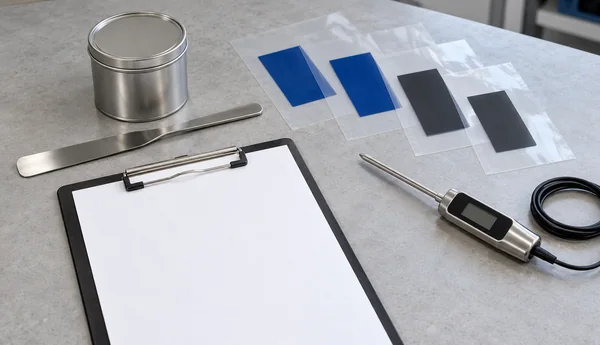
During qualification, assign each measurement a sample identifier and connect it to the corresponding print. Keep screen construction and the job setup traceable through the mesh specification and stencil record. This avoids comparing ink readings from trials that also used different screens.
Ask the trial team to propose an operating window based on acceptable print results and repeatable measurement, with the ink supplier reviewing the method. Separate an alert that triggers a check from a rejection limit. Write down who may authorize an adjustment and which evidence is needed to restart. Do not adopt a convenient round number as the limit simply because it appears on a supplier’s typical-value sheet.
Keep the record useful when production changes
Specify which changes require review: a different ink series or shade, formulation change, new substrate construction, revised screen or a different measurement method. Record the review even when only a small part of the method changes. An existing operating window may not apply to the revised job.
For a known defect, use the relevant troubleshooting path rather than expanding this record into a generic repair checklist. The pinholes guide and blocking and sticking guide cover those separate questions.

What to send with a film-printing machine enquiry
Winshol’s equipment catalogue covers roll-to-roll and sheet-fed configurations with different printing and drying routes. A viscosity figure alone cannot select among them.
Send the production film, artwork, intended ink and current technical data sheet together with your measurement method, representative readings and linked print samples. Identify whether the readings came from fresh ink or prepared press ink. Include any changes made during the trial so the engineering team knows which formulation produced the samples.
Ask the ink supplier to confirm the preparation and measurement method, and ask the equipment supplier to confirm the proposed trial scope. If an inline viscosity system, temperature-control accessory or ink-delivery arrangement is required, request written confirmation of its inclusion and compatibility. Do not infer those features from a model name.
Contact Winshol with that job record to discuss a suitable configuration and the evidence needed for evaluation.
Frequently asked questions
1. What viscosity should screen printing ink have for film printing?
Use a range agreed for the exact ink, measurement method and qualified print process. A typical supplier value should not become an acceptance limit without agreement. There is no single target suitable for every ink, film and screen.
2. Can two suppliers’ viscosity readings be compared directly?
Only after checking that the methods and sample states are comparable. Ask for the instrument setup, temperature, timing, preparation history and units with each result. If those differ, request a controlled comparison rather than ranking the inks by the numbers alone.
3. Is a viscosity cup sufficient for screen printing ink?
Use a cup only within a method validated for the ink and the intended control purpose. A cup time should not be treated as a full description of a non-Newtonian ink or converted to a rotational result with an unsupported general formula.
4. Does rotational speed equal shear rate?
Not by itself. The relationship depends on the measurement geometry. Record the spindle and container configuration with RPM, and report a shear rate only when the instrument and method support it.
5. Why record temperature when the ink batch has not changed?
The same ink can give a different reading at a different temperature. Record actual sample temperature and use the agreed conditioning method. Keep a reference-temperature result separate from a record of the ink’s temperature at the press.
6. Should thinner be added whenever the viscosity reading is high?
First confirm the sample identity, preparation and measurement conditions. Any adjustment must follow the exact ink supplier’s instructions and be recorded and re-evaluated. Do not use a generic thinner or an unrelated ink’s addition percentage.
7. Does an acceptable viscosity result prove the printed film will pass?
No. Link the reading to a qualified print sample and the agreed finished requirements. Adhesion, cure, registration and downstream handling still need their applicable checks; viscosity alone cannot release the finished job.
8. What viscosity information should accompany a machine enquiry?
Provide the ink identity and current technical data sheet, measurement procedure, sample preparation record and readings linked to printed film. Include the substrate and artwork. Ask separately whether measuring equipment, ink-delivery features or control accessories are included in the proposed configuration.