

When Does Intermittent Cold Foil Stamping Save Foil on Roll-Fed Labels?
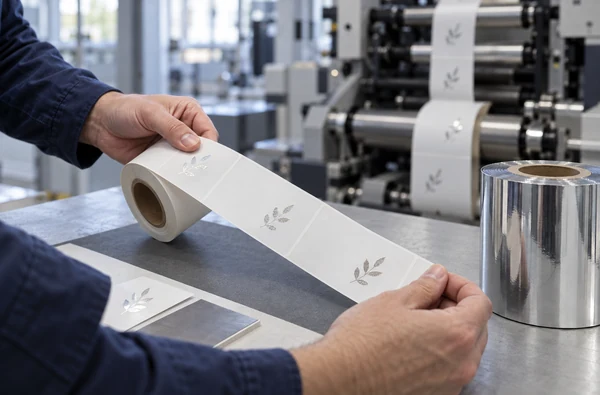
A short metallic logo followed by a long blank gap is a good reason to test intermittent cold foiling. The machine may be able to use less carrier film between repeats. The buying decision rests on a trial: how much foil did the run consume, and how many finished labels passed inspection?
Winshol’s WL-500TB-LTJ intermittent cold foil stamping machine uses mark tracking and an intermittent operating mode. The catalogue presents it as a foil-saving configuration but gives no saving rate or minimum index length. Both depend on the job tested.
Why a small metallic image can still use a lot of foil
Cold foil transfers where adhesive has been applied. Untransferred foil stays on the carrier, which goes to waste take-up. ITW ShineMark’s cold-foil guide explains that saving carrier film requires equipment features such as foil-feed indexing. A smaller metallic image alone will not shorten the film unwound.
Look first in the direction the label web travels. With a synchronized continuous foil feed, carrier film advances through the blank stretch between metallic images. An intermittent feed may shorten that advance while still placing each image correctly. How much it can skip depends on the artwork and the feed sequence that passes the job’s quality checks.
Then look across the web. A full-width foil roll may cover several narrow logos with unused carrier between them. Narrower ribbons could reduce film use if the quoted equipment can handle them. Keep width and feed-length savings separate in the comparison. ITW ShineMark’s cold-foil FAQ also notes that foil-roll width and artwork layout affect cost.
Look at the repeat before asking for a saving percentage
Mark the foil image on a dimensioned layout. Measure its span along the feed direction, the distance to the next repeated image, and its position across every lane. Include small metallic details that are easy to miss when someone measures only the main logo. The relevant image length is the envelope from the first to the last foil detail in a repeat, with whatever allowances the tested process needs.
Suppose the repeat is 250 mm long and the entire foil image sits within 80 mm. The drawing leaves a 170 mm gap. Some of it may still be needed for feed motion, registration correction or transfer contact, so 170 mm is a geometric gap rather than a saving figure. Have the supplier measure the advance at a setting that produces acceptable labels.
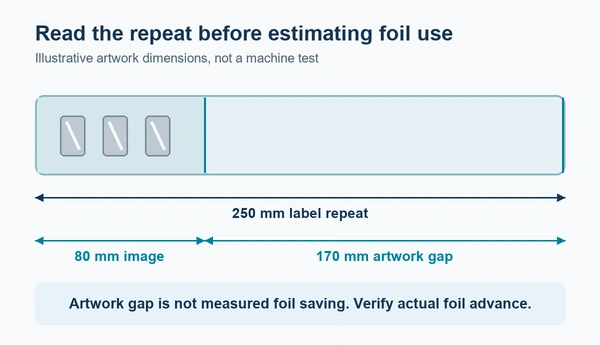
A compact image with clear gaps is promising. A metallic border that runs almost the full repeat gives the foil feed little room to pause. Widely separated details within one label can also use more film than their combined printed area suggests: the carrier may have to cross the full span between them.
| What the drawing shows | What to check on the trial |
|---|---|
| Repeat pitch and the full length of the foil image envelope | Foil length advanced for a known number of accepted repeats |
| Number and position of label lanes | Foil width or ribbon arrangement actually loaded |
| Registration marks and their distance from the foil image | Alignment at startup and during steady running |
| Stock, adhesive and foil specification | Transfer, cure and adhesion at the chosen setting |
Keep the exact artwork revision with the trial report. A later change to the repeat or the position of a small metallic element can change the amount of foil the job needs.
Compare like with like when you calculate foil use
Use the current method or a continuous-feed proposal as the reference. Test the intermittent proposal with the same artwork and production stock. For a clean comparison of feed motion, keep the foil grade and width the same. If the new proposal also changes to narrow ribbons, show that change separately; it saves material for a different reason.
For each option, record the foil width and the length taken from the supply roll during the run. Include startup, registration adjustment, splices and material discarded at changeover when estimating the cost of a real order. If the line uses multiple foil ribbons, add the area of each ribbon rather than multiplying the machine’s web width by one feed length.
Foil area consumed = sum of (foil-ribbon width × length consumed) for every ribbon used.
Foil area per accepted label = total foil area consumed ÷ labels accepted at the agreed inspection stage.
Saving against the reference = (reference area per accepted label − trial area per accepted label) ÷ reference area per accepted label × 100%.
Compare results for the same order size and inspection point. An intermittent setup could use less film during steady running yet take more to register at startup. On a short order, that difference may erase part of the saving. Report steady-run and whole-order figures separately.
A logo covering 10% of the label face does not imply a 90% foil saving. The carrier still needs enough width for the logo and enough movement for each repeat. Film consumed per accepted label is the figure to compare.
Check what the WL-500TB-LTJ actually includes
The WL-500TB-LTJ product specification lists a 500 mm maximum web width, mark-tracking control, foil supply and waste shafts, UV drying equipment, heated upper and lower rollers, and a rewinder. The rewinder is specified for a maximum diameter of 600 mm and a maximum load of 60 kg. The listed foil-speed range is 0–15 m/min. A timed job trial is needed to establish finished-label output.
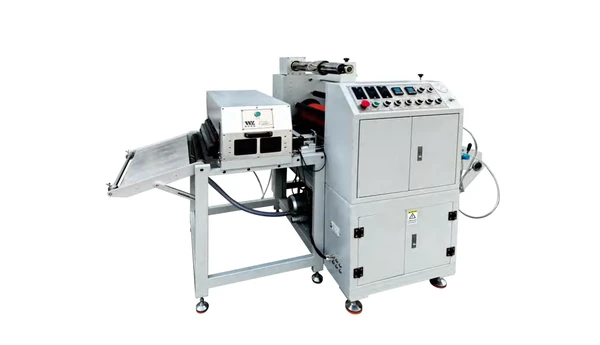
The equipment list contains no screen-printing station. The line drawing should show how the adhesive image is applied upstream and how that roll enters the foil unit. Test the specified foil, adhesive and label stock together, including the UV conditions. A demonstration on different materials says little about this label after rewinding and conversion.
Request a job-specific motion and web-path drawing from Winshol. It should locate the mark sensor and show how the foil is supplied and collected. Specify the required registration tolerance and test method in the enquiry; the catalogue gives no guaranteed tolerance, minimum skipped gap or fixed saving rate.
Run the comparison at an acceptable finish
Send the production stock, the foil-mask artwork as a separate layer and the preprinted sample if the job follows another press. Agree in advance on alignment points, acceptable edge detail, adhesion checks and the finishing step after foiling. ITW ShineMark identifies release, adhesion and through-cure as properties to trial with a selected foil system. Use the foil and adhesive suppliers’ methods for the actual material combination.
Measure startup and steady running separately. For each, log foil consumed, web length, repeat count, settings and rejection reasons. Keep samples from the beginning and end of the roll. Inspect after curing and rewinding, then after lamination or die cutting if those steps are planned. Only accepted finished labels belong in the saving calculation.
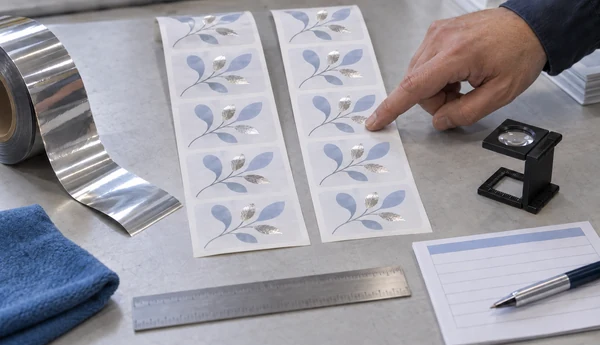
Give registration its own line in the report. A sensor may find every printed mark while foil still drifts against a fine border or preprinted logo. Inspect several labels from each lane. If the mark or preprint varies along the source roll, document that variation with representative stock. Our registration-mark guide shows how to specify marks and alignment requirements for equipment review.
Measure output alongside foil consumption. Slower running may save film but add production time. The roll-to-roll output guide explains how to use web advance, repeat and accepted count for a job-specific estimate. Report foil area per accepted label alongside accepted labels per clock hour.
Make the equipment decision from the job, not the label on the machine
If intermittent feeding gives a clear reduction in foil area per accepted label at the required appearance and output, ask for that tested setup in the quotation. If the image covers most of the repeat, first check whether a narrower foil arrangement can reduce waste. Where the project needs screen printing and cold foil in one quoted line, compare the WL-350DW screen printing and cold foil machine as a different equipment scope. Its published specification includes a printing station; the WL-500TB-LTJ listing does not.
For a useful RFQ, send the order quantity, web width and roll details, foil-mask artwork, repeat pitch, lanes, registration marks, substrate, adhesive and foil grade. State the minimum finished-label quality and the accepted output needed. Request the proposed foil width, trial consumption record, full line drawing and the conditions under which any saving estimate was obtained. The site’s machine RFQ checklist covers the remaining installation details.
Common questions
1. Does intermittent cold foiling always save foil?
No. It needs a layout with usable space between foil images and a machine setting that can take advantage of that space while meeting the job’s registration and quality requirements. Compare measured film use per accepted label.
2. If only 10% of a label is metallic, will foil consumption fall by 90%?
That does not follow. Metallic coverage describes the transferred image; foil consumption also depends on carrier width, feed length, setup and rejected labels. Measure the carrier consumed during the run.
3. Can I calculate the saving from repeat pitch minus logo length?
That subtraction shows the geometric gap. It does not account for the tested machine’s feed motion, registration correction or transfer conditions. Use it to decide whether a trial is worth arranging, then measure the actual advance.
4. Is 500 mm the foil width of the WL-500TB-LTJ?
No. The catalogue specifies a 500 mm maximum label-web width. Confirm the foil roll width or ribbon arrangement for the proposed artwork with Winshol.
5. Does the listed 0–15 m/min range guarantee production speed?
No. It is the published foil-speed range. Run the job with its stock, adhesive and foil, then record accepted labels and elapsed time at an approved setting.
6. Does this model screen-print the adhesive image?
The published equipment list does not identify a screen-printing station. Include the upstream printing or adhesive-application step in the line drawing and quotation.
7. What should I request before accepting a foil-saving claim?
Ask for the artwork version, foil width, foil length consumed, number of accepted labels, startup waste, operating setting and quality results. A saving percentage without that record cannot be applied reliably to your order.
Send the dimensioned foil mask and production material through Winshol’s contact page to request a documented trial for the WL-500TB-LTJ.
