

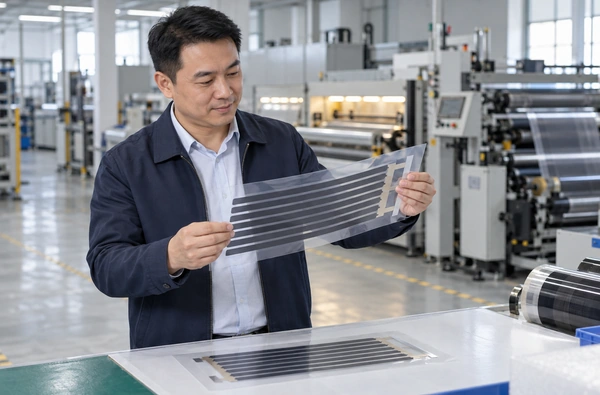
How to Choose a Screen Printing Machine for Heating Film ?
Choose a screen printing machine for heating film by checking the approved film, ink system and heater drawing against the proposed printing and drying configuration. Confirm the complete artwork fits, test registration through the required layers, and approve electrical resistance and temperature distribution on representative finished assemblies. Agree on production output after those checks.
Winshol lists heating-film applications for the WL-5080DW three-point registration screen printer and two separate oven models discussed below. Their catalogue data help identify configurations to review. An application listing still needs a trial with the intended materials and heater design.
This guide concerns roll-fed film carrying screen-printed functional layers. The heater drawing and consumable specifications should be available before the equipment enquiry becomes a production quotation.
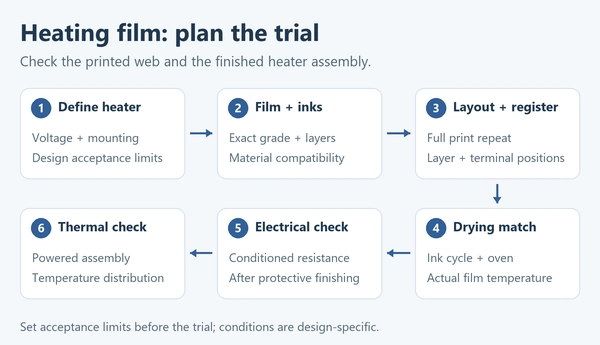
Define the finished heater before specifying the press
Describe the heater as it will be supplied: printed, dried, connected and protected. The enquiry should show the active heating area, outline, connection locations and mounting arrangement. Include the operating voltage and the specified resistance, power and temperature limits, with the measurement conditions for each value.
A cool, unmounted sample and a powered heater bonded to a product represent different test conditions. Identify whether each acceptance requirement applies to the printed film, a laminated heater, or the complete assembly in use.
The design team should also identify the heater type. A conventional resistive pattern and a positive temperature coefficient, or PTC, construction need their own material and test specifications. The Henkel ECI 8090 technical data sheet, for example, describes a screen-printable carbon PTC ink for self-regulating heaters on film. That material example does not qualify a Winshol machine for a particular heater.
Approved drawings and known-good samples give the supplier a basis for the trial. A new design may need material development before equipment acceptance. If the ink, geometry and drying settings all change during one demonstration, the results will say little about the repeatability of the proposed process.
Specify the film and the complete printed layer sequence
Identify the film manufacturer, grade, thickness, printable side and surface treatment. Include roll width, core size, outside diameter and any liner or protective film that remains during processing. A description such as “PET heating film” leaves too much room for differences in material handling and thermal response.
Show each layer on the drawing, including conductive tracks, a resistive or PTC layer, dielectric areas and any protective finish. The approved design determines their materials, overlaps and printing order. The ink supplier should review adhesion and compatibility between adjacent layers, including the later adhesive or laminate.
The Henkel EDAG 423SS data sheet lists heating elements among the applications for a screen-printable conductive carbon ink. It provides coating-thickness, drying and electrical-property information under stated conditions. Use the current sheet for the selected ink to develop the trial; a carbon ink description alone is insufficient to set a heater process.
WL-5080DW is listed as a single-color configuration. A job with several functional inks therefore needs a documented plan for separate passes, screens, drying stages and handling between operations. Ask which layers the proposed equipment will print and how the material returns for subsequent registration. Include cleaning and changeover time in the production estimate.
Check the web path with the actual layer sequence. Establish which rollers or supports touch the printed face, whether the previous layer has cooled sufficiently, and how the material is rewound. During the trial, inspect for surface marking, sticking, creases and damage around connection areas. Record winding conditions for samples held before the next operation.
Check artwork fit and registration after drying
WL-5080DW has a catalogue maximum print area of 500 × 800 mm, maximum web width of 510 mm, maximum feed length of 800 mm, and screen frame size of 800 × 1000 mm. Review these as separate dimensions.
The production layout needs room for the heating pattern, conductive tracks, connection pads, registration references, inspection features and cutting allowance. Check that complete layout against the print envelope. Label the cross-web and feed directions and obtain approval for the full repeat. Our web width versus print area guide explains the format checks in more detail.
The model uses three-point registration in the catalogue description. It is not identified as a CCD configuration, and the project record gives no numerical registration guarantee. Provide the allowed positional error at the features that matter to the heater, then agree on how it will be measured.
For a layered design, inspect registration between the relevant printed features and after their drying stages. Also check the relationship to terminal attachment and cutting. Keep sample locations identifiable across the web and along the roll; an average result can hide a recurring problem at one edge.
If the film changes dimensions during the proposed thermal cycle, review whether a pre-shrink stage improves the result. Trial untreated and treated material under a defined procedure, including cooling and conditioning before measurement. Pre-shrinking is a material-dependent choice. The comparison should show the remaining dimensional change through the actual production sequence.
Review the Winshol configurations by their process roles
The printer and the two ovens perform different jobs. Use the table to frame a technical enquiry, then request a configuration drawing and confirmed specification for the intended process.
| Configuration | Relevant catalogue facts | Items to confirm for heating film |
|---|---|---|
| WL-5080DW screen printer | Single color; three-point registration; 500 × 800 mm print area; 510 mm maximum web width; drying oven included; main machine supply 220 V | Registration on the actual film; layer/pass arrangement; included oven temperature, airflow and exposure; complete line electrical requirements |
| WL-500-YSS-KX pre-shrink oven | 500 mm maximum web width; four heating zones; 60 m listed material storage; 380 V supply; 28 kW listed power | Working temperature range; usable path; treatment conditions; dimensional result after cooling and subsequent printing |
| WL-650-HZL-KX constant-tension oven | Maximum temperature 120°C; four heating zones; 65 m listed material storage; 380 V supply; 23 kW listed power | Usable web width; tension range; effective heated path; film temperature and drying performance at the proposed speed |
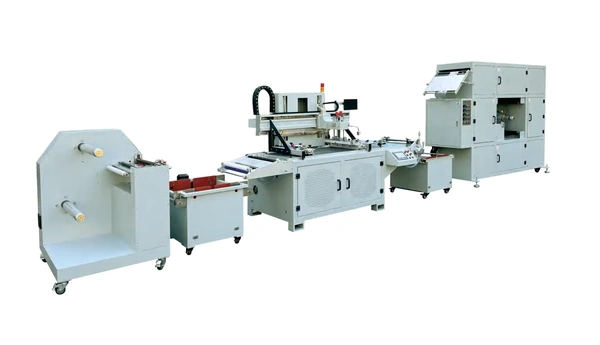
There is a width check to resolve if WL-5080DW and WL-500-YSS-KX are proposed together: their listed maximum web widths are 510 mm and 500 mm respectively. A 510 mm roll cannot be assumed suitable for the 500 mm oven. Base the review on the actual production web and the usable path through every operation.
For WL-650-HZL-KX, the usable width requires written confirmation. The model number does not establish a 650 mm working width. Its constant-tension description also needs a quoted operating range and an assessment of the selected film under heat.
The 60 m and 65 m figures describe material storage. A threading diagram should show the heated portions and how the web moves through them. Use that effective path and operating motion to calculate exposure in the heated sections.
WL-5080DW includes an oven in its listed arrangement, but that oven is not identified as either standalone model above. Ask the quotation to name the supplied drying configuration and any separately proposed pre-treatment equipment. The three listings do not establish a qualified integrated line.
Match the drying process to the selected ink
Start with each ink supplier’s drying requirements and the film’s allowable thermal exposure. Establish the required time, temperature and drying method for every layer. Compare those requirements with a confirmed dryer specification before discussing a production speed.
A specific example shows why this check matters. Henkel’s February 2026 ECI 8090 data sheet recommends 10 minutes at 140°C, whereas WL-650-HZL-KX has a catalogue maximum of 120°C. That oven rating does not meet the stated cycle. Request another drying configuration or an alternative process approved by the ink supplier and validated on the heater. Longer exposure at 120°C cannot simply be assumed equivalent. The same data sheet’s approximately 85°C self-regulation figure describes heater behavior, not its drying temperature. Source: Henkel ECI 8090.
The working temperature range for WL-500-YSS-KX is unconfirmed in the project record, so it cannot be substituted into that example on the strength of its pre-shrink designation. Likewise, the WL-5080DW included oven needs its own specification.
The drying-trial record should include zone settings, measured film temperature, airflow or ventilation conditions, loading and material speed. Track heating and cooling, especially before rewinding or another print pass. These measurements show the thermal history of the printed layer more clearly than the controller setpoint alone.
Have the equipment supplier review extraction and dryer suitability against the selected ink and its safety data sheet. Our UV curing versus hot-air drying guide can help structure the enquiry, but the drying method for a functional ink must follow its own material requirements.
Accept samples through electrical and thermal checks
Agree on a written trial plan before printing. Specify sample quantity, roll locations, measurement methods and pass/fail limits with the heater designer and material supplier. Keep the artwork revision, material batches and process settings attached to the sample record.
Measure resistance under defined conditions
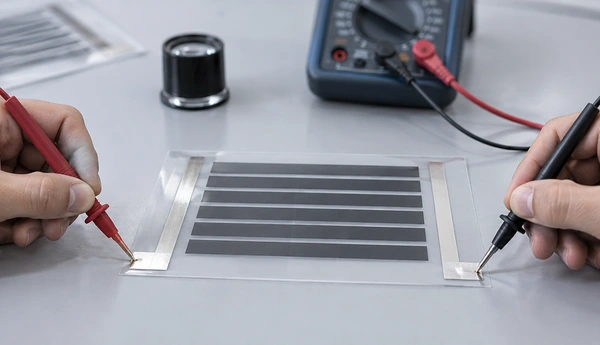
Measure the printed geometry and dry layer thickness at agreed locations, alongside visual defects and adhesion. For electrical readings, define the sample temperature, conditioning period, contact locations, instrument and probe arrangement. Use a suitable method for the resistance range and record it consistently.
Distinguish ink sheet resistance from finished-heater resistance. A data sheet value expressed in ohms per square under specified coating and drying conditions is not a direct terminal-to-terminal acceptance value for every printed heater. The finished pattern, contacts and assembly require their own specification. EDAG 423SS, for instance, reports sheet resistance using a four-point probe and defined drying conditions. Source: Henkel EDAG 423SS.
Recheck the specified electrical values after terminal attachment and protective finishing. For the ECI 8090 example, Henkel specifically notes that a protective layer can affect resistance. A successful bare-print result therefore needs follow-up in the intended construction. Source: Henkel ECI 8090.
Check heating behavior on the intended assembly
Use the design team’s approved powered-test procedure and fixture. Record applied voltage, current, ambient conditions, mounting arrangement and elapsed time. Assess warm-up behavior, stabilized temperatures and localized hot spots using the acceptance limits for that heater.
For temperature-uniformity inspection, define the measurement region and timing. Keep the mounting surface and thermal contact consistent between samples. Use the same temperature scale when comparing maps, and retain the numerical readings alongside the images.
Infrared inspection also needs a defined measurement method. FLIR’s temperature-measurement documentation identifies emissivity and reflected temperature among the parameters affecting readings. Record the relevant camera settings and the surface being measured, particularly where the image contains both film and exposed conductive areas.
| Trial stage | Record and inspect | Decision supported |
|---|---|---|
| Incoming film or pre-treatment | Grade, thickness, web width, reference dimensions and conditioning | Whether the material and any pre-shrink treatment suit the layout |
| Printing and drying | Artwork revision, layer order, screen setup, coating thickness and drying record | Whether the process reproduces the intended functional layers |
| Cooled printed film | Registration, defects, adhesion and resistance at defined conditions | Whether the printed web meets the agreed intermediate criteria |
| Connected and protected heater | Terminal arrangement, protective layers and repeated electrical measurements | Whether later assembly changes the accepted result |
| Powered finished assembly | Voltage, current, mounting, ambient conditions, temperature distribution and time | Whether the heater performs within its design limits |
| Required durability evaluation | Results after the specified bending, thermal cycling or ageing sequence | Whether the selected construction meets its stated service requirements |
Allocate samples across the web and from different portions of the run, including after a restart if that is part of the acceptance plan. Retain representative accepted and rejected samples with their records. The equipment agreement should state which durability and finished-assembly tests are included and who performs them.
Quote accepted output and complete installation requirements
State whether the required output means printed repeats, dried film pieces or completed heaters. Include the number of layouts per repeat and all required layers so the supplier can estimate the same amount of work.
Base the production estimate on the approved trial settings, allowing for separate passes, drying exposure, cooling, reel changes, setup waste and changeovers. On a multilayer job, a drying stage or return pass may set the practical capacity. The quotation should show how those operations lead to the estimated accepted output.
Send the supplier a compact enquiry package:
- Film specification, roll dimensions and representative material.
- Heater drawing, full print layout and layer sequence.
- Ink technical and safety data sheets, including drying requirements.
- Registration, resistance, thermal and durability acceptance criteria.
- Required output unit, production quantity and typical batch size.
- Available space, electrical supply and adjacent equipment details.
WL-5080DW’s listed 220 V supply applies to the main machine. The two standalone ovens list 380 V supplies. Obtain the complete electrical schedule for the quoted arrangement, including drying and auxiliary equipment. Also request the installation drawing, material-loading clearances, threading access and extraction requirements. These details belong in the review before the order is finalized.
For a fuller enquiry template, use our screen printing machine RFQ checklist.
Frequently asked questions
1. Can WL-5080DW print heating film?
Heating film is a catalogue-listed application. WL-5080DW offers single-color printing, three-point registration and an included drying oven. Suitability for a particular film, functional ink and heater design should be established through printing, drying and finished-sample tests.
2. Can it print every heater layer in one pass?
The listed configuration is single color. Supply the complete layer sequence so the supplier can define the passes, drying stages, screen changes and registration procedure. Several functional inks require a reviewed production arrangement.
3. Does three-point registration mean CCD registration?
No. WL-5080DW is identified as a three-point registration model. Specify the registration references and required tolerance for the actual artwork. A camera-based requirement needs a separately confirmed configuration.
4. Does every heating film need pre-shrink treatment?
The need depends on the film’s dimensional response and the later process. Compare samples under the intended thermal sequence and measure after cooling. Approve pre-treatment when the trial demonstrates the required dimensional result.
5. Is a 120°C oven suitable for any heating-film ink?
Check the selected ink’s drying specification. An oven’s maximum rating alone does not establish compatibility; the required exposure, actual material temperature and drying method must also be achievable. Obtain material-supplier approval for any alternative cycle.
6. Do 60 m and 65 m storage figures establish drying time?
They describe listed material storage. Drying exposure requires the effective heated path, threading arrangement and operating motion. Request those details for the proposed configuration before calculating time in the heated sections.
7. Can a resistance test replace a powered heating test?
It provides one part of the acceptance evidence. A finished heater also needs the design’s powered checks, including temperature distribution under the specified mounting and ambient conditions. Agree on both intermediate and finished-assembly requirements.
8. What sample should be sent for a quotation?
Send the intended film, approved artwork, ink information and a known-good finished heater if available. Include the target output and measurement criteria. For a new construction, identify which material-development questions remain open so the first trial has a clear purpose.
Discuss your heating-film project with Winshol
Send Winshol your heating-film enquiry with the material, layer drawing and acceptance requirements. Start with the WL-5080DW catalogue configuration, then request a drying and handling proposal matched to the selected inks and production web. Approve the quoted process through representative printed film and completed-heater samples.