
What Machines Are Needed for Screen Printing? Equipment Guide
Screen printing needs a press, prepared screens, an ink-compatible drying or curing process, and cleaning equipment. If you make screens in-house, add artwork output or computer-to-screen imaging, coating and screen-drying equipment, an exposure system, and a washout area. Roll-fed production also needs unwinding, controlled web transport and rewinding or another agreed collection method.
The machines needed for screen printing vary with the product. T-shirts need a different loading arrangement from individual sheets or label rolls. You can outsource some operations, and an integrated line may already include several of the functions listed below.
Write down the material, artwork, ink system and finished-product requirements before comparing presses. Match each production stage to the equipment or outside service that will perform it, then check those assignments against the quotation.
Screen printing equipment list at a glance
Use this list to decide which stages you will handle in-house. Every job needs a usable screen, but buying prepared screens can remove the initial screen-room equipment purchase.
| Production stage | Machines or equipment to consider | When you need them |
|---|---|---|
| Artwork and image output | Design computer; film-positive printer or computer-to-screen imaging system | For in-house artwork output; film positives or screen preparation can be outsourced |
| Screen coating and drying | Coating trough or automatic coater; suitable drying cabinet or controlled drying space | When preparing emulsion-coated screens in-house |
| Exposure and stencil development | Screen exposure unit; washout booth and suitable water supply | For an in-house photo-stencil workflow; the imaging system determines whether exposure is a separate step |
| Printing | Manual press, automatic garment press, sheet-fed press or roll-to-roll screen printer | Select the format around the product and material presentation |
| Ink drying or curing | Suitable drying racks, conveyor dryer, hot-air oven or UV curing system | Determined by the ink specification, substrate and production rate |
| Cleaning and screen reuse | Cleaning station; washout or reclaim equipment; drying and storage provision | Match the equipment to the inks, stencil system and screen-reuse plan |
| Roll handling | Unwinder, web transport, guiding and take-up equipment | For roll-fed work; review which functions the printing line already includes |
| Inspection | Lighting, magnification and job-specific measuring instruments | To verify the agreed print and finished-product requirements |
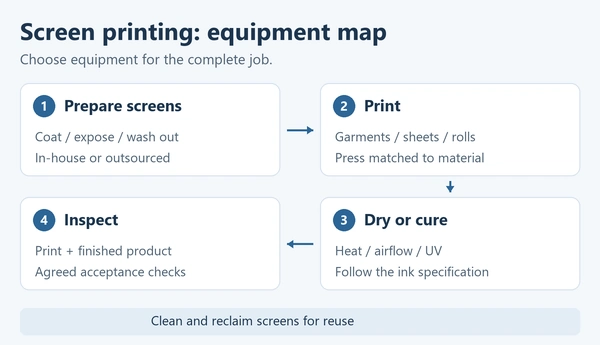
Screens, inks, emulsion, squeegees and cleaning materials also belong in the purchase plan. They are consumables or tools, so listing only large machines leaves part of the setup unpriced.
Equipment for making and preparing screens
A conventional photo-stencil workflow starts with prepared mesh, followed by coating, drying, exposure and development. Size the exposure unit and washout booth for the complete screen frame. The outside frame dimensions exceed the image area, so a machine selected only by print size may be too small.
Artwork output and screen exposure
A film-positive workflow uses an opaque image on transparent film to control which areas of the coated screen receive light. You can produce the film in-house or order it from a specialist. Include color separations and registration references in the artwork brief for jobs with multiple screens.
Computer-to-screen systems differ in their equipment requirements. A system that images a mask onto coated mesh may still need separate exposure; another configuration may integrate that step or expose directly. Confirm the sequence for the quoted system.
Select the exposure system for the emulsion, image detail and frame size. Establish exposure settings with the selected stencil materials and an exposure test. A larger light source alone does not establish fine-detail capability.
Coating and screen drying
For a small screen room, a coating trough and controlled drying area may be sufficient. An automatic coater becomes relevant when coating consistency or screen volume justifies the equipment. Ready-stretched screens can remove the need for an in-house mesh-stretching system.
The emulsion supplier’s procedure should guide coating and drying. Ulano’s coating guidance describes coating technique, trough-edge selection and drying orientation. Use the instructions for the actual emulsion and mesh combination to establish your own screen-preparation method.
A screen-drying cabinet handles prepared screens under the stencil supplier’s specified conditions. Keep it separate in the equipment plan from the dryer for printed material. Dried and exposed screens also need clean storage between preparation and printing.
Washout, cleaning and reclaiming
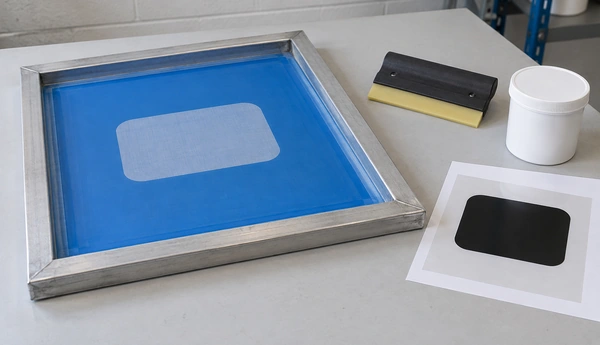
A washout area develops the exposed stencil by removing the intended unexposed areas. Reclaiming removes ink and stencil material when a reusable screen is prepared for another job. These operations need compatible chemistry and an appropriate washing process.
Equipment size, water delivery and drainage should suit the frames and cleaning materials. Automated washing or reclaiming can be considered when manual cleaning becomes a production constraint. Confirm the available site services against the equipment and chemical suppliers’ installation requirements.
A.W.T.’s textile equipment catalogue lists presses, exposure units, dryers and washout sinks as separate equipment categories. Use that separation when checking a package quotation, including any tools and supplies supplied with it.
Choose a press for the product you will print
The press positions the screen and material while a squeegee transfers ink through the stencil. Check how the operator or feeding system loads and locates the material. Samples of the smallest and largest planned jobs help establish the handling limits.
T-shirts and finished garments
Garment printing normally uses a press with platens that support the clothing during printing. A manual press can suit limited batches and a manageable color sequence. Automatic garment presses become relevant when repeat orders, loading arrangements and required output support that investment.
Check the number of print heads and garment stations separately. Also allow for underbases, intermediate flashing where required, and the actual loading and unloading work. A garment press proposal should describe the complete job through final curing.
The Winshol models discussed below cover sheet-fed and roll-fed industrial applications. For finished T-shirts, request a garment-specific press and dryer proposal.
Paper, plastic sheets and flat industrial parts
Sheet-fed screen printing starts with individual pieces. The proposal should describe how each sheet is separated, fed, supported, positioned and delivered after printing. Depending on the configuration, material support may include a vacuum table or another holding arrangement.
Artwork size is only one limit. Sheet dimensions, thickness, stiffness, surface condition and the required margins all affect handling. Test the actual stock, including any coating or earlier printing, before accepting the feed arrangement.
For a broader comparison of these formats, see our sheet-fed versus roll-to-roll screen printing guide.
Labels and films supplied on rolls
A roll-to-roll screen printing line needs an unwinder and controlled feeding through the print and drying stages. The finished web may be rewound or passed to a confirmed downstream operation. Check tension control and guiding across the complete path.
For multicolor work, establish how each screen aligns to the earlier image, whether the job uses several stations or separate passes. Guiding and registration have different roles: web guidance controls the material path, while registration positions printed features against the job’s references.
Compare maximum web width, print area and repeat or feed length independently. Our web width versus print area guide explains why a web that fits the machine can still carry artwork that exceeds its print envelope.
Match the dryer or curing system to the ink
The ink technical data sheet should guide this choice. Different ink systems need different processing conditions, and the printed material must tolerate the proposed process. Include cooling and handling after drying or curing in the equipment review.
Thermal curing for garment inks
For heat-cured garment inks, review a textile conveyor dryer against the actual ink and fabric. Include airflow and the way heat reaches the print. For water-based systems, account for moisture removal in the specified drying and curing process.
Avient’s Wilflex curing guidance explains that plastisol curing depends on time and ink temperature. It also discusses the effect of ink deposit and dryer conditions. The relevant ink must reach its specified cure conditions throughout the deposit; the dryer’s controller setting does not establish that result by itself.
A flash unit is often used to make an intermediate garment layer suitable for the next print. Include final curing as a separate acceptance requirement. If a small setup proposes using a flash unit for final cure, demonstrate that process on representative garments and coverage before relying on it for production.
Evaporation drying for graphic and industrial inks
Some screen inks dry through evaporation. A drying rack may suit an approved air-drying process at low volume, while forced-air equipment can support a different production arrangement. Select the method from the ink data and check the substrate’s thermal response.
For example, Nazdar’s 9700 Series data sheet describes both room-temperature and forced drying for this solvent-based graphic ink. It identifies air circulation as necessary for removing vaporized solvents and notes that multiple ink layers may take longer to dry. Those instructions apply to that ink series; another ink needs its own reviewed process.
Test the printed stock after the agreed drying and conditioning period. Include adhesion, surface condition and resistance to blocking, where relevant, before approving stacking or rewinding.
UV and UV-LED curing
UV-curable screen inks need a compatible curing system. Confirm the ink’s specified light source and exposure requirements, including wavelength where relevant. Lamp count alone does not establish the curing result.
Nazdar’s 2800 Series technical data sheet gives separate parameters for LED and mercury-vapor curing and requires checks on cooled prints. This is a useful example of why the ink and curing unit must be reviewed together. It does not demonstrate compatibility with any particular Winshol model.
A screen exposure unit makes the stencil before printing. An ink-curing unit processes the printed layer afterward. Specify these as separate functions in the equipment list. Our UV curing versus hot-air drying guide covers the process comparison in more detail.
Auxiliary equipment depends on the job
Add auxiliary machines when the job requires the operation or when a measured production constraint justifies them. The quotation should state the purpose of each additional stage.
- A film pre-shrink oven is considered when material trials identify a dimensional-stability problem through the intended thermal sequence.
- A separate web-guiding rewinder can serve a roll-preparation or finishing step when that operation is required outside the printing line.
- An ink mixer, automatic screen coater or screen washer may be justified by batch sizes and the time spent on those tasks.
- Cutting, slitting, laminating or die-cutting equipment belongs in the plan when those operations are part of the supplied product.
- Cold foil equipment is considered for a specified foil finish. It does not perform the screen-printing function on its own unless the quoted configuration includes a printing station.
Site equipment also depends on the final configuration. Obtain the complete electrical schedule and any compressed-air, extraction or cooling requirements. A main-machine voltage or motor rating is insufficient for planning the load of a line with additional dryers and auxiliaries.
Inspection tools should follow the drawing and acceptance plan. A visual label job may need color and registration checks; a printed circuit also needs the specified electrical measurements. Include the required instruments and responsibility for testing in the enquiry.
Winshol machine examples by production format
The following Winshol catalogue configurations illustrate the choices for sheet-fed and roll-fed work. Check each listed dimension separately, then use the production material and artwork to approve handling, print quality and accepted output.
| Winshol model | Listed configuration | Working dimensions | Equipment scope to confirm |
|---|---|---|---|
| WL-5070PZ | Automatic sheet-fed screen printer | 500 × 700 mm maximum print area; 500 mm maximum material width | Sheet feeding and delivery; downstream drying or curing, which is not identified in the listed equipment |
| WL-350D UV | Single-color roll-to-roll printer with a two-lamp UV dryer | 330 × 450 mm maximum print area; 350 mm maximum web width | Ink and UV-system compatibility; roll handling and the complete installation scope |
| WL-350-3C | Three printing stations and three UV drying units, each with two lamps; guided unwinding and rewinding | 330 × 450 mm maximum print area; 450 mm catalogue maximum web width | Color or coating sequence; usable layout and registration on the production material |
| WL-5080DW | Single-color roll-fed printing with three-point registration and a drying oven | 500 × 800 mm maximum print area; 510 mm maximum web width | Exact included oven specification; return passes for additional inks; material and registration trial |
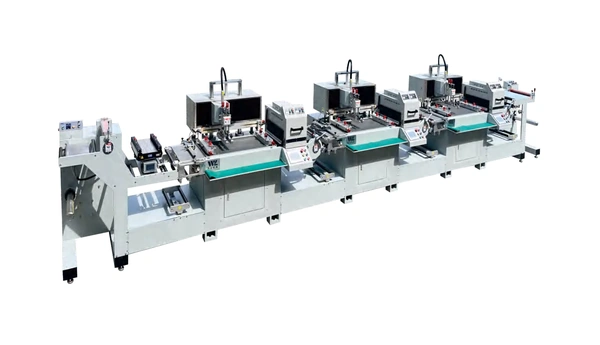
WL-350-3C’s catalogue web width is 450 mm; its model name should not be used to infer another value. WL-5080DW is specified with three-point registration. A requirement for CCD registration needs a separately confirmed configuration.
For a film process that includes pre-shrink treatment, the WL-500-YSS-KX lists a 500 mm maximum web width. Resolve the width difference before combining it with a 510 mm-capable printer. An integrated line proposal must also confirm the material path and operating sequence.
Build a practical purchase plan
A small shop can buy prepared screens and start with the press, suitable drying or curing equipment, cleaning provision and inspection tools. Bringing screen preparation in-house adds control over scheduling, but it also requires space, equipment and someone responsible for the process.
For garment work, plan the press and final cure around the same production target. For sheet-fed industrial work, allow for sheet delivery and the time needed before stacking. For roll-fed work, review the full path from the incoming reel to the agreed output reel or downstream machine.
Compare prices against one written job specification. A quotation with a press and dryer has a different scope from one that also includes screen preparation, tooling and installation. Add initial consumables, training and the required site work to the budget before comparing totals.
Ask how many accepted garments, sheets or printed repeats the proposed setup produces over an agreed trial period. Have the supplier show the allowance for setup, loading, drying, additional passes and rejected output. A press cycling rate alone cannot describe that complete result.
Send the supplier:
- The finished product and the operations included in the order.
- Material specifications, sheet or roll dimensions, and representative samples.
- Production artwork, colors, layer order and registration requirements.
- Ink data sheets and the required drying or curing process.
- Batch sizes, target accepted output and inspection criteria.
- Available space, local utilities and the screen-room operations you will outsource.
The screen printing machine RFQ checklist can help organize this information. Request an installation drawing and an itemized equipment list with the quotation, then check who supplies each required function.
Frequently asked questions
1. What is the minimum equipment needed for screen printing?
You need a prepared screen, a suitable press or printing fixture, ink and squeegee, an appropriate drying or curing process, and cleaning provision. In-house photo-stencil preparation adds coating, screen drying, exposure and washout equipment. Roll-fed production also requires controlled roll handling.
2. Do I need an exposure unit to start screen printing?
You need an exposure process when making conventional photo-stencils in-house. Buying prepared screens can remove that initial equipment purchase. With computer-to-screen systems, confirm whether the selected imaging configuration still requires a separate exposure unit.
3. Can I use one dryer for every screen printing ink?
Only use a dryer or curing system that meets the selected ink’s processing requirements and suits the substrate. Heat-cured inks, evaporation-dried inks and UV-curable inks need different process reviews. An equipment temperature or lamp rating alone does not prove suitability.
4. Is a flash dryer enough for T-shirt printing?
A flash unit can serve an intermediate drying or gelling step. Final cure must meet the ink’s requirements throughout the print. For any proposal that uses a flash unit for final curing, approve the actual garment process and practical output through testing.
5. Do all screen printing setups need a compressor?
Compressed air is needed when the selected equipment uses pneumatic functions or specifies an air supply. Obtain pressure, consumption and air-quality requirements for that configuration. Avoid sizing a compressor from a catalogue air-volume figure that has no time or cycle basis.
6. Is a heat press required for screen printing?
A heat press is needed when the selected workflow includes a heat-transfer application or an ink-approved finishing step. Direct screen printing onto a garment or industrial substrate has its own drying or curing requirements. Confirm the process before adding a heat press.
7. Is a roll-to-roll machine suitable for printing finished T-shirts?
Finished T-shirts are normally handled on garment presses. Roll-to-roll screen printers handle continuous web material, such as compatible label stock and films. Identify the finished product and how it reaches the printing station before choosing the machine format.
8. Do I need a separate rewinding machine?
Check the printing line’s collection equipment first. A separate rewinder is considered for an additional roll-handling operation or when the proposed line does not provide the required take-up arrangement. Confirm reel dimensions, winding quality and the operating sequence.
Plan your screen printing setup with Winshol
Send Winshol your material specification and artwork to discuss a sheet-fed or roll-fed industrial setup. Include the ink system and required finished product so the proposal can cover printing, drying or curing, handling and inspection. Agree on a material trial and an itemized equipment scope before ordering.